The Cosmopolitan Medieval Arabic World (Coursera)

Offered by Leiden University,
The Cosmopolitan Medieval Arabic World (Coursera)

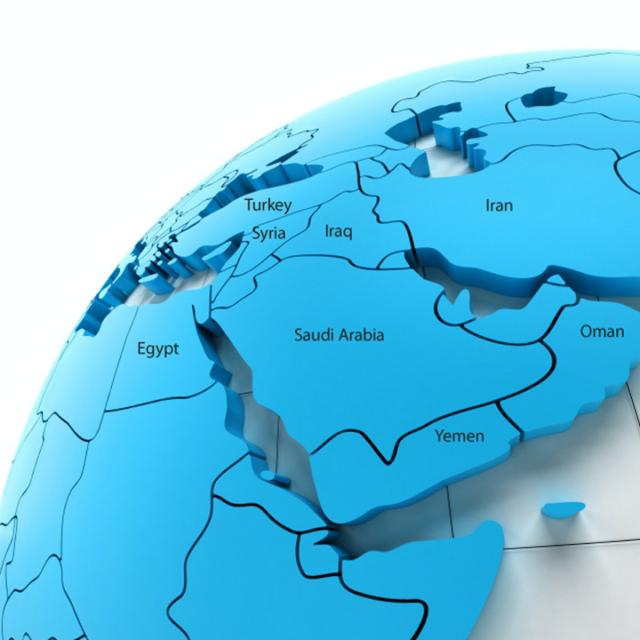
Did you know that Arabic was for centuries the lingua franca in an area stretching from the south of Spain to the Chinese border? Did you know that the Middle East under Muslim rule in those days was the world’s beating heart of trade, but also of science and scholarship?

Class Deals by MOOC List - Click here and see Coursera's Active Discounts, Deals, and Promo Codes.

Did you know that Islam in its formative period was heavily influenced by existing cultures in the region, like Indian, Greek, Persian and Byzantine culture? Did you know that for many centuries after the establishment of the Muslim Empire the majority of the population remained largely Christian and Jewish?
Did you know that they held a protected status in Islamic law? Did you know that this generally open-minded, curious and open society stimulated many great innovations and inventions?
Did you know that European scholarship in the Renaissance leaned heavily on the texts and inventions from the Middle East which were the outcome of this sophisticated advanced society?
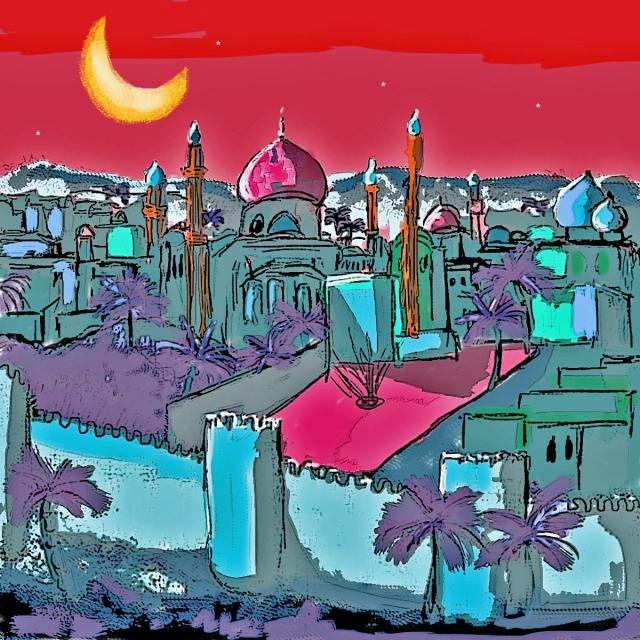
In this course we will focus on the fascinating history of the Arabic Medieval World. We will take you on a journey through the Middle Ages starting off in eighth-century Baghdad. Along the old pilgrim trails we will go to places like Mecca, Jerusalem and Najaf. We will show you the impressive markets of places like Cairo and Samarkand. However we will not hide the dark sides of society either, by introducing you to the flourishing widespread slave trade. We will visit the Abbasid court, the Harem of the caliph, and the palace of the Mamluk Sultan. We will show you some beautiful medieval manuscripts, that live on as the silent witnesses of the impressive achievements of scientists and medical doctors of this forgotten era. All along we will present you with historiographical debates and dilemma’s. Reflecting on the way we look at and interpret history. And while taking you on this journey, we will travel back and forth in time explaining to you how events of the past affected and shaped the world as we know it today.

What You Will Learn

  • In this course you will find out that the Arabic Medieval World was diverse, advanced and connected.
  • In this course you will learn that knowledge travels between cultures and that the Arabic Medieval World influenced the world as we know it today.

Syllabus

WEEK 1
Welcome to this Course
Great that you are joining us! In this course you will learn about the Cosmopolitan Medieval Arabic World. Before you start with the course we invite you to first go through this module and introduce yourself in the forum to meet your fellow learners. If you encounter any difficulties while studying, please let us know in the forum. For technical difficulties or questions regarding the course certificate, you can always contact the Coursera Learner Helpdesk. Good luck & we hope you will enjoy this course!
The Medieval Islamic City
In this Module we will examine the Islamic City. We will discuss if such a thing as "the Islamic city" exists. If so, what are the features that we are looking for ? We will also focus on specific examples of cities in the Medieval Middle East, most notably Baghdad. How was it possible that Baghdad grew to the size that it did? And what role did hygiene and medical care for instance play in that growth?

WEEK 2
Travel & Religion
In this Module we will focus on diversity and connection by looking at religion. We will explore Medieval society and zoom in on the fact that many different religions and religious views coexisted. We will see that different religions shared practices. Sometimes they would even worship in the same place. But we will also show examples of tension and the interaction between politics and religion. Furthermore we will try to find out how religious travelling shaped society.

WEEK 3
Trade
In this module we will take a look at trade. For the Medieval Middle East, trade was immensely important and it owed much of its wealth and prosperity to trade. There are the romantic images of caravans carrying lush fabrics, porcelain and gold along the desert roads of the silk route. And there is the dark side of a flourishing slave trade. But how correct are our images of what the Islamic or Arab world was and is like? Why is it that many people know about harems and very few people know about the legal innovations that enabled trade that we will also discuss in this module? To explore that question further we will introduce you to the concept of Orientalism.

WEEK 4
Power Play
In the last Module we introduced the slave trade in the Medieval Middle East. In this module we will further explore slavery. How was it possible that some of the most powerful people in society, both men and women, were or had been slaves? We will discuss the outrage that followed professor Jonathan Brown's views on slavery and Islam. And with the concept of Orientalism in mind, we will try to sketch a more realistic picture of Harems.

WEEK 5
Science
In this module we will focus on science in the Medieval Muslim world. How did scientific inventions of the Medieval Arabic world make their way to Europe and how did they eventually contribute to shaping today's world? How was knowledge preserved and how did books travel through the ages? We will research if survival of ideas and sources was a matter of sheer luck, or if we can recognize some patterns.

WEEK 6
In conclusion: the Cosmopolitain Medieval Arabic World
In this Course we tried to show you that the Medieval Islamic world was diverse advanced and connected. We have also focused on the danger of over- or under-representation of historical facts. Lastly we have tried to connect the past to the present by explaining and showing how events that took place a long time ago still affect today's world.

Go to Class
MOOC List is learner-supported. When you buy through links on our site, we may earn an affiliate commission.

Related Courses

Arctic Economy (Coursera) Coursera
University of Alberta,UiT The Arctic University of Norway

Arctic Economy (Coursera)

Arctic communities have diverse histories and roles in local, regional and global economies. However, the scope and scale of globalization has increased so quickly that vulnerable Arctic communities are facing new kinds of challenges to their survival. In this 3-week MOOC, a unique collaboration between the University of Alberta and UiT The Arctic University of Norway, you will investigate the challenges faced by Indigenous, North American, Russian and Nordic Arctic communities in a modern world. So join us as we venture above the 60th parallel North, and explore how these fascinating communities adjust to change while maintaining their ways of life, socio-economic histories, and cultural traditions.

Sep 14th 2026
4 Weeks
The Final Solution to the Jewish Question (Coursera) Coursera
Yad Vashem

The Final Solution to the Jewish Question (Coursera)

The "Final Solution to the Jewish Question" was the official code name used by Nazi German authorities for the planned annihilation of Jews during World War II. This course focuses on the origins, evolution, and implementation of this deadly operation which led to the murder of six million Jews by the Nazis and their collaborators.

Sep 14th 2026
5-12 Weeks
Applied Public History: Places, People, Stories (Coursera) Coursera
University of London

Applied Public History: Places, People, Stories (Coursera)

This course introduces learners to applied public history: understanding and interpreting the past today, and engaging diverse communities in the practice of making and sharing histories. The course draws on project case studies, expert insights and diverse perspectives to model exciting approaches to researching and sharing the history of places and people. Learners will develop a toolkit to apply in their own practice, by participating in discussion, quizzes, creative activities and mini masterclasses. What kinds of stories can we discover through research into the history of places and people?

Sep 7th 2026
5-12 Weeks
Terrorism and Counterterrorism: Comparing Theory and Practice (Coursera) Coursera
Leiden University

Terrorism and Counterterrorism: Comparing Theory and Practice (Coursera)

Terrorism has arguably been one of the defining factors of our age. It frequently makes headlines, threatening or attacking governments, private business and ordinary citizens. And in many parts of the world, it has been one of the most important threats to peace, security and stability. But what does this exactly mean? What is the nature of this threat? Who or what is threatened, how, by whom and why? What can be done about it or how can we at least limit the impact of terrorism and make sure that terrorists do not make headlines and manage to scare us? These are just a handful of questions that will be addressed in this course that consists of three parts.

Sep 7th 2026
5-12 Weeks
Christian Virtues for Spiritual Growth (Coursera) Coursera
Duke University

Christian Virtues for Spiritual Growth (Coursera)

This Duke Divinity+ course is for all those who seek to cultivate their interior lives and to develop a way of thinking about ethics inspired by Christian tradition. In this course, renowned theologian Stanley Hauerwas reflects on the significance of specific virtues for understanding what it means to be a Christian. He examines the meaning and significance of four key virtues—kindness, hope, humility, and generosity—and their importance to living a good life.

Sep 14th 2026
4 Weeks
Exploring Beethoven’s Piano Sonatas Part 2 (Coursera) Coursera
Curtis Institute of Music

Exploring Beethoven’s Piano Sonatas Part 2 (Coursera)

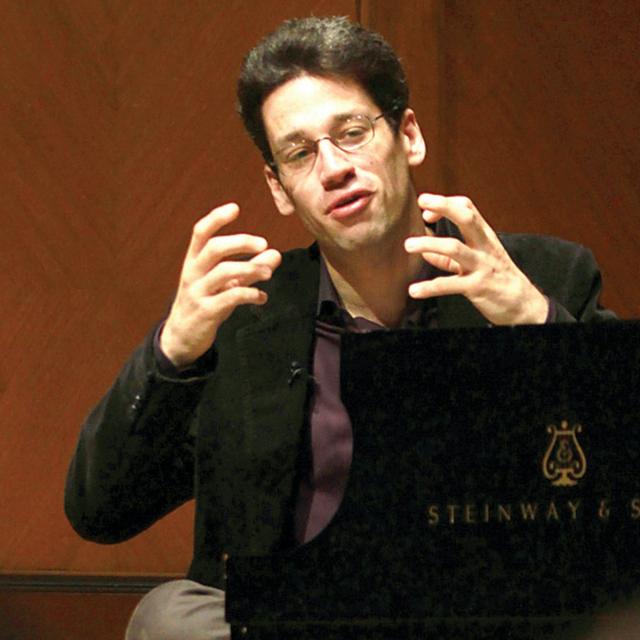
Welcome to Part 2 of Exploring Beethoven's Piano Sonatas! I'm delighted to launch another set of new lectures of this course as Part 2. As before, this class is meant for people of all levels of experience with Beethoven's music (including no experience at all!). Remember that you are able to watch the lectures as many times as you like, at whatever pace is comfortable for you.

Sep 7th 2026
5-12 Weeks
The Holocaust - An Introduction (II): The Final Solution (Coursera) Coursera
Tel Aviv University,Yad Vashem

The Holocaust - An Introduction (II): The Final Solution (Coursera)

The Holocaust was an inconceivable historical event, which forever robbed Western culture of its innocence. As civilized human beings, we fail to understand how events of such horror could have taken place, and how an idea so inhumanly warped could have spread like wildfire through an entire continent, instigating the systematic annihilation of millions of Jews.

Sep 7th 2026
3 Weeks
Violences et religions (Coursera) Coursera
University of Geneva

Violences et religions (Coursera)

La question « violences et religions » est d’actualité, et pas seulement depuis les attentats d’Al-Qaïda ou de Daech. Pour bien la comprendre, ce cours propose de prendre du recul et de l’envisager sous un angle historique et comparatiste. Le domaine concerné étant l’espace euro-méditerranéen, ce sont essentiellement le christianisme et l’islam qui seront traités (quelques séquences sont également consacrées au judaïsme).

Sep 7th 2026
5-12 Weeks
The Emergence of the Modern Middle East - Part II (Coursera) Coursera
Tel Aviv University

The Emergence of the Modern Middle East - Part II (Coursera)

This course will discuss the developments in the Middle East from the early 20th century to the present. It will discuss the rise and retreat of Arab nationalism, the problems of internal cohesion of the Arab states, issues of religion and state, and the evolution of Islamist politics. It will also focus on the evolution of the Arab-Israeli conflict and its impact on the region and will conclude with an in depth analysis of the “Arab Spring” by placing these contemporary revolutionary events in their historical context.

Sep 7th 2026
5-12 Weeks
Words Spun Out of Images: Visual and Literary Culture in Nineteenth Century Japan (Coursera) Coursera
The University of Tokyo

Words Spun Out of Images: Visual and Literary Culture in Nineteenth Century Japan (Coursera)

In their ambition to capture “real life,” Japanese painters, poets, novelists and photographers of the nineteenth century collaborated in ways seldom explored by their European contemporaries. This course offers learners the chance to encounter and appreciate behavior, moral standards and some of the material conditions surrounding Japanese artists in the nineteenth century, in order to renew our assumptions about what artistic “realism” is and what it meant.

Sep 7th 2026
4 Weeks