Spacecraft Relative Motion Control (Coursera)

Spacecraft Relative Motion Control (Coursera)

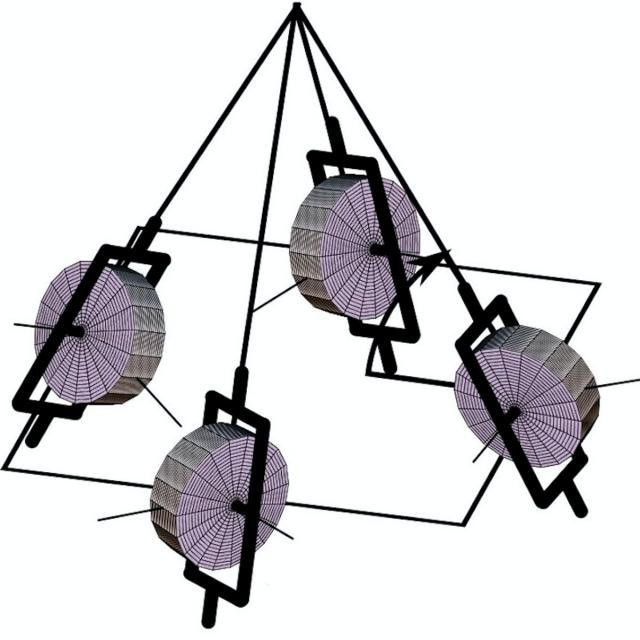
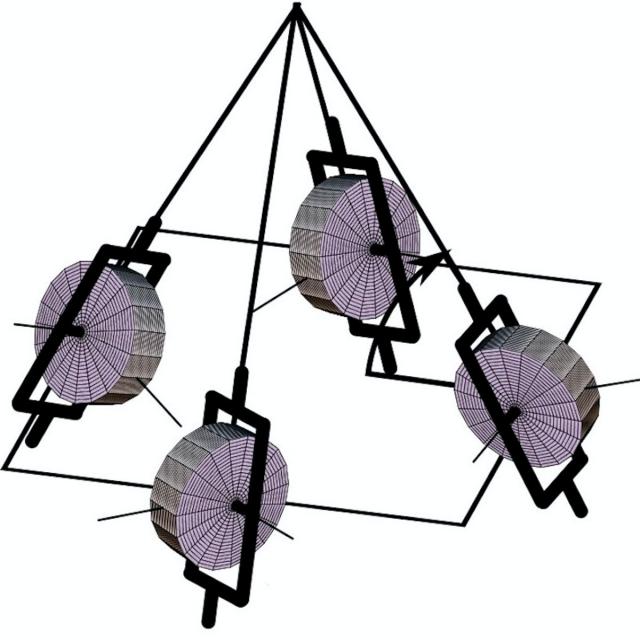
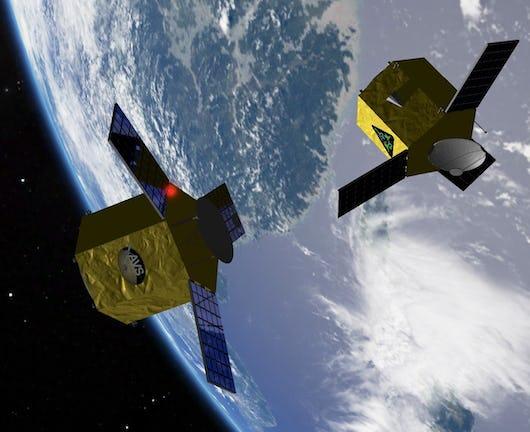
Spacecraft relative motion control solutions stabilize the spacecraft relative to another spacecraft. This is useful control the approach prior to docking, to circumnavigate while inspect the target object, or to remain in a bounded vicinity about the target. This course covers the basics of nonlinear control theory to apply Lyapunov's direct method to the relative motion control problem.

Class Deals by MOOC List - Click here and see Coursera's Active Discounts, Deals, and Promo Codes.

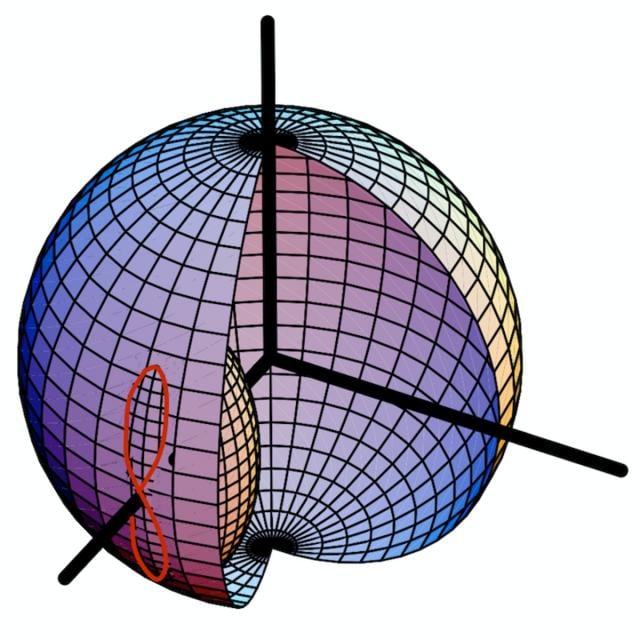
Feedback control strategies using inertial coordinates, differential orbit elements and Hill frame coordinates are studied. Reference relative motions are considered that are either naturally occurring or require a feed-forward control component.
After this course, you will be able to...

  • Develop nonlinear relative motion control strategies
  • Discuss the stability guarantees of these control solutions
  • Numerically simulate the relative motion control solutions
  • Create reference motions that are natural and don't require control effort when the tracking errors have converged
  • Study the impact of uncertain dynamics and control errors.

Please note: this is an advanced course, best suited for working engineers or students with college-level knowledge in mathematics and physics.
This course is part of the Spacecraft Formation Relative Orbits Specialization

What you'll learn

  • numerically simulate spacecraft relative motion
  • Analyze relative motion stability
  • Develop relative motion feedback control solutions

Syllabus

Basics of Nonlinear Control using Lyapunov's Principle
Module 1
The basics of nonlinear stability of dynamical systems is reviewed. A range of stability definitions are reviewed. The general methodology to develop feedback controls using Lyapunov's princple is presented.

Relative Motion Feedback Control
Module 2
Develop feedback control strategies to drive a spacecraft towards a desired relative trajectory.
Go to Class
MOOC List is learner-supported. When you buy through links on our site, we may earn an affiliate commission.

Related Courses

Analytical Mechanics for Spacecraft Dynamics (Coursera) Coursera
University of Colorado Boulder

Analytical Mechanics for Spacecraft Dynamics (Coursera)

This course is part 2 of the specialization Advanced Spacecraft Dynamics and Control. It assumes you have a strong foundation in spacecraft dynamics and control, including particle dynamics, rotating frame, rigid body kinematics and kinetics. The focus of the course is to understand key analytical mechanics methodologies to develop equations of motion in an algebraically efficient manner.

Jun 15th 2026
3 Weeks
Spacecraft Dynamics Capstone: Mars Mission (Coursera) Coursera
University of Colorado Boulder

Spacecraft Dynamics Capstone: Mars Mission (Coursera)

The goal of this capstone spacecraft dynamics project is to employ the skills developed in the rigid body Kinematics, Kinetics and Control courses. An exciting two-spacecraft mission to Mars is considered where a primary mother craft is in communication with a daughter vehicle in another orbit. The challenges include determining the kinematics of the orbit frame and several desired reference frames, numerically simulating the attitude dynamics of the spacecraft in orbit, and implementing a feedback control that then drives different spacecraft body frames to a range of mission modes including sun pointing for power generation, nadir pointing for science gathering, mother spacecraft pointing for communication and data transfer. Finally, an integrated mission simulation is developed that implements these attitude modes and explores the resulting autonomous closed-loop performance.

Jun 22nd 2026
5-12 Weeks
Engineering the Space Shuttle (edX) EdX
MIT,MITx

Engineering the Space Shuttle (edX)

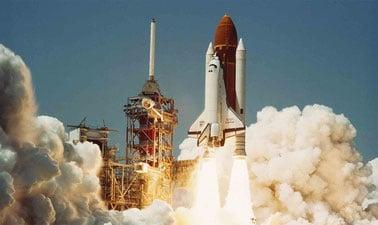
Learn all about the world’s first reusable spacecraft - the Space Shuttle - from the very people who designed, built, and operated it for 30 years. This course examines how the Space Shuttle was designed and how its design was influenced by economics and politics. The course goes into detail on many of the Shuttle’s subsystems (e.g. rocket engines, thermal protection, aerodynamics, environmental control and life support, communications, etc.) and explains how the Shuttle was operated (launch, mission control, payloads, etc.). The course also uses the Space Shuttle to present the fundamentals of Systems Engineering.

Feb 16th 2022
5-12 Weeks
Rigid Body Dynamics (Coursera) Coursera
Korea Advanced Institute of Science and Technology - KAIST

Rigid Body Dynamics (Coursera)

This course teaches dynamics, one of the basic mechanics subjects of Mechanical Engineering. Students would be able to organize their knowledge about force and motion, work-energy, impulse-momentum in view of Newton's 2nd law and its integration over time and displacement. The Engineering Dynamics consists of two parts: particle dynamics and rigid body dynamics. This is the second part of the dynamics: rigid body dynamics.

Jun 22nd 2026
13-24 Weeks
Displays (Coursera) Coursera
University of Colorado Boulder

Displays (Coursera)

The course will dive deep into electronic display devices, including liquid crystals, electroluminescent, plasma, organic light emitting diodes, and electrowetting based displays. You'll learn about various design principles, affordances and liabilities, and also a variety of applications in the real world of professional optics.

Jun 22nd 2026
3 Weeks
Thermodynamique : fondements (Coursera) Coursera
École Polytechnique Fédérale de Lausanne

Thermodynamique : fondements (Coursera)

Ce cours vous apportera une compréhension des concepts fondamentaux de la thermodynamique du point de vue de la physique, de la chimie et de l’ingénierie. Il est scindé un deux MOOCs. Dans la première partie, le Professeur J.-Ph. Ansermet de l’EPFL et son collaborateur le Dr. Sylvain Bréchet ont rassemblé en quatre leçons tous les principes fondamentaux de la thermodynamique. La deuxième partie du MOOC illustre l’approche thermodynamique par une série d’applications présentées par des spécialistes provenant de diverses institutions partenaires du réseau RESCIF.

Jun 22nd 2026
4 Weeks
Nanophotonics and Detectors (Coursera) Coursera
University of Colorado Boulder

Nanophotonics and Detectors (Coursera)

This course dives into nanophotonic light emitting devices and optical detectors, including metal semiconductors, metal semiconductor insulators, and pn junctions. We will also cover photoconductors, avalanche photodiodes, and photomultiplier tubes. Weekly homework problem sets will challenge you to apply the principles of analysis and design we cover in preparation for real-world problems.

Jun 22nd 2026
5-12 Weeks
Photovoltaic Systems (Coursera) Coursera
Technical University of Denmark - DTU

Photovoltaic Systems (Coursera)

This course offers you advanced knowledge within the field of photovoltaic system technology. We'll learn about the solar resource and how photovoltaic energy conversion is used to produce electric power. From this fundamental starting point we'll cover the design and fabrication of different solar cell and module technologies, the various photovoltaic system components, how to design a photovoltaic plant and carry out energy yield simulations, essentials in energy economics, O&M and reliability assessment, as well as the role of photovoltaic energy in sustainable energy systems.

Jun 23rd 2026
5-12 Weeks
Conceptos y Herramientas para la Física Universitaria (Coursera) Coursera
Tecnológico de Monterrey

Conceptos y Herramientas para la Física Universitaria (Coursera)

Este curso provee al estudiante con conceptos y herramientas matemáticas para modelar problemas en física, que al aplicar podrá enfrentar con éxito los cursos de física universitarios. Así pues, la filosofía de este curso consiste en cubrir temas conceptuales relativos a la Física y desarrollar tu capacidad de aprender y aplicarlos en tu vida profesional.

Jun 22nd 2026
5-12 Weeks