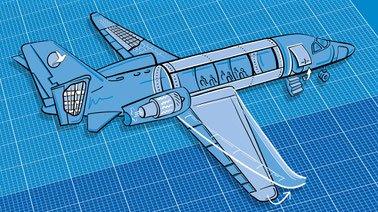
Explore the structural and material design of aircraft and spacecraft from the viewpoint of an aerospace engineer. How do you design an aircraft or spacecraft? And in doing so, how do you keep the risk of failure minimal while bearing in mind that they will eventually fail? In this course you will be taken on a journey through the structural and material design of aircraft. You will see and understand how aircraft and spacecraft are manufactured, and learn how safety is enshrined at every stage.
Class Deals by MOOC List - Click here and see EdX's Active Discounts, Deals, and Promo Codes.
Experts from the Aerospace Structures and Materials Department of Delft University of Technology will help you explore and analyze the mechanical properties of materials; learning about manufacturing techniques, fatigue, loads and stresses, design considerations and more – all the scientific and engineering principles that structural and materials engineers face on a daily basis. By the end of the course, you will have learned to think like they do!
Join us for an exciting learning experience that includes experiments; some of which you can do by yourself at home, online lectures, quizzes, and design assignments.
Prerequisites
Basic knowledge of Physics (concepts of forces and moments, springs and temperature) and some familiarity with aircraft and spacecraft terminology: (e.g. wing, fuselage, tail plane, rocket, launcher).
What you'll learn
- How aerospace structures are designed and why particular choices are made
- Which materials are used and the reasons for using them
- How to explain loads and stresses aerospace structures have to withstand
- How aircraft and spacecraft are manufactured
- The safety philosophies that are used in aerospace structural design and how they affect design choices
- How to create preliminary design solutions for structural design problems
Course Syllabus
Part 1: Material Properties & the Environment
This part presents the basic concepts of material properties and the phenomena of stress and strain in aircraft or spacecraft at different temperatures and in different environments.
Part 2: Materials and Manufacturing Methods
We introduce the properties and manufacturing methods of typical aerospace materials such as metals, ceramics and composites. We will let you play around and create your own materials and ask you to come up with your first design proposal.
Part 3: Aerospace Structures
This part covers the essential structural elements of aircraft and spacecraft. The assignment involves studying the skeleton of your favorite aircraft or spacecraft to identify why certain structural elements were used by their designers.
Part 4: Loads and Stresses
Covers the loads that act on the different aircraft parts, the paths these loads travel on through a structure, and how this affects design choices when designing wings and fuselages. We look at the consequences of pressurized fuselages and of bending of wing spars and how it impacts the design. At the end of this part, you will face your first dilemma as a designer: how to satisfy all the design requirements even if they appear contradictory.
Part 5: Selection of Materials and Structures
This part looks at the structural performance of aircraft and how to select the appropriate structural and materials solutions for a design problem based on stiffness and strength. The concepts of specific strength and specific modulus will be introduced. We will also take you through the basic steps on how to dimension a spacecraft.
Part 6: Design, Certification, Fatigue and Durability
Part 6 examines dealing with failure - how to eliminate possibilities for failure during the design process. We will discuss fatigue and damage tolerance, and how to improve the durability of aircraft and spacecraft. In your assignment, you will be asked to study an actual accident and ask you to look at it again with your newly gained knowledge.
Part 7: Joining & Manufacturing
In this part we look at how aircraft and spacecraft are assembled, what joining methods are used and why. As your final assignment, you will choose a joining method for your aircraft based on a dilemma we will present you with!
Part 8: Wrap Up
As always, no job is done until the paperwork is done. We ask you to look back at your initial expectations and see how far you have come. We also kindly ask you to give us some feedback on what you liked in the course and which bits could be improved.