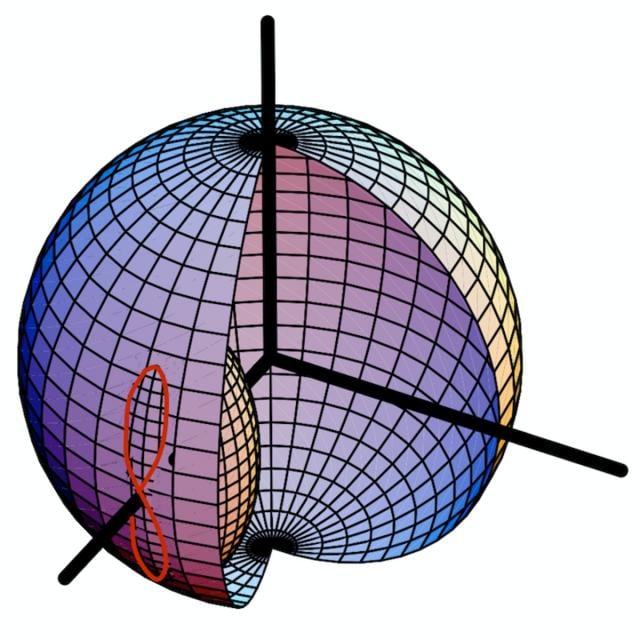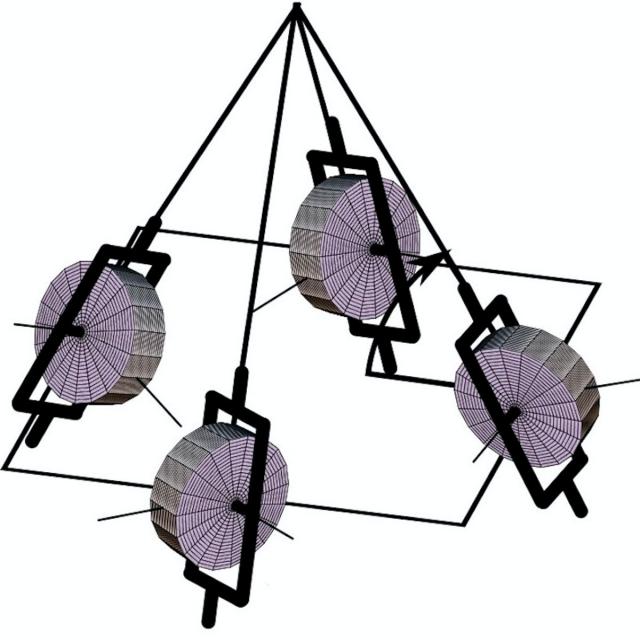
Analytical Mechanics for Spacecraft Dynamics (Coursera)

Analytical Mechanics for Spacecraft Dynamics (Coursera)

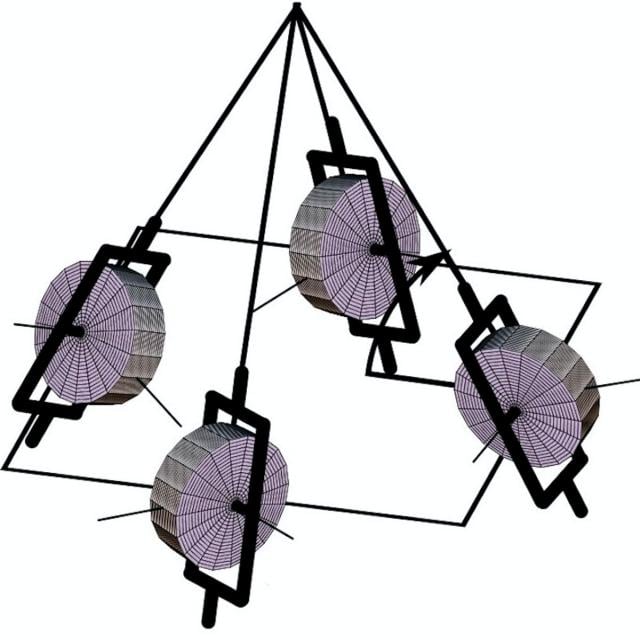
This course is part 2 of the specialization Advanced Spacecraft Dynamics and Control. It assumes you have a strong foundation in spacecraft dynamics and control, including particle dynamics, rotating frame, rigid body kinematics and kinetics. The focus of the course is to understand key analytical mechanics methodologies to develop equations of motion in an algebraically efficient manner.

Class Deals by MOOC List - Click here and see Coursera's Active Discounts, Deals, and Promo Codes.

The course starts by first developing D’Alembert’s principle and how the associated virtual work and virtual displacement concepts allows us to ignore non-working force terms. Unconstrained systems and holonomic constrains are investigated. Next Kane's equations and the virtual power form of D'Alembert's equations are briefly reviewed for particles.
Next Lagrange’s equations are developed which still assume a finite set of generalized coordinates, but can be applied to multiple rigid bodies as well. Lagrange multipliers are employed to apply Pfaffian constraints.
Finally, Hamilton’s extended principle is developed to allow us to consider a dynamical system with flexible components. Here there are an infinite number of degrees of freedom. The course focuses on how to develop spacecraft related partial differential equations, but does not study numerically solving them. The course ends comparing the presented assumed mode methods to classical final element solutions.

What You Will Learn

  • Use virtual work methods to develop equations of motion of mechanical systems.
  • Understand how to use Lagrange multipliers to study constrained dynamical systems.
  • Be able to derive the equations of motion of a spacecraft with flexible sub-components.

Syllabus

WEEK 1
Generalized Methods of Analytical Mechanics
Learn the methodology of developing equations of motion using D'Alembert's principle, virtual power forms, Lagrange's equations as well as the Boltzmann-Hamel equations. These methods allow for more efficient equations of motion development where state based (holonomic) and rate based (Pfaffian constraints) are considered.

WEEK 2
Energy Based Equations of Motion
Derive methods to develop the equations of motion of a dynamical system with finite degrees of freedom based on energy expressions.

WEEK 3
Variational Methods in Analytical Dynamics
Learn to develop the equations of motion for a dynamical system with deformable shapes. Such systems have infinite degrees of freedom and lead to partial differential equations.
Go to Class
MOOC List is learner-supported. When you buy through links on our site, we may earn an affiliate commission.

Related Courses

Converter Control (Coursera) Coursera
University of Colorado Boulder

Converter Control (Coursera)

This course teaches how to design a feedback system to control a switching converter. The equivalent circuit models derived in the previous courses are extended to model small-signal ac variations. These models are then solved, to find the important transfer functions of the converter and its regulator system. Finally, the feedback loop is modeled, analyzed, and designed to meet requirements such as output regulation, bandwidth and transient response, and rejection of disturbances.

Jun 22nd 2026
4 Weeks
Diode - pn Junction and Metal Semiconductor Contact (Coursera) Coursera
University of Colorado Boulder

Diode - pn Junction and Metal Semiconductor Contact (Coursera)

This course presents in-depth discussion and analysis of pn junction and metal-semiconductor contacts including equilibrium behavior, current and capacitance responses under bias, breakdown, non-rectifying behavior, and surface effect. You'll work through sophisticated analysis and application to electronic devices.

Jun 28th 2026
4 Weeks
Engineering the Space Shuttle (edX) EdX
MIT,MITx

Engineering the Space Shuttle (edX)

Learn all about the world’s first reusable spacecraft - the Space Shuttle - from the very people who designed, built, and operated it for 30 years. This course examines how the Space Shuttle was designed and how its design was influenced by economics and politics. The course goes into detail on many of the Shuttle’s subsystems (e.g. rocket engines, thermal protection, aerodynamics, environmental control and life support, communications, etc.) and explains how the Shuttle was operated (launch, mission control, payloads, etc.). The course also uses the Space Shuttle to present the fundamentals of Systems Engineering.

Feb 16th 2022
5-12 Weeks
Introduction to Aerospace Structures and Materials (edX) EdX
Delft University of Technology,DelftX

Introduction to Aerospace Structures and Materials (edX)

Explore the structural and material design of aircraft and spacecraft from the viewpoint of an aerospace engineer. How do you design an aircraft or spacecraft? And in doing so, how do you keep the risk of failure minimal while bearing in mind that they will eventually fail? In this course you will be taken on a journey through the structural and material design of aircraft. You will see and understand how aircraft and spacecraft are manufactured, and learn how safety is enshrined at every stage.

Self Paced
Self-Paced
Internet of Things: Multimedia Technologies (Coursera) Coursera
University of California, San Diego

Internet of Things: Multimedia Technologies (Coursera)

Content is an eminent example of the features that contributed to the success of wireless Internet. Mobile platforms such as the Snapdragon™ processor have special hardware and software capabilities to make acquisition, processing and rendering of multimedia content efficient and cost-effective.

Jun 22nd 2026
3 Weeks
Material Processing (Coursera) Coursera
Georgia Institute of Technology

Material Processing (Coursera)

Have you ever wondered why ceramics are hard and brittle while metals tend to be ductile? Why some materials conduct heat or electricity while others are insulators? Why adding just a small amount of carbon to iron results in an alloy that is so much stronger than the base metal? In this course, you will learn how a material’s properties are determined by the microstructure of the material, which is in turn determined by composition and the processing that the material has undergone.

Jun 22nd 2026
2 Weeks
Creativity, Innovation, and Change (Coursera) Coursera
Pennsylvania State University

Creativity, Innovation, and Change (Coursera)

Our lives are being disrupted by pandemics, global warming, wars, political chaos, and technological innovations. We must prepare for an unpredictable and unknown future - and this is the goal of the course on Creativity, Innovation and Transformation (CIT)! CIT is an upgrade of the former Creativity, Innovation and Change (CIC) course, which is now streamlined and updated with a new module on Transformation.

Jun 22nd 2026
4 Weeks
Spacecraft Relative Motion Control (Coursera) Coursera
University of Colorado Boulder

Spacecraft Relative Motion Control (Coursera)

Spacecraft relative motion control solutions stabilize the spacecraft relative to another spacecraft. This is useful control the approach prior to docking, to circumnavigate while inspect the target object, or to remain in a bounded vicinity about the target. This course covers the basics of nonlinear control theory to apply Lyapunov's direct method to the relative motion control problem.

Jun 22nd 2026
2 Weeks
Getting There and Going Beyond (Coursera) Coursera
University of Colorado Boulder

Getting There and Going Beyond (Coursera)

Welcome to Course 2 - Getting There and Going Beyond. If you are here, you have successfully completed Course 1 (Our Place in the Cosmos) and are ready for more. There is so much more to learn in Course 2 with 40 learning objectives spread out over 5 weeks and 12 lessons. We will cover all the ways we explore space and near space from planes to rockets to satellites and humans.

Jun 22nd 2026
5-12 Weeks
Machine Design Part I (Coursera) Coursera
Georgia Institute of Technology

Machine Design Part I (Coursera)

“Machine Design Part I” is the first course in an in-depth three course series of “Machine Design.” The “Machine Design” Coursera series covers fundamental mechanical design topics, such as static and fatigue failure theories, the analysis of shafts, fasteners, and gears, and the design of mechanical systems such as gearboxes. Throughout this series of courses we will examine a number of exciting design case studies, including the material selection of a total hip implant, the design and testing of the wing on the 777 aircraft, and the impact of dynamic loads on the design of an bolted pressure vessel. In this first course, you will learn robust analysis techniques to predict and validate design performance and life.

Jun 22nd 2026
5-12 Weeks
Cómo autoconstruir tu vivienda (Coursera) Coursera
Universidad Nacional Autónoma de México

Cómo autoconstruir tu vivienda (Coursera)

Aprenderás las bases y los procedimientos precisos paso a paso para que puedas llevar a cabo la autoconstrucción de una vivienda básica, segura y económica para ti y tu familia; también te será de gran utilidad si estás buscando aprender a reparar, mejorar la estructura de tu vivienda e incluso si buscas autoemplearte.

Jun 22nd 2026
4 Weeks
Control of Nonlinear Spacecraft Attitude Motion (Coursera) Coursera
University of Colorado Boulder

Control of Nonlinear Spacecraft Attitude Motion (Coursera)

This course trains you in the skills needed to program specific orientation and achieve precise aiming goals for spacecraft moving through three dimensional space. First, we cover stability definitions of nonlinear dynamical systems, covering the difference between local and global stability. We then analyze and apply Lyapunov's Direct Method to prove these stability properties, and develop a nonlinear 3-axis attitude pointing control law using Lyapunov theory. Finally, we look at alternate feedback control laws and closed loop dynamics.

Jun 22nd 2026
4 Weeks