EdX

Simulating a Quadcopter's Electromechanics (edX)

Offered by MathWorks,
Simulating a Quadcopter's Electromechanics (edX)

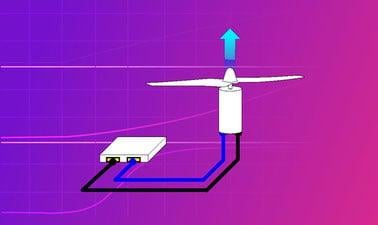
Learn how to integrate multiple physical domains and optimize system performance of a quadcopter. Welcome to Modeling the Quadcopter Electromechanical System, the third course in the Engineering Design and Simulation Program. This course introduces the electrical part of the system to model the battery and the transfer of electrical energy to power the mechanical components powering the flight of the quadcopter.

Class Deals by MOOC List - Click here and see EdX's Active Discounts, Deals, and Promo Codes.

Building upon the foundations established in the first two courses of the program, this course takes you further in refining the quadcopter system model. You will model the quadcopter’s electromechanical components, which include the battery, motor, and propeller. By simulating the behavior of these components, we will determine if they are sufficient to lift the quadcopter off the ground. You will construct multidomain models, which combine multiple engineering disciplines, such as mechanical and electrical. Prebuilt blocks containing essential physics will be introduced to simplify the modeling process. This approach provides engineers with the right level of detail to evaluate a design without spending time to derive every aspect from scratch.
To further explore the system’s behavior, you will run a parameter sweep, characterizing the performance of the electromechanical system under various conditions. This analysis will provide critical insights into optimizing the quadcopter’s design.
The course project focuses on modeling and simulating the dynamics of a hydraulic braking system. Using an incremental modeling approach, you will start with a starter model and gradually add more functionality while varying the applied brake pressure. This practical project will deepen your understanding of complex system behavior and enhance your modeling and simulation skills.
By the end of this course, you will have acquired the knowledge and skills necessary to model and simulate the electromechanical system of the quadcopter. You will understand how to visualize the behavior of complex models through measurements and simulations, enabling you to make informed design decisions.
No prior modeling experience is required. Simulink and Simscape, industry-leading block diagram environments, are used throughout the courses to teach fundamental modeling workflows. You will be provided with a free license for the duration of the program.
This course is part of the Engineering Design and Simulation Professional Certificate.

What you'll learn

  • An introduction of the electrical part of the system
  • Model the electromechanical component
  • How to perform a parameter sweep

Go to Class
MOOC List is learner-supported. When you buy through links on our site, we may earn an affiliate commission.

Related Courses

Simulation, Algorithm Analysis, and Pointers (Coursera) Coursera
University of Colorado System

Simulation, Algorithm Analysis, and Pointers (Coursera)

This course is the fourth and final course in the specialization exploring both computational thinking and beginning C programming. Rather than trying to define computational thinking, we’ll just say it’s a problem-solving process that includes lots of different components. Most people have a better understanding of what beginning C programming means!

Jun 8th 2026
4 Weeks
Groundwater Cycle (edX) EdX
Purdue University,PurdueX

Groundwater Cycle (edX)

The Earth is blue for its oceans but green for the blankets of groundwater under our feet. This course explores the water cycle from under the ground. How much groundwater do we use and what for? How much do the trees? How do we model water fluxes? This course explores the water cycle from an underground perspective. We start with the description of groundwater as a resource: How much is there? Where is it? How do we use it? How much groundwater do plants and trees use every year? How much water do aquifers lose during droughts? How much do they gain during rain events or in a typical year?

Jan 10th 2022
5-12 Weeks
Assembling and Testing a Quadcopter (edX) EdX
MathWorks

Assembling and Testing a Quadcopter (edX)

Learn the crucial skills of system-level integration, comprehensive testing, and collaboration to design and evaluate quadcopter systems effectively. Welcome to Integration and Testing of Quadcopter Systems, the final course in the Engineering Design and Simulation Program. This course is focused on integrating all the quadcopter subsystems into a cohesive system-level model and conducting thorough testing to ensure optimal performance.

Self Paced
Self-Paced
Customising your models with TensorFlow 2 (Coursera) Coursera
Imperial College London

Customising your models with TensorFlow 2 (Coursera)

Welcome to this course on Customising your models with TensorFlow 2! In this course you will deepen your knowledge and skills with TensorFlow, in order to develop fully customised deep learning models and workflows for any application. You will use lower level APIs in TensorFlow to develop complex model architectures, fully customised layers, and a flexible data workflow. You will also expand your knowledge of the TensorFlow APIs to include sequence models.

Jun 8th 2026
5-12 Weeks
Modeling and Simulation of Multibody Systems - Part I (edX) EdX
LouvainX,Université Catholique de Louvain - UCL

Modeling and Simulation of Multibody Systems - Part I (edX)

Vehicles, bicycles, cranes, human body and robots are multibody systems. Learn how to model them and compute their kinematic and dynamic characteristics, such as velocities, accelerations and forces. This course aims at acquainting you with the modeling and simulation of complex articulated mechanical systems, denoted as multibody systems, such as vehicles, merry-go-rounds, motorbikes, cranes, human bodies, suspensions, robot manipulators, mechanical transmissions, etc.

Self Paced
Self-Paced
Input Filter Design (Coursera) Coursera
University of Colorado Boulder

Input Filter Design (Coursera)

This is Course #3 in the Modeling and Control of Power Electronics course sequence. After completion of this course, you will gain an understanding of issues related to electromagnetic interference (EMI) and electromagnetic compatibility (EMC), the need for input filters and the effects input filters may have on converter responses.

Jun 8th 2026
3 Weeks
Big Data Modeling and Management Systems (Coursera) Coursera
University of California, San Diego

Big Data Modeling and Management Systems (Coursera)

Once you’ve identified a big data issue to analyze, how do you collect, store and organize your data using Big Data solutions? In this course, you will experience various data genres and management tools appropriate for each. You will be able to describe the reasons behind the evolving plethora of new big data platforms from the perspective of big data management systems and analytical tools.

Jun 8th 2026
5-12 Weeks
Question Everything: Scientific Thinking in Real Life (edX) EdX
University of Queensland,UQx

Question Everything: Scientific Thinking in Real Life (edX)

Learn how to use math and science to solve everyday problems and better prepare yourself to continue studying science in high school and beyond. Have you ever wondered how you can apply math and science skills to real life? Do you wish you could go beyond what you've learned in the classroom? This science course will advance your knowledge as we unpack some important scientific thinking skills using real-world examples.

Self Paced
Self-Paced
Modeling Time Series and Sequential Data (Coursera) Coursera
SAS

Modeling Time Series and Sequential Data (Coursera)

In this course you learn to build, refine, extrapolate, and, in some cases, interpret models designed for a single, sequential series. There are three modeling approaches presented. The traditional, Box-Jenkins approach for modeling time series is covered in the first part of the course. This presentation moves students from models for stationary data, or ARMA, to models for trend and seasonality, ARIMA, and concludes with information about specifying transfer function components in an ARIMAX, or time series regression, model. A Bayesian approach to modeling time series is considered next.

Jun 8th 2026
5-12 Weeks
Introduction to Analytics Modeling (edX) EdX
Georgia Institute of Technology,GTx

Introduction to Analytics Modeling (edX)

Learn essential analytics models and methods and how to appropriately apply them, using tools such as R, to retrieve desired insights. Analytical models are key to understanding data, generating predictions, and making business decisions. Without models it’s nearly impossible to gain insights from data.

May 13th 2024
13-24 Weeks
Constraint Programming (edX) EdX
LouvainX,Université Catholique de Louvain - UCL

Constraint Programming (edX)

Learn the basics of constraint programming from the implementation of solvers to modeling techniques for solving concrete combinatorial problems such as routing and scheduling. In this course, we will learn the basics of constraint programming: a paradigm that aims to reduce the cost of developing and solving combinatorial problems through extensive reuse of code, whose design is open-ended, but also through pruning techniques of the search space by reasoning at the level of constraints.

Self Paced
Self-Paced