Advanced Modeling for Discrete Optimization (Coursera)

Advanced Modeling for Discrete Optimization (Coursera)

Optimization is a common form of decision making, and is ubiquitous in our society. Its applications range from solving Sudoku puzzles to arranging seating in a wedding banquet. The same technology can schedule planes and their crews, coordinate the production of steel, and organize the transportation of iron ore from the mines to the ports. Good decisions in manpower and material resources management also allow corporations to improve profit by millions of dollars.

Class Deals by MOOC List - Click here and see Coursera's Active Discounts, Deals, and Promo Codes.

Similar problems also underpin much of our daily lives and are part of determining daily delivery routes for packages, making school timetables, and delivering power to our homes. Despite their fundamental importance, all of these problems are a nightmare to solve using traditional undergraduate computer science methods.
This course is intended for students who have completed Basic Modelling for Discrete Optimization. In this course you will learn much more about solving challenging discrete optimization problems by stating the problem in a state-of-the-art high level modeling language, and letting library constraint solving software do the rest. This course will focus on debugging and improving models, encapsulating parts of models in predicates, and tackling advanced scheduling and packing problems. As you master this advanced technology, you will be able to tackle problems that were inconceivable to solve previously.

Syllabus

WEEK 1
Debugging and Improving Models
Similar to computer programs, models can have bugs. In this module, you will see the symptoms (unsatisfiability, too many solutions, too few solutions) of different bugs, and learn methods to discover what is going wrong with your model and how to fix it. Equipped with these tools, you will be able to develop and debug complex models.

WEEK 2
Predicates
In this module, you will learn how to encapsulate a complex constraint definition in a predicate definition to enable its reuse. This will enable the construction of far more complex models with improved readability in a modular manner. You will also encounter for the first time a problem with multiple objectives and learn how to compress them into one single objective. In addition to this, you will learn how to model the banquet seating problem, which will assist you in many occasions in life.

WEEK 3
Scheduling
Learn how to tackle complex project scheduling problems of various forms, progressively from ones with only basic precedence requirements to ones with unary resources and even cumulative resources. You will see how to model some of the complex constraints that arise in these applications.

WEEK 4
Packing
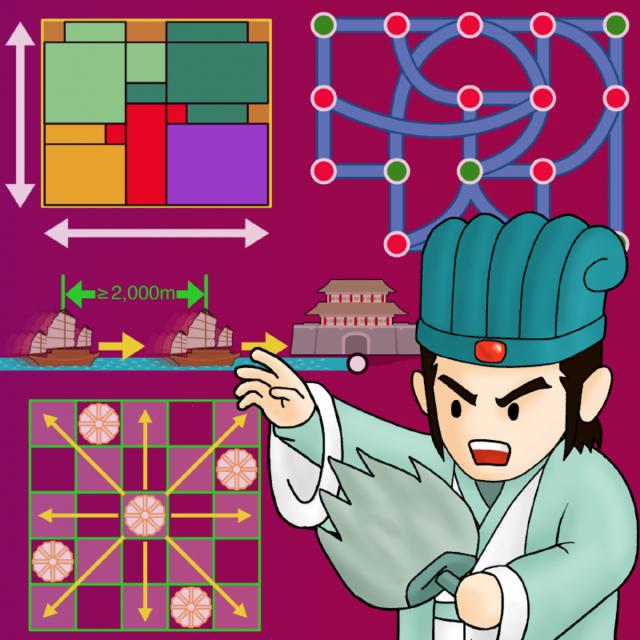
In this module, you will learn the important application of packing, from the packing of squares to rectilinear shapes with and without rotation. Again, you will see how to model some of the complex constraints that arise in these applications.

WEEK 5
Symmetry and Dominance
This final module looks at the various forms of symmetries that can appear in discrete optimization problems. You will learn various methods and special constraints to break such symmetries so as to increase solving efficiency. You will also learn the notion of dominance, which is a generalization of symmetries, and also dominance breaking techniques.

Go to Class
MOOC List is learner-supported. When you buy through links on our site, we may earn an affiliate commission.

Related Courses

Introdução ao Teste de Software (Coursera) Coursera
Universidade de São Paulo, Brasil

Introdução ao Teste de Software (Coursera)

A necessidade das empresas em produzir software com qualidade tem aumentado a demanda por profissionais com conhecimentos e habilidades em Teste de Software. Entretanto, existe uma escassez de mão-de-obra especializada nesta área. Considerando essa lacuna, o curso de Introdução ao Teste de Software foi planejado para servir como um guia para pessoas que necessitam de uma fonte de consulta e/ou aprendizado na área.

Oct 5th 2026
5-12 Weeks
Principles of Computing (Part 2) (Coursera) Coursera
Rice University

Principles of Computing (Part 2) (Coursera)

This two-part course introduces the basic mathematical and programming principles that underlie much of Computer Science. Understanding these principles is crucial to the process of creating efficient and well-structured solutions for computational problems. To get hands-on experience working with these concepts, we will use the Python programming language. The main focus of the class will be weekly mini-projects that build upon the mathematical and programming principles that are taught in the class.

Oct 5th 2026
4 Weeks
AI for Efficient Programming: Harnessing the Power of LLMs (Coursera) Coursera
Fred Hutchinson Cancer Center

AI for Efficient Programming: Harnessing the Power of LLMs (Coursera)

This course on Artificial Intelligence (AI) for software development explores the use of AI large language models such as ChatGPT, Bard, and others and their potential benefits and challenges. Through examples and hands-on activities, you will develop an understanding of the ways in which AI can speed up software development tasks and free up time for more creative and strategic work.

Oct 5th 2026
4 Weeks
COBOL Programming with VSCode (Coursera) Coursera
IBM

COBOL Programming with VSCode (Coursera)

Professor Tak Auyeung of American River College, said it beautifully, “A programming language is not a fashion statement” it is used for a purpose. Whether it is to add new features, modify logic, create APIs to integrate it into other applications, or implement modern development practices, businesses around the world need application developers who know COBOL.

Oct 12th 2026
3 Weeks
Basic Modeling for Discrete Optimization (Coursera) Coursera
University of Melbourne,The Chinese University of Hong Kong

Basic Modeling for Discrete Optimization (Coursera)

Optimization is a common form of decision making, and is ubiquitous in our society. Its applications range from solving Sudoku puzzles to arranging seating in a wedding banquet. The same technology can schedule planes and their crews, coordinate the production of steel, and organize the transportation of iron ore from the mines to the ports. Good decisions in manpower and material resources management also allow corporations to improve profit by millions of dollars.

Oct 12th 2026
4 Weeks
Experimentation for Improvement (Coursera) Coursera
McMaster University

Experimentation for Improvement (Coursera)

We are always using experiments to improve our lives, our community, and our work. Are you doing it efficiently? Or are you (incorrectly) changing one thing at a time and hoping for the best? In this course, you will learn how to plan efficient experiments - testing with many variables. Our goal is to find the best results using only a few experiments. A key part of the course is how to optimize a system.

Oct 12th 2026
5-12 Weeks
Executing Full Text Queries with Elasticsearch (Coursera) Coursera
Board Infinity

Executing Full Text Queries with Elasticsearch (Coursera)

This course is designed to teach you how to execute full-text queries with Elasticsearch, a powerful search and analytics engine widely used for data exploration, log analysis, and real-time search applications. In this course, you will learn the basics of Elasticsearch, including how to install and configure the software, index data, and create mappings. You will then explore the various query types supported by Elasticsearch, such as term queries, match queries, and phrase queries. You will also learn how to use Elasticsearch's aggregation framework to analyze and summarize your data.

Oct 5th 2026
3 Weeks
Design of Transmission Line: Modelling and Performance (Coursera) Coursera
L&T EduTech

Design of Transmission Line: Modelling and Performance (Coursera)

This course is designed to provide a detailed exploration of the critical elements involved in transmission lines' design, modeling, and performance assessment. By enrolling in this course, participants will not only gain theoretical knowledge but also practical skills that are directly applicable in the field of transmission line engineering. Whether you're a student aspiring to enter the industry or a professional seeking to deepen your expertise, this course offers a unique blend of theoretical insights and hands-on applications, equipping you with the tools to excel in this dynamic field.

Oct 5th 2026
3 Weeks
Build a Modern Computer from First Principles: Nand to Tetris Part II (project-centered course) (Coursera) Coursera
Hebrew University of Jerusalem

Build a Modern Computer from First Principles: Nand to Tetris Part II (project-centered course) (Coursera)

In this project-centered course you will build a modern software hierarchy, designed to enable the translation and execution of object-based, high-level languages on a bare-bone computer hardware platform. In particular, you will implement a virtual machine and a compiler for a simple, Java-like programming language, and you will develop a basic operating system that closes gaps between the high-level language and the underlying hardware platform.

Oct 12th 2026
5-12 Weeks