EdX

Assembling and Testing a Quadcopter (edX)

Offered by MathWorks,
Assembling and Testing a Quadcopter (edX)

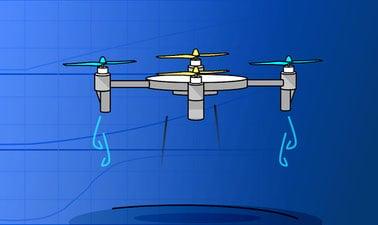
Learn the crucial skills of system-level integration, comprehensive testing, and collaboration to design and evaluate quadcopter systems effectively. Welcome to Integration and Testing of Quadcopter Systems, the final course in the Engineering Design and Simulation Program. This course is focused on integrating all the quadcopter subsystems into a cohesive system-level model and conducting thorough testing to ensure optimal performance.

Class Deals by MOOC List - Click here and see EdX's Active Discounts, Deals, and Promo Codes.

Building upon the airframe and electromechanical models developed in earlier courses, you will merge these subsystems into a system-level model. This integration process will enable you to simulate the quadcopter's flight virtually and gain valuable insights into its behavior. Through the creation of interactive tests, you can observe firsthand how the quadcopter behaves under different conditions. This iterative approach will aid in refining the design and achieving optimal performance. Additionally, scenario-based tests will be conducted to thoroughly evaluate the quadcopter's design. Advances in engineering design and simulation have led to the development of concepts like virtual prototyping and digital twins, allowing engineers to test and refine their designs without needing physical prototypes. Simulating various scenarios will ensure that the quadcopter functions as intended in real-world situations.
Just as we build up a system by combining smaller components into a larger, more complex one, we can also combine work divided among an engineering team. For instance, you can group the airframe blocks into a single subsystem, enhancing integration and organization.
In the course project, you will combine a go-kart model with a brake subsystem to comprehensively test designs under different track conditions. This practical application will strengthen your skills in integrating subsystems and evaluating system performance.
By the end of this course, you will learn the crucial skills of system-level integration, comprehensive testing, and organization. You'll gain the confidence to design and evaluate quadcopter systems effectively, ensuring optimal performance and functionality.
No prior modeling experience is required. Simulink and Simscape, industry-leading block diagram environments, are used throughout the courses to teach fundamental modeling workflows. You will be provided with a free license for the duration of the program.
This course is part of the Engineering Design and Simulation Professional Certificate.

What you'll learn

  • How to create subsystems and masks
  • How to integrate designs into a system-level model
  • How to test a system-level model
Go to Class
MOOC List is learner-supported. When you buy through links on our site, we may earn an affiliate commission.

Related Courses

A-Level Further Mathematics for Year 12 - Course 2: 3 x 3 Matrices, Mathematical Induction, Calculus Methods and Applications, Maclaurin Series, Complex Numbers and Polar Coordinates (edX) EdX
Imperial College London,ImperialX

A-Level Further Mathematics for Year 12 - Course 2: 3 x 3 Matrices, Mathematical Induction, Calculus Methods and Applications, Maclaurin Series, Complex Numbers and Polar Coordinates (edX)

Develop your thinking skills, fluency and confidence in A-level further maths and prepare for undergraduate STEM degrees. This course by Imperial College London is designed to help you develop the skills you need to succeed in your A-level further maths exams. You will investigate key topic areas to gain a deeper understanding of the skills and techniques that you can apply throughout your A-level study.

Self Paced
Self-Paced
Managing the New Product Development Process (Coursera) Coursera
University of Colorado Boulder

Managing the New Product Development Process (Coursera)

This course covers the product development process in detail. With the opportunity defined, learners begin with ideation techniques such as Design Thinking to create new product concepts. Learners define the tools to create product specifications that meet customer requirements, then conceptualize different ways of meeting those requirements. Learners conclude by exploring prototyping and the techniques used to down-select to a concept that is then carried through launch.

Jun 1st 2026
5-12 Weeks
Calculus I: From Functions to Differential Equations (edX) EdX
Delft University of Technology,DelftX

Calculus I: From Functions to Differential Equations (edX)

Refresh and review your bachelor-level calculus. This course covers all the various differentiation and integration techniques and guides you through several important methods for solving differential equations. A strong foundation in mathematics is critical for success in all science and engineering disciplines. Whether you want to make a strong start to a master’s degree, prepare for more advanced courses, solidify your knowledge in a professional context or simply brush up on fundamentals, this course will get you up to speed.

Self Paced
Self-Paced
Engineering: Building with Nature (edX) EdX
Delft University of Technology,DelftX

Engineering: Building with Nature (edX)

Learn how to use ecological and engineering design principles to develop more effective and sustainable hydraulic infrastructure. If you’re interested in the concept of building with nature, then this is the engineering course for you. This course explores the use of natural materials and ecological processes in achieving effective and sustainable hydraulic infrastructural designs.

Self Paced
Self-Paced
Introduction to Computer Science and Programming Using Python (edX) EdX
MIT,MITx

Introduction to Computer Science and Programming Using Python (edX)

An introduction to computer science as a tool to solve real-world analytical problems using Python 3.5. This course is the first of a two-course sequence: Introduction to Computer Science and Programming Using Python, and Introduction to Computational Thinking and Data Science. Together, they are designed to help people with no prior exposure to computer science or programming learn to think computationally and write programs to tackle useful problems.

Jan 24th 2024
5-12 Weeks
Creative Design, Prototyping, and Testing (Coursera) Coursera
University of Maryland, College Park

Creative Design, Prototyping, and Testing (Coursera)

Designing the customer and user experience is essential to creating great products today. Gone is the old paradigm of “form follows function” model of design. The process must be iterative and follow the best product design and development processes. While designing a great user experience can be a lengthy and expensive process, there are approaches to doing it faster and smarter, without compromising results.

Jun 1st 2026
4 Weeks