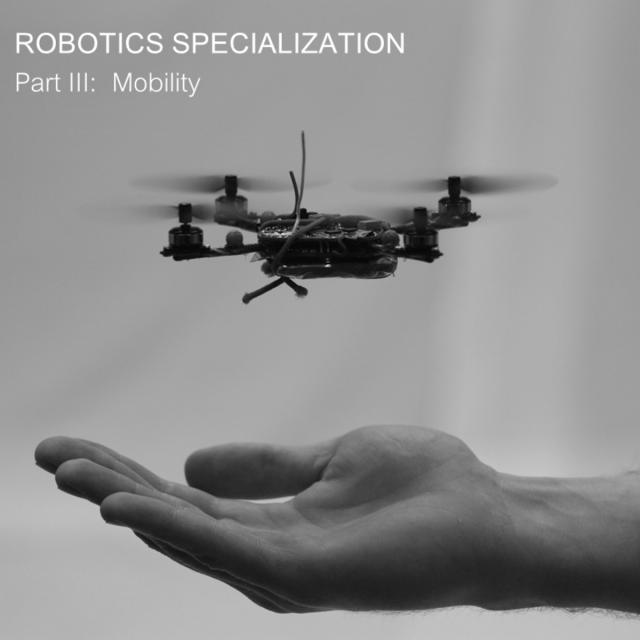
Robotics: Mobility (Coursera)

Robotics: Mobility (Coursera)

How can robots use their motors and sensors to move around in an unstructured environment? You will understand how to design robot bodies and behaviors that recruit limbs and more general appendages to apply physical forces that confer reliable mobility in a complex and dynamic world. We develop an approach to composing simple dynamical abstractions that partially automate the generation of complicated sensorimotor programs.

Class Deals by MOOC List - Click here and see Coursera's Active Discounts, Deals, and Promo Codes.

Specific topics that will be covered include: mobility in animals and robots, kinematics and dynamics of legged machines, and design of dynamical behavior via energy landscapes.
Course 3 of 6 in the Robotics Specialization.

Syllabus

WEEK 1
Introduction: Motivation and Background
We start with a general consideration of animals, the exemplar of mobility in nature. This leads us to adopt the stance of bioinspiration rather than biomimicry, i.e., extracting principles rather than appearances and applying them systematically to our machines. A little more thinking about typical animal mobility leads us to focus on appendages – limbs and tails – as sources of motion. The second portion of the week offers a bit of background on the physical and mathematical foundations of limbed robotic mobility. We start with a linear spring-mass-damper system and consider the second order ordinary differential equation that describes it as a first order dynamical system. We then treat the simple pendulum – the simplest revolute kinematic limb – in the same manner just to give a taste for the nature of nonlinear dynamics that inevitably arise in robotics. We’ll finish with a treatment of stability and energy basins.

WEEK 2
Behavioral (Templates) & Physical (Bodies)
We’ll start with behavioral components that take the form of what we call “templates:” very simple mechanisms whose motions are fundamental to the more complex limbed strategies employed by animal and robot locomotors. We’ll focus on the “compass gait” (the motion of a two spoked rimless wheel) and the spring loaded inverted pendulum – the abbreviated versions of legged walkers and legged runners, respectively.We’ll then shift over to look at the physical components of mobility. We’ll start with the notion of physical scaling laws and then review useful materials properties and their associated figures of merit. We’ll end with a brief but crucial look at the science and technology of actuators – the all important sources of the driving forces and torques in our robots.

WEEK 3
Anchors: Embodied Behaviors
Now we’ll put physical links and joints together and consider the geometry and the physics required to understand their coordinated motion. We’ll learn about the geometry of degrees of freedom. We’ll then go back to Newton and learn a compact way to write down the physical dynamics that describes the positions, velocities and accelerations of those degrees of freedom when forced by our actuators.Of course there are many different ways to put limbs and bodies together: again, the animals can teach us a lot as we consider the best morphology for our limbed robots. Sprawled posture runners like cockroaches have six legs which typically move in a stereotyped pattern which we will consider as a model for a hexapedal machine. Nature’s quadrupeds have their own varied gait patterns which we will match up to various four-legged robot designs as well. Finally, we’ll consider bipedal machines, and we’ll take the opportunity to distinguish human-like robot bipeds that are almost foredoomed to be slow quasi-static machines from a number of less animal-like bipedal robots whose embrace of bioinspired principles allows them to be fast runners and jumpers.

WEEK 4
Composition (Programming Work)
We now introduce the concept of dynamical composition, reviewing two types: a composition in time that we term “sequential”; and composition in space that we call “parallel.” We’ll put a bit more focus into that last concept, parallel composition and review what has been done historically, and what can be guaranteed mathematically when the simple templates of week 2 are tasked to worked together “in parallel” on variously more complicated morphologies. The final section of this week’s lesson brings you to the horizons of research into legged mobility. We give examples of how the same composition can be anchored in different bodies, and, conversely, how the same body can be made to run using different compositions. We will conclude with a quick look at the ragged edge of what is known about transitional behaviors such as leaping.
Go to Class
MOOC List is learner-supported. When you buy through links on our site, we may earn an affiliate commission.

Related Courses

Factory Automation: Shaping the Future of Manufacturing (Coursera) Coursera
Starweaver

Factory Automation: Shaping the Future of Manufacturing (Coursera)

This course provides a comprehensive understanding of factory automation, covering foundational concepts to practical applications. Participants explore the evolution of automation technology, including robotics and control systems, witnessing its role in optimizing production processes and enhancing productivity. Through real-world case studies, they learn how automation improves efficiency, safety, and innovation in manufacturing.

Jun 22nd 2026
4 Weeks
Matlab and Simulink Basics (Coursera) Coursera
Starweaver

Matlab and Simulink Basics (Coursera)

Matlab and Simulink Basics is a meticulously crafted course offering a comprehensive introduction to Matlab's programming environment and Simulink's modeling capabilities. This course is tailored for individuals keen on bolstering their skills in these indispensable tools for engineering, science, and research domains. From laying down foundational concepts to delving into practical applications, participants will embark on a journey that hones their abilities to manipulate data, design models, and interpret results with Matlab and Simulink.

Jun 22nd 2026
4 Weeks
Modern Robotics, Course 2: Robot Kinematics (Coursera) Coursera
Northwestern University

Modern Robotics, Course 2: Robot Kinematics (Coursera)

Do you want to know how robots work? Are you interested in robotics as a career? Are you willing to invest the effort to learn fundamental mathematical modeling techniques that are used in all subfields of robotics? If so, then the "Modern Robotics: Mechanics, Planning, and Control" specialization may be for you. This specialization, consisting of six short courses, is serious preparation for serious students who hope to work in the field of robotics or to undertake advanced study. It is not a sampler.

Jun 15th 2026
4 Weeks
Data Science Project: MATLAB for the Real World (Coursera) Coursera
MathWorks

Data Science Project: MATLAB for the Real World (Coursera)

Like most subjects, practice makes perfect in Data Science. In the capstone project, you will apply the skills learned across courses in the Practical Data Science with MATLAB specialization to explore, process, analyze, and model data. You will choose your own pathway to answer key questions with the provided data. To complete the project, you must have mastery of the skills covered in other courses in the specialization. The project will test your ability to import and explore your data, prepare the data for analysis, train a predictive model, evaluate and improve your model, and communicate your results.

Jun 15th 2026
4 Weeks
Robotics Engineering & Applications (Coursera) Coursera
L&T EduTech

Robotics Engineering & Applications (Coursera)

The "Robotics Engineering & Applications" course stands as a beacon of innovation and opportunity in the realm of collaborative robotics. Comprising three dynamic modules, participants embark on a transformative journey delving into the essentials of robotic engineering, advanced programming techniques, and the integration of vision systems in designing and building robots for real-world applications.

Jun 22nd 2026
3 Weeks
Modern Robotics, Course 3: Robot Dynamics (Coursera) Coursera
Northwestern University

Modern Robotics, Course 3: Robot Dynamics (Coursera)

Do you want to know how robots work? Are you interested in robotics as a career? Are you willing to invest the effort to learn fundamental mathematical modeling techniques that are used in all subfields of robotics? If so, then the "Modern Robotics: Mechanics, Planning, and Control" specialization may be for you. This specialization, consisting of six short courses, is serious preparation for serious students who hope to work in the field of robotics or to undertake advanced study. It is not a sampler.

Jun 15th 2026
4 Weeks
Digitalisation in the Aerospace Industry (Coursera) Coursera
Technische Universität München - TUM

Digitalisation in the Aerospace Industry (Coursera)

The online course Digitalisation in Aerospace aims at making you aware of special production requirements connected with digitalisation. You will learn about the role of robotics and automation in manufacturing and gain a better understanding of differing perspectives on research and manufacturing as well as the points where these intersect.

Jun 15th 2026
3 Weeks
Modern Robotics, Course 4: Robot Motion Planning and Control (Coursera) Coursera
Northwestern University

Modern Robotics, Course 4: Robot Motion Planning and Control (Coursera)

Do you want to know how robots work? Are you interested in robotics as a career? Are you willing to invest the effort to learn fundamental mathematical modeling techniques that are used in all subfields of robotics? If so, then the "Modern Robotics: Mechanics, Planning, and Control" specialization may be for you. This specialization, consisting of six short courses, is serious preparation for serious students who hope to work in the field of robotics or to undertake advanced study. It is not a sampler.

Jun 22nd 2026
4 Weeks