Rigid Body Dynamics (Coursera)

Rigid Body Dynamics (Coursera)

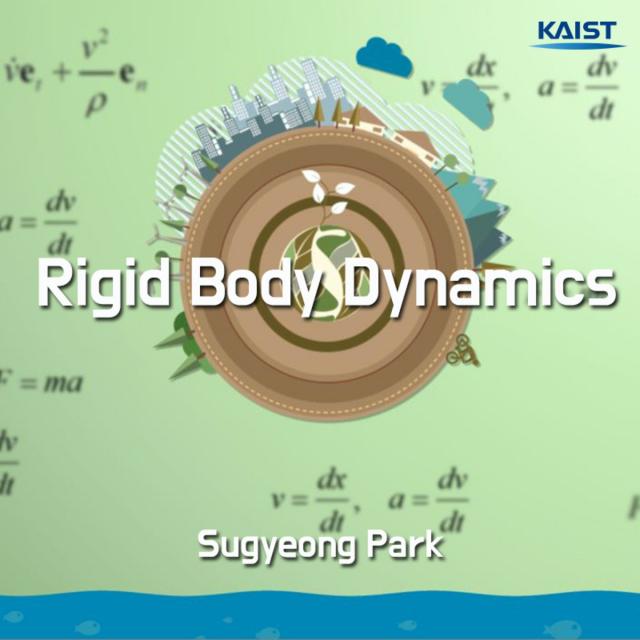
This course teaches dynamics, one of the basic mechanics subjects of Mechanical Engineering. Students would be able to organize their knowledge about force and motion, work-energy, impulse-momentum in view of Newton's 2nd law and its integration over time and displacement. The Engineering Dynamics consists of two parts: particle dynamics and rigid body dynamics. This is the second part of the dynamics: rigid body dynamics.

Class Deals by MOOC List - Click here and see Coursera's Active Discounts, Deals, and Promo Codes.

The class will consist of lecture videos, which are about 15 min length (or a bit longer). These contain a couple of practice problem solving. There will also be standalone homeworks that are not part of video lectures, and a final exam.

Syllabus

WEEK 1
Lecture Note
Before you start the Lecture, please download this lecture note. Each chapter has two version of lecture note. One is student version that has blanks, the Other is filled version.

WEEK 2
1-1 Week
Introduction to Rigid Body Kinematics, Absolute and Relative Kinematics

WEEK 3
1-2 Week
Relative Velocity & Acceleration

WEEK 4
2-1 Week
Motion Relative to Rotating Axis

WEEK 5
2-2 Week
Fundamentals of Kinematics of rigid body

WEEK 6
3-1 Week
General plane motion of rigid body

WEEK 7
3-2 Week
Work and energy of rigid body

WEEK 8
4-1 Week
Work and energy of rigid body

WEEK 9
4-2 Week
Impulse and momentum of rigid body

WEEK 10
5-1 Week
Impulse and momentum of rigid body

WEEK 11
5-2 Week
3D Kinematics of rigid body

WEEK 12
6-1 Week
3D Kinematics of rigid body

WEEK 13
6-2 Week
3D Kinetics of rigid body

WEEK 14
7-1 Week
3D Kinetics of rigid body

WEEK 15
7-2 Week
Gyroscopic motion

Go to Class
MOOC List is learner-supported. When you buy through links on our site, we may earn an affiliate commission.

Related Courses

Intelligent Machining (Coursera) Coursera
University at Buffalo,The State University of New York

Intelligent Machining (Coursera)

Manufacturers are increasingly utilizing machine tools that are self-aware – they perceive their own states and the state of the surrounding environment – and are able to make decisions related to machine activity processes. This is called intelligent machining, and through this course students will receive a primer on its background, tools and related terminology.

Jun 29th 2026
4 Weeks
Introduction to Social Media Analytics (Coursera) Coursera
Emory University

Introduction to Social Media Analytics (Coursera)

Social media not only provides marketers with a means of communicating with their customers, but also a way to better understand their customers. Viewing consumers’ social media activity as the “voice of the consumer,” this session exposes learners to the analytic methods that can be used to convert social media data to marketing insights. In Introduction to Social Media Analytics, learners will be exposed to both the benefits and limitations of relying on social media data compared to traditional methods of marketing research.

Jun 22nd 2026
4 Weeks
The Modern World, Part One: Global History from 1760 to 1910 (Coursera) Coursera
University of Virginia

The Modern World, Part One: Global History from 1760 to 1910 (Coursera)

This is a survey of modern history from a global perspective. Part One begins with the political and economic revolutions of the late 1700s and tracks the transformation of the world during the 1800s. Part One concludes as these bewildering changes seem to be running beyond the capacity of older institutions to handle them. Throughout the course we try to grasp what is happening and ask: Why? And the answers often turn on very human choices.

Jun 22nd 2026
5-12 Weeks
Introduction to Thermodynamics: Transferring Energy from Here to There (Coursera) Coursera
University of Michigan

Introduction to Thermodynamics: Transferring Energy from Here to There (Coursera)

This course provides an introduction to the most powerful engineering principles you will ever learn - Thermodynamics: the science of transferring energy from one place or form to another place or form. We will introduce the tools you need to analyze energy systems from solar panels, to engines, to insulated coffee mugs. More specifically, we will cover the topics of mass and energy conservation principles; first law analysis of control mass and control volume systems; properties and behavior of pure substances; and applications to thermodynamic systems operating at steady state conditions.

Jun 29th 2026
5-12 Weeks
Non-Equilibrium Applications of Statistical Thermodynamics (Coursera) Coursera
University of Colorado Boulder

Non-Equilibrium Applications of Statistical Thermodynamics (Coursera)

Course 5 of Statistical Thermodynamics explores three different applications of non-equilibrium statistical thermodynamics. The first is the transport behavior of ideal gases, with some discussion of transport in dense gases and liquids. It starts with simple estimates of the transport properties of an ideas gas. It then introduces the Boltzmann Equation and describes the Chapman-Enskog solution of that equation in order to obtain the transport properties. It closes with a discussion of practical sources of transport properties.

Jun 22nd 2026
3 Weeks
Diversité et inclusion sur le lieu de travail (Coursera) Coursera
ESSEC Business School

Diversité et inclusion sur le lieu de travail (Coursera)

La diversité est une réalité indéniable dans le monde d'aujourd'hui. Les mouvements de femmes, le militantisme pour les droits civiques, Black Lives Matter, la mondialisation et bien d'autres encore ont tous contribué à attirer l'attention sur l'importance de la diversité et de l'inclusion. Les questions de diversité occupent systématiquement les deux faces d'une même pièce. D'une part, les mouvements sociaux ont historiquement mis en lumière les inégalités subies par les femmes et les groupes minoritaires. D'autre part, la diversité apporte des perspectives différentes et potentiellement nouvelles, qui peuvent être source d'innovation et de changement.

Jun 29th 2026
4 Weeks
Physics 101 - Energy and Momentum (Coursera) Coursera
Rice University

Physics 101 - Energy and Momentum (Coursera)

This course serves as an introduction to the physics of energy and momentum. Upon completion, learners will have an understanding of how mathematical laws and conservation principles describe the motions and interactions of objects all around us. They will gain experience in solving physics problems with tools such as graphical analysis, algebra, vector analysis, and calculus.

Jun 29th 2026
4 Weeks
Modern Robotics, Course 3: Robot Dynamics (Coursera) Coursera
Northwestern University

Modern Robotics, Course 3: Robot Dynamics (Coursera)

Do you want to know how robots work? Are you interested in robotics as a career? Are you willing to invest the effort to learn fundamental mathematical modeling techniques that are used in all subfields of robotics? If so, then the "Modern Robotics: Mechanics, Planning, and Control" specialization may be for you. This specialization, consisting of six short courses, is serious preparation for serious students who hope to work in the field of robotics or to undertake advanced study. It is not a sampler.

Jun 29th 2026
4 Weeks