Mechanics of Materials III: Beam Bending (Coursera)

Mechanics of Materials III: Beam Bending (Coursera)

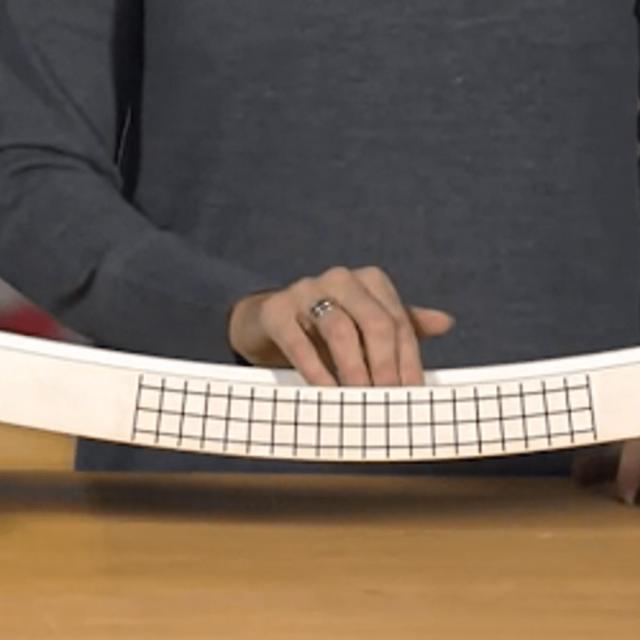
This course explores the analysis and design of beam bending problems.
Prerequisite Knowledge: You will need to have successfully completed my earlier course “Mechanics of Materials I: Fundamentals of Stress and Strain and Axial Loading” in order to be successful in this course.

Class Deals by MOOC List - Click here and see Coursera's Active Discounts, Deals, and Promo Codes.

Syllabus

Week 1
Welcome
Shear Force and Bending Moment Diagrams
In this section, we will review sketching shear force and bending moment diagrams.

Week 2
Elastic Beam Bending
In this section, we will learn how to analyze and design for elastic beam bending.

Week 3
Inelastic beam bending
In this section, we will learn about the analysis and design of inelastic beam bending.

Week 4
Shear Stresses in Beams subjected to Non-Uniform Loading
In this section, we will learn how to analyze and design for shear stresses in beams subjected to non-uniform loading.

Week 5
Design of Beams
In this section, we will learn how to design appropriate beams for use in real world engineering structures.

Go to Class
MOOC List is learner-supported. When you buy through links on our site, we may earn an affiliate commission.

Related Courses

Autonomous Aerospace Systems (Coursera) Coursera
University of Naples Federico II

Autonomous Aerospace Systems (Coursera)

The course aims to provide the knowledge needed to design and develop efficient driving and navigation solutions for autonomous vehicles. Driving can be strategic or tactical while navigation is the function that provides information about the position, speed and orientation of the vehicle. It is made by integrating measurement from different sources, such as sensors and receivers.

Jun 22nd 2026
5-12 Weeks
Construction Scheduling (Coursera) Coursera
Columbia University

Construction Scheduling (Coursera)

Learners will discover the key project scheduling techniques and procedures including; how to create a network diagram, how to define the importance of the critical path in a project network, and defining project activities float. Also covered are the fundamentals of Bar Charts, Precedence Diagrams, Activity on Arrow, PERT, Range Estimating, and linear project operations and the line of balance.

Jun 15th 2026
5-12 Weeks
Advanced Manufacturing Enterprise (Coursera) Coursera
University at Buffalo,The State University of New York

Advanced Manufacturing Enterprise (Coursera)

Enterprises that seek to become proficient in advanced manufacturing must incorporate manufacturing management tools and integrate data throughout the supply chain to be successful. This course will make students aware of what a digitally connected enterprise is, as they learn about the operational complexity of enterprises, business process optimization and the concept of an integrated product-process-value chain.

Jun 15th 2026
4 Weeks
Light and Materials (Coursera) Coursera
Rice University

Light and Materials (Coursera)

This second course serves as an introduction to the physics of waves and light. Upon completion, learners will understand how mathematical laws and conservation principles describe wave propagation and light in the context of both geometrical and physical optics. Learners will gain experience in solving physics problems with tools such as graphical analysis, algebra, vector analysis, and calculus.

Jun 22nd 2026
3 Weeks
Mécanique Lagrangienne (Coursera) Coursera
École Polytechnique Fédérale de Lausanne

Mécanique Lagrangienne (Coursera)

Le formalisme de Lagrange permet une résolution efficace de problèmes complexes de mécanique. Il permet aussi d'apporter un éclairage plus fondamental sur les lois de conservation (théorème de Noether). A titre d'illustration de la méthode de Lagrange, on traitera le problème très important des oscillateurs harmoniques couplés, exprimé comme un problème de valeurs propres et de vecteurs propres. On termine avec un formalisme permettant d'analyser les résonances paramétriques, notion illustrée par l'expérience montrant la stabilité d'un pendule inversé forcé.

Jun 15th 2026
5-12 Weeks
Introduction to Basic Vibrations (Coursera) Coursera
Korea Advanced Institute of Science and Technology - KAIST

Introduction to Basic Vibrations (Coursera)

Introduction to Basic Vibrations starts with the fundamental principle of vibrations with a single and double degree of freedom systems. These fundamental vibration systems provide a solid platform not only to understand general vibrations but also to apply or use them into simple mechanical problems.

Jun 15th 2026
5-12 Weeks
Engineering Systems in Motion: Dynamics of Particles and Bodies in 2D Motion (Coursera) Coursera
Georgia Institute of Technology

Engineering Systems in Motion: Dynamics of Particles and Bodies in 2D Motion (Coursera)

This course is an introduction to the study of bodies in motion as applied to engineering systems and structures. We will study the dynamics of particle motion and bodies in rigid planar (2D) motion. This will consist of both the kinematics and kinetics of motion. Kinematics deals with the geometrical aspects of motion describing position, velocity, and acceleration, all as a function of time. Kinetics is the study of forces acting on these bodies and how it affects their motion.

Jun 15th 2026
5-12 Weeks
3D CAD Fundamental (Coursera) Coursera
National Taiwan University

3D CAD Fundamental (Coursera)

There have many three-dimensional shape of the object in your brain that are wanted to share, but do not know how to express? How to "sketch" the three-dimensional image in your mind? 3D modeling technology can help us construct the most intuitive and understandable three-dimensional model. The use of floor plan interpret the three-dimensional object process-the most direct and effective expression of our ideas.

Jun 15th 2026
5-12 Weeks
Mastering Statics (Coursera) Coursera
The Hong Kong University of Science and Technology - HKUST

Mastering Statics (Coursera)

Statics is the most fundamental course in Mechanics. In this course, you will learn the conditions under which an object or a structure subjected to time-invariant (static) forces is in equilibrium - i.e. the conditions under which it remains stationary or moves with a constant velocity-. You will also learn how to calculate the reaction forces as well as the internal forces experienced throughout the structure so that later you can properly design and size the foundation and the members of the structure to assure the structure’s safety and serviceability.

Jun 15th 2026
5-12 Weeks
Rigid Body Dynamics (Coursera) Coursera
Korea Advanced Institute of Science and Technology - KAIST

Rigid Body Dynamics (Coursera)

This course teaches dynamics, one of the basic mechanics subjects of Mechanical Engineering. Students would be able to organize their knowledge about force and motion, work-energy, impulse-momentum in view of Newton's 2nd law and its integration over time and displacement. The Engineering Dynamics consists of two parts: particle dynamics and rigid body dynamics. This is the second part of the dynamics: rigid body dynamics.

Jun 22nd 2026
13-24 Weeks
Mécanique du point matériel (Coursera) Coursera
École Polytechnique Fédérale de Lausanne

Mécanique du point matériel (Coursera)

Pour illustrer les concepts introduits dans la première partie, on traite ici des problèmes pour lesquels le système mécanique peut être considéré comme un point matériel. Cette partie couvre notamment les problèmes à traiter en coordonnées cylindriques ou sphériques, le problème des orbites des planètes et les référentiels accélérés.

Jun 15th 2026
5-12 Weeks