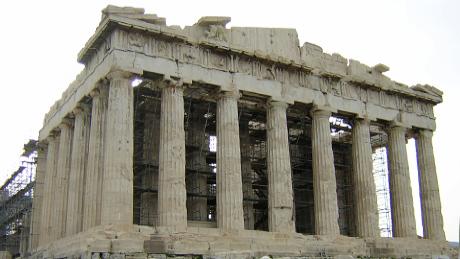
Myths are traditional stories that have endured over a long time. Some of them have to do with events of great importance, such as the founding of a nation. Others tell the stories of great heroes and heroines and their exploits and courage in the face of adversity. Still others are simple tales about otherwise unremarkable people who get into trouble or do some great deed. What are we to make of all these tales, and why do people seem to like to hear them? This course will focus on the myths of ancient Greece and Rome, as a way of exploring the nature of myth and the function it plays for individuals, societies, and nations. We will also pay some attention to the way the Greeks and Romans themselves understood their own myths.
Class Deals by MOOC List - Click here and see Coursera's Active Discounts, Deals, and Promo Codes.
Are myths subtle codes that contain some universal truth? Are they a window on the deep recesses of a particular culture? Are they a set of blinders that all of us wear, though we do not realize it? Or are they just entertaining stories that people like to tell over and over? This course will investigate these questions through a variety of topics, including the creation of the universe, the relationship between gods and mortals, human nature, religion, the family, sex, love, madness, and death.
Syllabus
WEEK 1
Introduction
Welcome to Greek and Roman Mythology! This first week we’ll introduce the class, paying attention to how the course itself works. We’ll also begin to think about the topic at hand: myth! How can we begin to define "myth"? How does myth work? What have ancient and modern theorists, philosophers, and other thinkers had to say about myth? This week we’ll also begin our foray into Homer’s world, with an eye to how we can best approach epic poetry. Readings: No texts this week, but it would be a good idea to get started on next week's reading to get ahead of the game. Video Lectures: 1.1-1.7 Quiz: Complete the quiz by the end of the week.
WEEK 2
Becoming a Hero
In week 2, we begin our intensive study of myth through Homer’s epic poem, the Odyssey. This core text not only gives us an exciting story to appreciate on its own merits but also offers us a kind of laboratory where we can investigate myth using different theoretical approaches. This week we focus on the young Telemachus’ tour as he begins to come of age; we also accompany his father Odysseus as he journeys homeward after the Trojan War. Along the way, we’ll examine questions of heroism, relationships between gods and mortals, family dynamics, and the Homeric values of hospitality and resourcefulness. Readings: Homer, Odyssey, books 1-8. Video Lectures: 2.1-2.10. Quiz: Complete the quiz by the end of the week.
WEEK 3
Adventures Out and Back
This week we’ll follow the exciting peregrinations of Odysseus, "man of twists and turns," over sea and land. The hero’s journeys abroad and as he re-enters his homeland are fraught with perils. This portion of the Odyssey features unforgettable monsters and exotic witches; we also follow Odysseus into the Underworld, where he meets shades of comrades and relatives. Here we encounter some of the best-known stories to survive from all of ancient myth. Readings: Homer, Odyssey, books 9-16. Video Lectures: 3.1-3.10. Quiz: Complete the quiz by the end of the week.
WEEK 4
Identity and Signs
As he makes his way closer and closer to re-taking his place on Ithaca and with his family, a disguised Odysseus must use all his resources to regain his kingdom. We’ll see many examples of reunion as Odysseus carefully begins to reveal his identity to various members of his household—his servants, his dog, his son, and finally, his wife Penelope—while also scheming against those who have usurped his place. Readings: Homer, Odyssey, books 17-24. Video Lectures: 4.1-4.8. Quiz: Complete the quiz by the end of the week.
WEEK 5
Gods and Humans
We will take a close look at the most authoritative story on the origin of the cosmos from Greek antiquity: Hesiod’s Theogony. Hesiod was generally considered the only poet who could rival Homer. The Theogony, or "birth of the gods," tells of an older order of gods, before Zeus, who were driven by powerful passions—and strange appetites! This poem presents the beginning of the world as a time of fierce struggle and violence as the universe begins to take shape, and order, out of chaos. Readings: Hesiod, Theogony (the Works and Days is NOT required for the course). Video Lectures: 5.1-5.9. Quiz: Complete the quiz by the end of the week.
WEEK 6
Ritual and Religion
This week’s readings give us a chance to look closely at Greek religion in its various guises. Myth, of course, forms one important aspect of religion, but so does ritual. How ancient myths and rituals interact teaches us a lot about both of these powerful cultural forms. We will read two of the greatest hymns to Olympian deities that tell up-close-and-personal stories about the gods while providing intricate descriptions of the rituals they like us humans to perform. Readings: Homeric Hymn to Apollo; Homeric Hymn to Demeter (there are two hymns to each that survive, only the LONGER Hymn to Apollo and the LONGER Hymn to Demeter are required for the course). Video Lectures: 6.1-6.7. Quiz: Complete the quiz by the end of the week.
WEEK 7
Justice
What counts as a just action, and what counts as an unjust one? Who gets to decide? These are trickier questions than some will have us think. This unit looks at one of the most famously thorny issues of justice in all of the ancient world. In Aeschylus’ Oresteia—the only surviving example of tragedy in its original trilogy form—we hear the story of Agamemnon’s return home after the Trojan War. Unlike Odysseus’ eventual joyful reunion with his wife and children, this hero is betrayed by those he considered closest to him. This family's cycle of revenge, of which this story is but one episode, carries questions of justice and competing loyalties well beyond Agamemnon’s immediate family, eventually ending up on the Athenian Acropolis itself. Readings: Aeschylus, Agamemnon; Aeschylus, Eumenides. Video Lectures: 7.1-7.10. Quiz: Complete the quiz by the end of the week.
WEEK 8
Unstable Selves
This week we encounter two famous tragedies, both set at Thebes, that center on questions of guilt and identity: Sophocles’ Oedipus Rex and Eurpides’ Bacchae. Oedipus is confident that he can escape the unthinkable fate that was foretold by the Delphic oracle; we watch as he eventually realizes the horror of what he has done. With Odysseus, we saw how a great hero can re-build his identity after struggles, while Oedipus shows us how our identities can dissolve before our very eyes. The myth of Oedipus is one of transgressions—intentional and unintentional—and about the limits of human knowledge. In Euripides’ Bacchae, the identity of gods and mortals is under scrutiny. Here, Dionysus, the god of wine and of tragedy, and also madness, appears as a character on stage. Through the dissolution of Pentheus, we see the terrible consequences that can occur when a god’s divinity is not properly acknowledged. Readings: Sophocles, Oedipus Rex; Euripides, Bacchae. Video Lectures: 8.1-8.9. Quiz: Complete the quiz by the end of the week.
WEEK 9
The Roman Hero, Remade
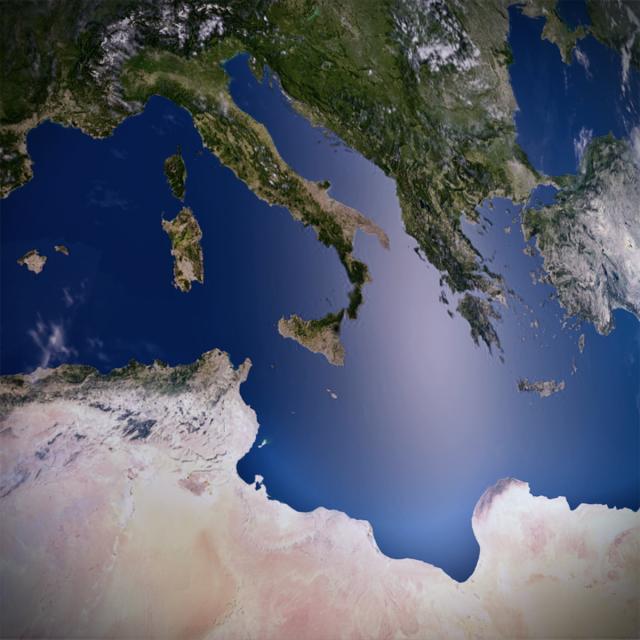
Moving ahead several centuries, we jump into a different part of the Mediterranean to let the Romans give us their take on myth. Although many poets tried to rewrite Homer for their own times, no one succeeded quite like Vergil. His epic poem, the Aeneid, chronicles a powerful re-building of a culture that both identifies with and defines itself against previously told myths. In contrast to the scarcity of information about Homer, we know a great deal about Vergil’s life and historical context, allowing us insight into myth-making in action. Readings: Vergil, Aeneid, books 1-5. Video Lectures: 9.1-9.10. Quiz: Complete the quiz by the end of the week.
WEEK 10
Roman Myth and Ovid's Metamorphoses
Our consideration of Vergil’s tale closes with his trip to the underworld in book 6. Next, we turn to a more playful Roman poet, Ovid, whose genius is apparent in nearly every kind of register. Profound, witty, and satiric all at once, Ovid’s powerful re-tellings of many ancient myths became the versions that are most familiar to us today. Finally, through the lens of the Romans and others who "remythologize," we wrap up the course with a retrospective look at myth. Readings: Vergil, Aeneid, book 6; Ovid, Metamorphoses, books 3, 12, and 13. Video Lectures: 10.1-10.9. Quiz: Complete the quiz by the end of the week.