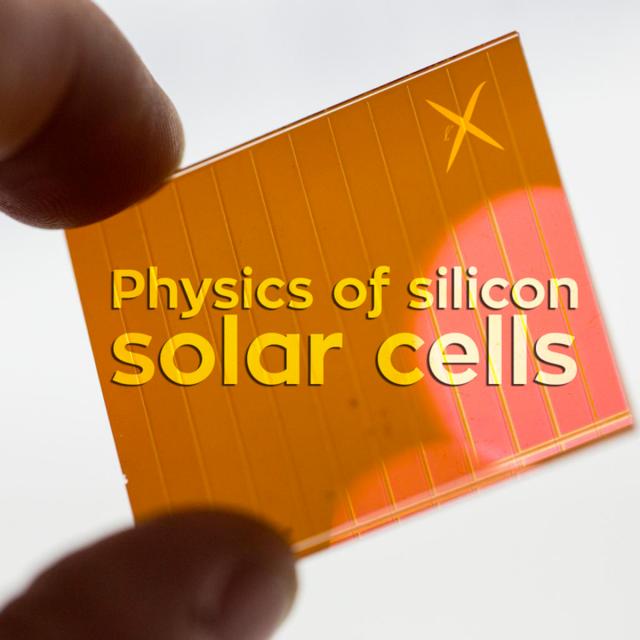
Physics of silicon solar cells (Coursera)

Offered by École Polytechnique,
Physics of silicon solar cells (Coursera)

The first MOOC “Photovoltaic solar energy” is a general presentation of the solar photovoltaics technologies in the global energetic context, without extensive details. In particular the description of the solar cell operation is restricted to the ideal case. In contrast this second MOOC allows a deep understanding of the properties of solar cells based on crystalline semiconductors.

Class Deals by MOOC List - Click here and see Coursera's Active Discounts, Deals, and Promo Codes.

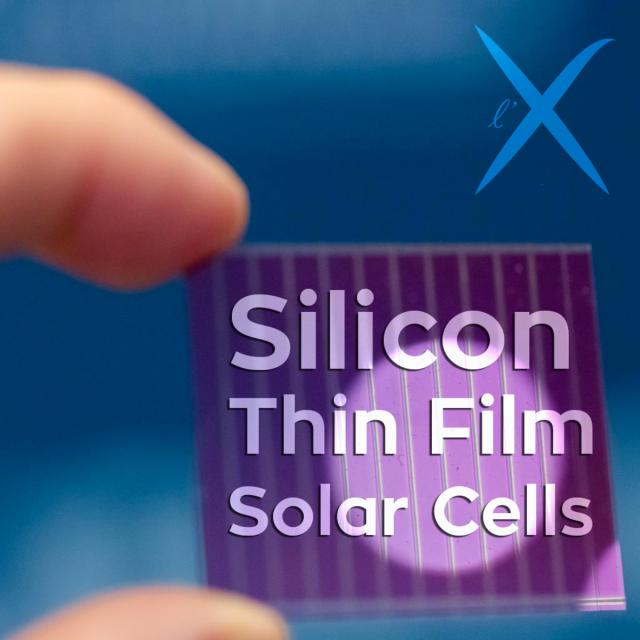
It consists in a general presentation of the physics of the photovoltaics devices with a particular emphasize on the silicon technology that currently represents more than 90% share of the market. Photovoltaic applications of III-V semiconductors are also mentioned.
Indeed from a fundamental point of view, a solar cell can be considered as a semiconductor device (a diode) exposed to the sunlight. An introduction to the semiconductor physics is given, followed by the electron transport phenomena in a diode device. A detailed description of the solar cell operation is then provided, including the conversion efficiency limitations. A description of the solar spectrum and the optical properties of the cells are also presented. Finally the crystalline silicon technology is described from the bulk crystalline growth up to the preparation of heterojunctions combining crystalline and amorphous materials.

Syllabus

WEEK 1
Introduction to semiconductor physics
Introduction to semiconductor physics : band structure of crystalline semiconducors, optical absorption and doping.

WEEK 2
Transport phenomena: the p-n junction
Transport phenomena in semiconductors : carrier injection by light and recombination; the equilibrium and non-equilibrium p-n junction; the photovoltaic effect

WEEK 3
Asymmetrical devices
Metal-semiconductor contacts and semiconductor surface; Heterojunctions

WEEK 4
Solar cell operation
Solar Spectrum; solar cell Fundamentals; limitations of conversion efficiency; solar modules

WEEK 5
Crystalline semiconductor solar cells
Description of the crystalline silicon photovoltaic technology from bulk crystal growth. Extension to III-V compounds solar cells.

WEEK 6
Silicon heterojunctions
Go to Class
MOOC List is learner-supported. When you buy through links on our site, we may earn an affiliate commission.

Related Courses

Electrodynamics: An Introduction (Coursera) Coursera
Korea Advanced Institute of Science and Technology - KAIST

Electrodynamics: An Introduction (Coursera)

The depth and breadth of electromagnetism, the foundation for many fields including materials science, electrical engineering, and physical chemistry, requires a long, steep, and steady learning curve. This course aims to bridge the gap between the fundamental principles taught in electromagnetism and its practical application to specific fields such as materials, physics, and chemistry related to energy storage and harvesting.

Jun 8th 2026
5-12 Weeks
Fundamentals of Semiconductor Characterization (Coursera) Coursera
Arizona State University

Fundamentals of Semiconductor Characterization (Coursera)

The goal of this course is to review the fundamentals of semiconductor materials, p-n junction diodes, and MOS capacitors. There are many semiconductor technologies based on different material systems, but the most important is complementary metal-oxide-semiconductor, or CMOS for short. This course will focus on semiconductor materials and devices relevant to CMOS manufacturing, but the concepts can be applied much more broadly.

Jun 8th 2026
4 Weeks
Outsmarting intermittency (Coursera) Coursera
École Polytechnique

Outsmarting intermittency (Coursera)

Solar and wind offer clean and renewable ways to produce large amounts of electricity. They have boomed over the last few years, evolving from an eco-daydream to a major market and showing unprecedented growth rates. Yet, installing solar panels and wind turbines is by no means the end of the story. The electrical grid, which connects production means to the end-users’ sockets, is not a simple electron pipe. It is the beating heart of our electricity system and ensures its stability. Solar and wind raise specific challenges for the grid, and these challenges will have to be tackled if we want to deploy larger amounts of renewable sources.

Jun 8th 2026
4 Weeks
Electron and Ion Beam Characterization (Coursera) Coursera
Arizona State University

Electron and Ion Beam Characterization (Coursera)

Electron and ion beams are widely used for both qualitative and quantitative analysis of semiconductor materials and devices. They can be used to image structures with sub-nm resolution and to provide information about elemental composition and dopant concentration. This course describes the fundamentals of electron and ion beam characterization and includes a project that analyzes the surface roughness of a solar cell.

Jun 8th 2026
5-12 Weeks
Analyzing the Universe (Coursera) Coursera
Rutgers University

Analyzing the Universe (Coursera)

Using publicly available data from NASA of actual satellite observations of astronomical x-ray sources, we explore some of the mysteries of the cosmos, including neutron stars, black holes, quasars and supernovae. We will analyze energy spectra and time series data to understand how these incredible objects work. We utilize an imaging tool called DS9 to explore the amazing diversity of astronomical observations that have made x-ray astronomy one of the most active and exciting fields of scientific investigation in the past 50 years.

Jun 8th 2026
5-12 Weeks
Physics 102 - Electric Potential and DC Circuits (Coursera) Coursera
Rice University

Physics 102 - Electric Potential and DC Circuits (Coursera)

This course serves as an introduction to the physics of electricity and magnetism. Upon completion, learners will have an understanding of how the forces between electric charges are described by fields, and how these fields are related to electrical circuits. They will gain experience in solving physics problems with tools such as graphical analysis, algebra, vector analysis, and calculus.

Jun 8th 2026
3 Weeks
Optical and X-Ray Characterization (Coursera) Coursera
Arizona State University

Optical and X-Ray Characterization (Coursera)

Optical and X-ray techniques are powerful ways to characterize semiconductor thin films. They can be used to measure film thickness, purity and crystalline quality, and for compositional analysis. Modern techniques are fast, turn-key, and generally non-destructive, allowing for rapid assessment of material properties. This course describes the fundamentals of optical and X-ray characterization and provides real-world examples of how they are used in semiconductor manufacturing.

Jun 8th 2026
5-12 Weeks
Control of Nonlinear Spacecraft Attitude Motion (Coursera) Coursera
University of Colorado Boulder

Control of Nonlinear Spacecraft Attitude Motion (Coursera)

This course trains you in the skills needed to program specific orientation and achieve precise aiming goals for spacecraft moving through three dimensional space. First, we cover stability definitions of nonlinear dynamical systems, covering the difference between local and global stability. We then analyze and apply Lyapunov's Direct Method to prove these stability properties, and develop a nonlinear 3-axis attitude pointing control law using Lyapunov theory. Finally, we look at alternate feedback control laws and closed loop dynamics.

Jun 8th 2026
4 Weeks
Physics 102 - Magnetic Fields and Faraday's Law (Coursera) Coursera
Rice University

Physics 102 - Magnetic Fields and Faraday's Law (Coursera)

This course serves as an introduction to the physics of electricity and magnetism. Upon completion, learners will have an understanding of how the forces between electric charges are described by fields, and how these fields are related to electrical circuits. They will gain experience in solving physics problems with tools such as graphical analysis, algebra, vector analysis, and calculus. The course follows the typical progression of topics of a first-semester university physics course: charges, electric forces, electric fields potential, magnetic fields, currents, magnetic moments, electromagnetic induction, and circuits.

Jun 8th 2026
4 Weeks