Global Warming I: The Science and Modeling of Climate Change (Coursera)

Offered by University of Chicago,
Global Warming I: The Science and Modeling of Climate Change (Coursera)

This class describes the science of global warming and the forecast for humans’ impact on Earth’s climate. Intended for an audience without much scientific background but a healthy sense of curiosity, the class brings together insights and perspectives from physics, chemistry, biology, earth and atmospheric sciences, and even some economics—all based on a foundation of simple mathematics (algebra).

Class Deals by MOOC List - Click here and see Coursera's Active Discounts, Deals, and Promo Codes.

Syllabus

Week 1
Overview
What you will find in this class.

Week 2
Heat, Light, and Energy
A primer on how to use units to describe numbers when describing temperature, energy, and light. Even if you don't plan on doing calculations yourself, understanding how units work will help to follow the rest of the lectures in the class. If you are interested in practicing your analysis skills, using units to guide calculations, there are some exercises in the Part II of this class.

Week 3
First Climate Model
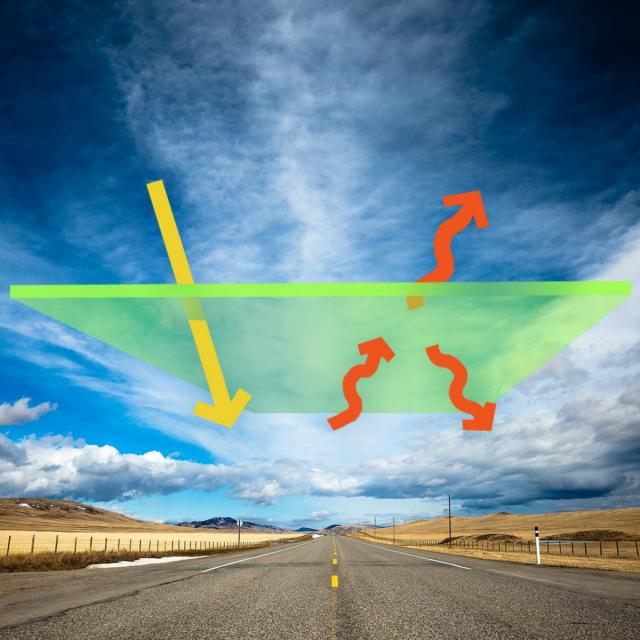
The balance of energy flow, as incoming sunlight and outgoing infrared, allow us to create our first simple climate model, including a simple greenhouse effect. There are two extended exercises in Part II of this class, one an analytical (algebraic) model of the equilibrium temperature of a planet, the other a numerical model of how that temperature might evolve through time.

Week 4
Greenhouse Gases and the Atmosphere
The Layer Model above assumes that the pane of glass representing the atmosphere absorbs all of the infrared radiation that hits it and that it radiates at all infrared wavelengths. In other words, the layer model atmosphere is an infrared blackbody, but transparent in the visible. In reality, greenhouse gases are not "black" at all; they are very choosy about which frequencies of light they absorb and emit. This selective absorption of infrared light by greenhouse gases leads to the band saturation effect, which makes rare, trace gases like methane disproportionally powerful relative to higher-concentration gases like CO₂.

Week 5
The Structure of the Atmosphere
The greenhouse effect works because the air in the upper atmosphere is colder than the ground, so that absorption and re-emission of IR by greenhouse gases decreases the amount of energy leaving the planet to space. Here we explore the physics responsible for keeping the upper atmosphere cold.

Week 6
Weather and Climate
Another property of the real world, missing in our model so far, is that the real world is not everywhere the same temperature, and the heat fluxes to and from space do not necessarily balance at any given time or location. This is because the winds in the atmosphere and the currents in the ocean carry heat around, in general from the hot tropics up to the cold high latitudes.

Week 7
Feedbacks
Feedbacks are loops of cause-and-effect that can either stabilize Earth's climate or amplify future climate changes. There is an exercise in Part II of this class where you solve for a planet's temperature by iteration, and in the process demonstrate a runaway ice albedo feedback that might have led to the Snowball Earth climate state 700 million years ago.

Week 8
The Carbon Cycle
Now we shift gears in a major way — away from climate physics (you now have seen its main ingredients) to the emergent miracle that is the carbon cycle on Earth. Not only is carbon the chemical element of life, it is also the means of storing life's energy. We will look at how carbon cycles through the land, the oceans, and the deep earth, going in and out of the atmosphere -- and how that stabilizes the earth's climate.

Week 9
The Perturbed Carbon Cycle
On the carbon locked up in fossil fuels and what happens when we burn those fuels. In Part II of this class, you can create a simple but somewhat realistic model of Earth's temperature evolution in the coming decades, in response to the release of CO2 (or in the sudden stop of emissions in a scenario called "The world without us").

Week 10
Looking for a Human Impact on Climate
You have now seen the ideas behind the forecast for a human impact on Earth's climate. The next question is: Do we see it happening today? It turns out that the "smoking gun" for a human impact on climate is the global average temperature record since about the 1970's. In order to interpret that temperature change, we need to consider it within the context of natural climate changes in Earth's geologic past.

Week 11
Potential Impacts
This unit we focus on the potential impacts of continued business-as-usual CO2 emissions. This is also the topic of the Working Group 2 volume of the IPCC reports (the Working Group 1 report is on the scientific basis, which is what we've been studying so far this course). You may find this material distressing, but hang on, because next week we'll go over "Mitigation", which is what it takes to avoid climate change (treated in the Working Group 3 report). Remember that most of the carbon we're worried about is still in the ground, so these impacts are inevitable only if we continue to decide to make them so. In Part II of this class, you can create a simple ice sheet model of your own.

Week 12
Mitigation
The last unit of the class finds us considering the options for avoiding, or "mitigating," a human impact on Earth's climate. Bottom line: I think it would be a challenge that humankind could beat if we decided to. If there hypothetically were no more coal on Earth, our potential to alter the climate would be much less. Finding energy sources in that world would not be an existential threat would just be a business opportunity. The hard part, in my opinion, is making that decision.


Go to Class
MOOC List is learner-supported. When you buy through links on our site, we may earn an affiliate commission.

Related Courses

Averaged-Switch Modeling and Simulation (Coursera) Coursera
University of Colorado Boulder

Averaged-Switch Modeling and Simulation (Coursera)

This is Course #1 in the Modeling and Control of Power Electronics course sequence. The course is focused on practical design-oriented modeling and control of pulse-width modulated switched mode power converters using analytical and simulation tools in time and frequency domains. A design-oriented analysis technique known as the Middlebrook's feedback theorem is introduced and applied to analysis and design of voltage regulators and other feedback circuits.

Jun 1st 2026
3 Weeks
Villes africaines: Environnement et enjeux de développement durable (Coursera) Coursera
École Polytechnique Fédérale de Lausanne

Villes africaines: Environnement et enjeux de développement durable (Coursera)

Le cours propose une lecture de l’environnement urbain en Afrique à travers les thématiques les plus pertinentes pour mesurer le niveau de développement d’un pays : eau et vie urbaine, assainissement (eaux usées et pluviales), gestion des déchets solides, agriculture urbaine. Après avoir analysé les différents enjeux de celles-ci, nous aborderons les liens entre environnement urbain et santé.

Jun 1st 2026
5-12 Weeks
The Dynamic Earth: A Course for Educators (Coursera) Coursera
American Museum of Natural History

The Dynamic Earth: A Course for Educators (Coursera)

The AMNH course The Dynamic Earth: A Course for Educators provides students with an overview of the origin and evolution of the Earth. Informed by the recently released Next Generation Science Standards, this course examines geological time scales, radiometric dating, and how scientists “read the rocks.” We will explore dramatic changes in the Earth over the last 4 billion years, including how the evolution of life on Earth has affected its atmosphere. In addition to looking at geology on a global scale, participants will take to their own backyards to explore and share their local geologic history.

Jun 1st 2026
4 Weeks
Modeling Risk and Realities (Coursera) Coursera
University of Pennsylvania

Modeling Risk and Realities (Coursera)

Useful quantitative models help you to make informed decisions both in situations in which the factors affecting your decision are clear, as well as in situations in which some important factors are not clear at all. In this course, you can learn how to create quantitative models to reflect complex realities, and how to include in your model elements of risk and uncertainty.

Jun 1st 2026
4 Weeks
Introduction to Thermodynamics: Transferring Energy from Here to There (Coursera) Coursera
University of Michigan

Introduction to Thermodynamics: Transferring Energy from Here to There (Coursera)

This course provides an introduction to the most powerful engineering principles you will ever learn - Thermodynamics: the science of transferring energy from one place or form to another place or form. We will introduce the tools you need to analyze energy systems from solar panels, to engines, to insulated coffee mugs. More specifically, we will cover the topics of mass and energy conservation principles; first law analysis of control mass and control volume systems; properties and behavior of pure substances; and applications to thermodynamic systems operating at steady state conditions.

Jun 1st 2026
5-12 Weeks
Planet Earth ... and You! (Coursera) Coursera
University of Illinois at Urbana-Champaign

Planet Earth ... and You! (Coursera)

Earthquakes, volcanoes, mountain building, ice ages, landslides, floods, life evolution, plate motions—all of these phenomena have interacted over the vast expanses of deep time to sculpt the dynamic planet that we live on today. Planet Earth presents an overview of several aspects of our home, from a geological perspective. We begin with earthquakes—what they are, what causes them, what effects they have, and what we can do about them. We will emphasize that plate tectonics—the grand unifying theory of geology—explains how the map of our planet's surface has changed radically over geologic time, and why present-day geologic activity—including a variety of devastating natural disasters such as earthquakes—occur where they do. We consider volcanoes, types of eruptions, and typical rocks found there.

Jun 1st 2026
5-12 Weeks
Sustentabilidad y Economías Sociales (Coursera) Coursera
Universidad de Chile

Sustentabilidad y Economías Sociales (Coursera)

En los últimos años el fenómeno del Emprendimiento con Sentido, la Innovación Social y la relevancia de la Sustentabilidad dan cuenta de la imperiosa necesidad de modernizar los esquemas de gestión de empresas y adaptarlos a una realidad cambiante, modificando paradigmas hacia las nuevas economías enfocadas en un desarrollo sustentable.

Jun 1st 2026
5-12 Weeks
Beyond the Sustainable Development Goals (SDGs): Addressing Sustainability and Development (Coursera) Coursera
University of Michigan

Beyond the Sustainable Development Goals (SDGs): Addressing Sustainability and Development (Coursera)

We’re excited you’re here! This course, “Beyond the Sustainable Development Goals (SDGs): Addressing Sustainability and Development,” is the first course in the upcoming Sustainability and Development MasterTrack Certificate program (Fall 2020), but you can also take this course as a stand-alone learning opportunity.

Jun 3rd 2026
5-12 Weeks
Securing Investment Returns in the Long Run (Coursera) Coursera
University of Geneva

Securing Investment Returns in the Long Run (Coursera)

In this course, you will learn about the famous dichotomy between active and passive investing, how to appropriately measure and analyze investment performance and what the future trends in the investment management industry are. You will first learn about absolute and relative performance, risk-adjusted returns and how to decompose investment performance. The focus will then shift to the two main categories of investment vehicles, active and passive funds, and what they entail in terms of expected performance.

Jun 1st 2026
4 Weeks
Quantitative Formal Modeling and Worst-Case Performance Analysis (Coursera) Coursera
EIT Digital

Quantitative Formal Modeling and Worst-Case Performance Analysis (Coursera)

Welcome to Quantitative Formal Modeling and Worst-Case Performance Analysis. In this course, you will learn about modeling and solving performance problems in a fashion popular in theoretical computer science, and generally train your abstract thinking skills. After finishing this course, you have learned to think about the behavior of systems in terms of token production and consumption, and you are able to formalize this thinking mathematically in terms of prefix orders and counting functions. You have learned about Petri-nets, about timing, and about scheduling of token consumption/production systems, and for the special class of Petri-nets known as single-rate dataflow graphs, you will know how to perform a worst-case analysis of basic performance metrics, like throughput, latency and buffering.

Jun 1st 2026
4 Weeks