The Philosophy of Socrates or Plato in the Apology (Skillshare)

Offered by Skillshare,
The Philosophy of Socrates or Plato in the Apology (Skillshare)

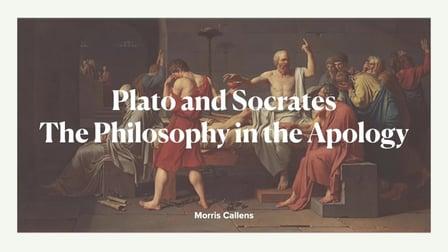
Today, I will give you some insights in the philosophy of Socrates (or Plato, as mentioned in the class) which is used in the Apology. These lessons consist some important quotes of Socrates, his method on conversing with others, his meaning of life, his 'god', and much more.

The Apology is the only work of Plato which is not written in dialogue-form. It should be an oration of Socrates, defending himself in front of the 'down to earth' judges, but even if you think it is, then why does he tell the people to be quiet when he is speaking, not to say their comments out loud? The Apology is full of the secrets of his philosophy.
For the class project, check the work sheet in the attachments!
Let us first delve into a short question. What is the meaning of life to you? This can at first look be an overwhelming question, but I will specify it for you. What do you love so, that you could do/have it at every moment in your life? Think about it for a moment: do you know yourself? γνωθι σεαυτον? Is it the same as for Socrates? Rewatch part 7, the meaning of life and Socrate’s vision on life. What do you think about it? If you do not agree, why? Try to make a scheme for yourself: What is the thing you like most? and why? Then, try to create a text in which you explain why Socrates is wrong and you are right.
If you even want to be more creative, you could do this in a dialogue style. You are talking to Socrates and are having a philosophical conversation. Rewatch part 9, the elenchus method, and try to practice your skills with Socrates himself. You know his vision and you know what he will say, now it is your turn to turn his vision around. Use the worksheet down below.
What will happen after death? What do you think? Rewatch part 7, Socrate’s vision on death, and think about whether it is right or wrong, in your perspective. It is always fun to compare different views on death. Pythagoras had the idea of reincarnation, possibly in an animal (The reason why the pupil of his school did not eat animal flesh). Try for example Christianity, Shinto, Islam, Buddhism,…
Try to compare these in a short text and try to write, draw how your afterlife looks like and share it in the project section.


Go to Class
MOOC List is learner-supported. When you buy through links on our site, we may earn an affiliate commission.

Related Courses

The History of Medicine: Philosophy, Science, and Psychology (Coursera) Coursera
University of California, Santa Cruz

The History of Medicine: Philosophy, Science, and Psychology (Coursera)

"History of Medicine" provides an accessible historical and interdisciplinary perspective on medicine, focused primarily upon therapy and practice, to achieve better understanding of the scope, practice, and limits of medicine. Medicine is defined as the treatment of disease. Human attempts to understand and treat disease will be seen as evolving from the spiritual and mystical practices of the distant past, to the rational approach of the Classical World, and finally to the scientific thinking of the Renaissance and beyond.

Aug 3rd 2026
5-12 Weeks
活用希臘哲學 (Understanding the Greek Philosophy) (Coursera) Coursera
National Taiwan University

活用希臘哲學 (Understanding the Greek Philosophy) (Coursera)

本課程之教學內容以希臘哲學之發展為主,並輔以哲學對人生意義之說明。希臘哲學是西洋哲學的骨幹,呈現西方人思維的核心理念,不但足以解釋今日之西方世界,甚至可以說明全世界的發展趨勢。本課程以希臘哲學為教學之主幹,分為先蘇哲學、詭辯學派、蘇格拉底、柏拉圖、亞理斯多德五個階段。教學的方式以強調他們之間的不同與相同的部分。課程將以演講的方式進行,揉合日常經驗作說明,並不時地會以整體的角度回頭看希臘哲學在今日哲學與社會所扮演的角色。

Jul 27th 2026
5-12 Weeks
Justice (edX) EdX
HarvardX,Harvard University

Justice (edX)

Justice, one of the most famous courses taught at Harvard College, is an introduction to moral and political philosophy, offering an opportunity to discuss contemporary dilemmas and controversies. Taught by lauded Harvard professor Michael Sandel, Justice explores critical analysis of classical and contemporary theories of justice, including discussion of present-day applications.

Self Paced
Self-Paced
A Life of Happiness and Fulfillment (Coursera) Coursera
Indian School of Business - ISB

A Life of Happiness and Fulfillment (Coursera)

What are the determinants of a happy and fulfilling life? This is surely one of life’s biggest questions, and a question that has interested many of our ancestors. Buddha famously gave up his kingdom in search of happiness. Several Greek philosophers (from Aristotle to Epicurus and Plato to Socrates) had their own views on what it takes to be happy. And of course, we all have our own theories about happiness too.

Aug 17th 2026
5-12 Weeks
Humanidades digitales (Coursera) Coursera
Universitat Autònoma de Barcelona

Humanidades digitales (Coursera)

¿Te has planteado para qué sirven las humanidades en el siglo XXI? ¿Cómo el advenimiento de lo Digital ha cambiado nuestra forma de acercarnos a las Humanidades? ¿Y al revés? ¿De qué forma las Humanidades influencian sobre los diferentes aspectos de la Tecnología? Te ofrecemos el primer curso online que da respuesta a estas preguntas. Una visión de las Humanidades Digitales desde la filosofía, la historia, la arqueología, el arte,… y desde las ciencias computacionales y la visión por ordenador.

Aug 3rd 2026
4 Weeks
Christianity & Ecology (Coursera) Coursera
Yale University

Christianity & Ecology (Coursera)

There is a need for broader literacy and deeper knowledge of the world’s religions and their ecological contributions. This course is designed as a gateway to the rich ecological dimensions of the Christian religious tradition. We delve into unique contributions from Orthodox, Catholic, and Protestant Christianity, exploring views on and relationship with the natural world.

Aug 17th 2026
5-12 Weeks
Ancient Philosophy: Plato & His Predecessors (Coursera) Coursera
University of Pennsylvania

Ancient Philosophy: Plato & His Predecessors (Coursera)

What is philosophy? How does it differ from science, religion, and other modes of human discourse? This course traces the origins of philosophy in the Western tradition in the thinkers of Ancient Greece. We begin with the Presocratic natural philosophers who were active in Ionia in the 6th century BCE and are also credited with being the first scientists.

Aug 17th 2026
4 Weeks
Introduction to Korean Philosophy and Culture (Coursera) Coursera
Sungkyunkwan University - SKKU

Introduction to Korean Philosophy and Culture (Coursera)

This course will give you the cultural and historical background to begin your journey into Korean philosophy, and there is no prerequisite knowledge on philosophy required. Anybody who either has an interest in Korean culture, maybe through K-Dramas or K-pop, or an interest in philosophy from a cross-cultural perspective, are all welcome.

Aug 3rd 2026
4 Weeks
Intellectual Humility: Theory (Coursera) Coursera
University of Edinburgh

Intellectual Humility: Theory (Coursera)

Faced with difficult questions people often tend to dismiss and marginalize dissent. Political and moral disagreements can be incredibly polarizing, and sometimes even dangerous. And whether it’s Christian fundamentalism, Islamic extremism, or militant atheism, religious dialogue remains tinted by arrogance, dogma, and ignorance. The world needs more people who are sensitive to reasons both for and against their beliefs, and are willing to consider the possibility that their political, religious and moral beliefs might be mistaken. The world needs more intellectual humility.

Aug 3rd 2026
3 Weeks
Alfabetização Midiática, Informacional e Diálogo Intercultural - UNESCO e UNICAMP (Coursera) Coursera
Universidade Estadual de Campinas - UNICAMP

Alfabetização Midiática, Informacional e Diálogo Intercultural - UNESCO e UNICAMP (Coursera)

Este curso quer pensar junto com você sobre um fenômeno recente no Brasil, que é a presença de uma grande quantidade de informação via mundo digital. Vamos mostrar diferentes caminhos do que podemos fazer com essa quantidade incrível de midias e como participar da construção de conteúdo digital de maneira sóbria e segura.

Aug 3rd 2026
5-12 Weeks
Luther and the West (Coursera) Coursera
Northwestern University

Luther and the West (Coursera)

In this course we will discuss the history of some ideas that have been hugely influential in the modern west and that were taken out to the rest of the world. The discussion centers on an extraordinary and historically important figure, a sixteenth century German man named Martin Luther. Luther is recognized today as the originator of many of the most significant ideas that continue to affect and shape who we as modern people are and how we see the world and ourselves for better and for worse.

Jul 27th 2026
5-12 Weeks