Object Localization with TensorFlow (Coursera)

Object Localization with TensorFlow (Coursera)

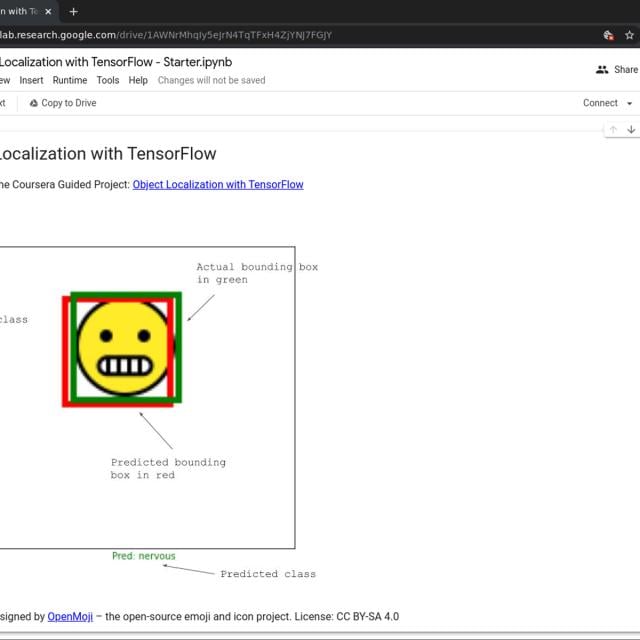
Welcome to this 2 hour long guided project on creating and training an Object Localization model with TensorFlow. In this guided project, we are going to use TensorFlow's Keras API to create a convolutional neural network which will be trained to classify as well as localize emojis in images. Localization, in this context, means the position of the emojis in the images. This means that the network will have one input and two outputs.

Class Deals by MOOC List - Click here and see Coursera's Active Discounts, Deals, and Promo Codes.

Think of this task as a simpler version of Object Detection. In Object Detection, we might have multiple objects in the input images, and an object detection model predicts the classes as well as bounding boxes for all of those objects. In Object Localization, we are working with the assumption that there is just one object in any given image, and our CNN model will classify and localize that object.
Please note that you will need prior programming experience in Python. You will also need familiarity with TensorFlow. This is a practical, hands on guided project for learners who already have theoretical understanding of Neural Networks, Convolutional Neural Networks, and optimization algorithms like Gradient Descent but want to understand how to use use TensorFlow to solve computer vision tasks like Object Localization.

In this Free Guided Project, you will:

  • Create synthetic data for model training
  • Create and train a multi output neural network to perform object localization
  • Create custom metrics and calbacks in Keras
  • Showcase this hands-on experience in an interview

Learn step-by-step:

  • Introduction
  • Download and Visualize Data
  • Create Examples
  • Plot Bouding Boxes
  • Data Generator
  • Model
  • Custom Metric: IoU
  • Compile the Model
  • Custom Callback
  • Model Training
Go to Class
MOOC List is learner-supported. When you buy through links on our site, we may earn an affiliate commission.

Related Courses

Matrix Methods (Coursera) Coursera
University of Minnesota

Matrix Methods (Coursera)

Mathematical Matrix Methods lie at the root of most methods of machine learning and data analysis of tabular data. Learn the basics of Matrix Methods, including matrix-matrix multiplication, solving linear equations, orthogonality, and best least squares approximation. Discover the Singular Value Decomposition that plays a fundamental role in dimensionality reduction, Principal Component Analysis, and noise reduction.

Aug 17th 2026
5-12 Weeks
Probabilistic Graphical Models 2: Inference (Coursera) Coursera
Stanford University

Probabilistic Graphical Models 2: Inference (Coursera)

Probabilistic graphical models (PGMs) are a rich framework for encoding probability distributions over complex domains: joint (multivariate) distributions over large numbers of random variables that interact with each other. These representations sit at the intersection of statistics and computer science, relying on concepts from probability theory, graph algorithms, machine learning, and more.

Aug 17th 2026
5-12 Weeks
Accounting Data Analytics with Python (Coursera) Coursera
University of Illinois at Urbana-Champaign

Accounting Data Analytics with Python (Coursera)

This course focuses on developing Python skills for assembling business data. It will cover some of the same material from Introduction to Accounting Data Analytics and Visualization, but in a more general purpose programming environment (Jupyter Notebook for Python), rather than in Excel and the Visual Basic Editor. These concepts are taught within the context of one or more accounting data domains (e.g., financial statement data from EDGAR, stock data, loan data, point-of-sale data).

Aug 17th 2026
5-12 Weeks
Internet of Things: Multimedia Technologies (Coursera) Coursera
University of California, San Diego

Internet of Things: Multimedia Technologies (Coursera)

Content is an eminent example of the features that contributed to the success of wireless Internet. Mobile platforms such as the Snapdragon™ processor have special hardware and software capabilities to make acquisition, processing and rendering of multimedia content efficient and cost-effective.

Aug 17th 2026
3 Weeks
Visualization for Data Journalism (Coursera) Coursera
University of Illinois at Urbana-Champaign

Visualization for Data Journalism (Coursera)

While telling stories with data has been part of the news practice since its earliest days, it is in the midst of a renaissance. Graphics desks which used to be deemed as “the art department,” a subfield outside the work of newsrooms, are becoming a core part of newsrooms’ operation. Those people (they often have various titles: data journalists, news artists, graphic reporters, developers, etc.) who design news graphics are expected to be full-fledged journalists and work closely with reporters and editors.

Aug 10th 2026
5-12 Weeks
Data Visualization with Tableau Project (Coursera) Coursera
University of California, Davis

Data Visualization with Tableau Project (Coursera)

In this project-based course, you will follow your own interests to create a portfolio worthy single-frame viz or multi-frame data story that will be shared on Tableau Public. You will use all the skills taught in this Specialization to complete this project step-by-step, with guidance from your instructors along the way.

Aug 10th 2026
5-12 Weeks
Fundamentals of Machine Learning in Finance (Coursera) Coursera
New York University Tandon School of Engineering

Fundamentals of Machine Learning in Finance (Coursera)

The course aims at helping students to be able to solve practical ML-amenable problems that they may encounter in real life that include: (1) understanding where the problem one faces lands on a general landscape of available ML methods, (2) understanding which particular ML approach(es) would be most appropriate for resolving the problem, and (3) ability to successfully implement a solution, and assess its performance.

Aug 17th 2026
4 Weeks
Excel Essentials and Beyond (Coursera) Coursera
Board Infinity

Excel Essentials and Beyond (Coursera)

Dive into "Excel Essentials and Beyond", a comprehensive exploration of Excel, the world's leading spreadsheet tool. This course is thoughtfully crafted for both newcomers to Excel and also for those aiming for mastery. We begin by introducing Excel's robust interface and foundational features, ensuring a firm grasp of data organization techniques. As you advance, you'll delve into data visualization, transforming raw data into captivating stories.

Aug 17th 2026
5-12 Weeks
Machine Learning Introduction for Everyone (Coursera) Coursera
IBM

Machine Learning Introduction for Everyone (Coursera)

This three-module course introduces machine learning and data science for everyone with a foundational understanding of machine learning models. You’ll learn about the history of machine learning, applications of machine learning, the machine learning model lifecycle, and tools for machine learning. You’ll also learn about supervised versus unsupervised learning, classification, regression, evaluating machine learning models, and more.

Aug 17th 2026
3 Weeks
Data Ingestion, Exploration & Visualization in Qlik Sense (Coursera) Coursera
Coursera Instructor Network

Data Ingestion, Exploration & Visualization in Qlik Sense (Coursera)

This course is an intermediate-level course designed for learners who want to continue their data visualization journey with Qlik Sense, a powerful sophisticated Business Intelligence tool. Data preparation and ingestion is a key prerequisite for data visualization, and this course not only dives deep into that concept, but other important intermediate topics such as filters, expressions, and personalization.

Aug 17th 2026
1 Week
Introduction to TensorFlow for Artificial Intelligence, Machine Learning, and Deep Learning (Coursera) Coursera
DeepLearning.AI

Introduction to TensorFlow for Artificial Intelligence, Machine Learning, and Deep Learning (Coursera)

If you are a software developer who wants to build scalable AI-powered algorithms, you need to understand how to use the tools to build them. This course is part of the upcoming Machine Learning in Tensorflow Specialization and will teach you best practices for using TensorFlow, a popular open-source framework for machine learning.

Aug 17th 2026
4 Weeks