Machine Translation (Coursera)

Machine Translation (Coursera)

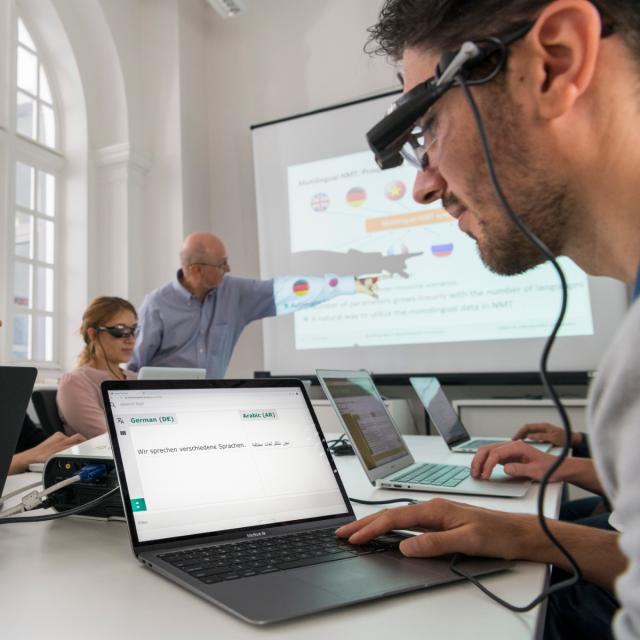
Welcome to the CLICS-Machine Translation MOOC. This MOOC explains the basic principles of machine translation. Machine translation is the task of translating from one natural language to another natural language. Therefore, these algorithms can help people communicate in different languages. Such algorithms are used in common applications, from Google Translate to apps on your mobile device.

Class Deals by MOOC List - Click here and see Coursera's Active Discounts, Deals, and Promo Codes.

After taking this course you will be able to understand the main difficulties of translating natural languages and the principles of different machine translation approaches. A main focus of the course will be the current state-of-the-art neural machine translation technology which uses deep learning methods to model the translation process. You will be able to decide which concepts fit your machine translation application best.

Syllabus

WEEK 1: Introduction to the basics of Machine Translation
WEEK 2: Language
WEEK 3: Evaluation
WEEK 4: Statistical Machine Translation
WEEK 5: Neural Network Models
WEEK 6: NMT
WEEK 7: More NMT


Go to Class
MOOC List is learner-supported. When you buy through links on our site, we may earn an affiliate commission.

Related Courses

A Crash Course in Data Science (Coursera) Coursera
Johns Hopkins University

A Crash Course in Data Science (Coursera)

By now you have definitely heard about data science and big data. In this one-week class, we will provide a crash course in what these terms mean and how they play a role in successful organizations. This class is for anyone who wants to learn what all the data science action is about, including those who will eventually need to manage data scientists. The goal is to get you up to speed as quickly as possible on data science without all the fluff. We've designed this course to be as convenient as possible without sacrificing any of the essentials.

Jun 29th 2026
1 Week
Genomic Data Science and Clustering (Bioinformatics V) (Coursera) Coursera
University of California, San Diego

Genomic Data Science and Clustering (Bioinformatics V) (Coursera)

How do we infer which genes orchestrate various processes in the cell? How did humans migrate out of Africa and spread around the world? In this class, we will see that these two seemingly different questions can be addressed using similar algorithmic and machine learning techniques arising from the general problem of dividing data points into distinct clusters.

Jun 29th 2026
3 Weeks
Learn to code with AI (Coursera) Coursera
Scrimba

Learn to code with AI (Coursera)

Imagine waking up tomorrow as a web developer. What would you want to build? With AI tools like ChatGPT, you're already a developer, regardless of your experience, if you know how to work with them. So in this course, you'll build functional, interactive front-end projects while learning how to write effective prompts and debug and refine your code with the help of AI.

Jul 1st 2026
2 Weeks
Data Science for Business Innovation (Coursera) Coursera
Politecnico di Milano,EIT Digital

Data Science for Business Innovation (Coursera)

The course is a compendium of the must-have expertise in data science for executive and middle-management to foster data-driven innovation. It consists of introductory lectures spanning big data, machine learning, data valorization and communication. Topics cover the essential concepts and intuitions on data needs, data analysis, machine learning methods, respective pros and cons, and practical applicability issues.

Jun 29th 2026
4 Weeks
Regression Models (Coursera) Coursera
Johns Hopkins University

Regression Models (Coursera)

Linear models, as their name implies, relates an outcome to a set of predictors of interest using linear assumptions. Regression models, a subset of linear models, are the most important statistical analysis tool in a data scientist’s toolkit. This course covers regression analysis, least squares and inference using regression models.

Jun 29th 2026
4 Weeks
The R Programming Environment (Coursera) Coursera
Johns Hopkins University

The R Programming Environment (Coursera)

This course provides a rigorous introduction to the R programming language, with a particular focus on using R for software development in a data science setting. Whether you are part of a data science team or working individually within a community of developers, this course will give you the knowledge of R needed to make useful contributions in those settings.

Jun 29th 2026
4 Weeks
Process Mining: Data science in Action (Coursera) Coursera
Eindhoven University of Technology

Process Mining: Data science in Action (Coursera)

Process mining is the missing link between model-based process analysis and data-oriented analysis techniques. Through concrete data sets and easy to use software the course provides data science knowledge that can be applied directly to analyze and improve processes in a variety of domains. Data science is the profession of the future, because organizations that are unable to use (big) data in a smart way will not survive. It is not sufficient to focus on data storage and data analysis. The data scientist also needs to relate data to process analysis.

Jun 29th 2026
5-12 Weeks
Statistical Inference (Coursera) Coursera
Johns Hopkins University

Statistical Inference (Coursera)

Statistical inference is the process of drawing conclusions about populations or scientific truths from data. There are many modes of performing inference including statistical modeling, data oriented strategies and explicit use of designs and randomization in analyses. Furthermore, there are broad theories (frequentists, Bayesian, likelihood, design based, …) and numerous complexities (missing data, observed and unobserved confounding, biases) for performing inference.

Jun 29th 2026
4 Weeks
Building a Data Science Team (Coursera) Coursera
Johns Hopkins University

Building a Data Science Team (Coursera)

Data science is a team sport. As a data science executive it is your job to recruit, organize, and manage the team to success. In this one-week course, we will cover how you can find the right people to fill out your data science team, how to organize them to give them the best chance to feel empowered and successful, and how to manage your team as it grows.

Jun 29th 2026
1 Week
Machine Learning Foundations: A Case Study Approach (Coursera) Coursera
University of Washington

Machine Learning Foundations: A Case Study Approach (Coursera)

Do you have data and wonder what it can tell you? Do you need a deeper understanding of the core ways in which machine learning can improve your business? Do you want to be able to converse with specialists about anything from regression and classification to deep learning and recommender systems? In this course, you will get hands-on experience with machine learning from a series of practical case-studies.

Jun 29th 2026
5-12 Weeks
Google Cloud Platform Fundamentals: Core Infrastructure (Coursera) Coursera
Google

Google Cloud Platform Fundamentals: Core Infrastructure (Coursera)

This course introduces you to important concepts and terminology for working with Google Cloud Platform (GCP). You learn about, and compare, many of the computing and storage services available in Google Cloud Platform, including Google App Engine, Google Compute Engine, Google Kubernetes Engine, Google Cloud Storage, Google Cloud SQL, and BigQuery. You learn about important resource and policy management tools, such as the Google Cloud Resource Manager hierarchy and Google Cloud Identity and Access Management. Hands-on labs give you foundational skills for working with GCP.

Jun 29th 2026
1 Week
Managing Data Analysis (Coursera) Coursera
Johns Hopkins University

Managing Data Analysis (Coursera)

This one-week course describes the process of analyzing data and how to manage that process. We describe the iterative nature of data analysis and the role of stating a sharp question, exploratory data analysis, inference, formal statistical modeling, interpretation, and communication. In addition, we will describe how to direct analytic activities within a team and to drive the data analysis process towards coherent and useful results.

Jun 29th 2026
1 Week