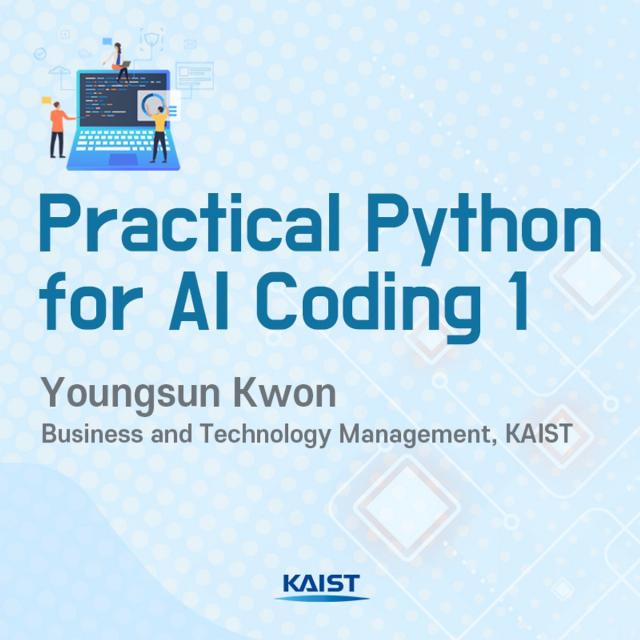
Practical Python for AI Coding 1 (Coursera)

Practical Python for AI Coding 1 (Coursera)

This course is for a complete novice of Python coding, so no prior knowledge or experience in software coding is required. This course selects, introduces and explains Python syntaxes, functions and libraries that were frequently used in AI coding. In addition, this course introduces vital syntaxes, and functions often used in AI coding and explains the complementary relationship among NumPy, Pandas and TensorFlow, so this course is helpful for even seasoned python users.

Class Deals by MOOC List - Click here and see Coursera's Active Discounts, Deals, and Promo Codes.

This course starts with building an AI coding environment without failures on learners’ desktop or notebook computers to enable them to start AI modeling and coding with Scikit-learn, TensorFlow and Keras upon completing this course. Because learners have an AI coding environment on their computers after taking this course, they can start AI coding and do not need to join or use the cloud-based services.

Syllabus

WEEK 1: Preparation for coding : Setting up AI coding environment
WEEK 2: Basic concepts and rules of Python coding
WEEK 3: Primitive data types
WEEK 4: Control statements and iteration
WEEK 5: Creating functions
WEEK 6: Non-primitive data types: Lists and tuples
WEEK 7: Non-primitive data types: Dictionaries and sets
Go to Class
MOOC List is learner-supported. When you buy through links on our site, we may earn an affiliate commission.

Related Courses

Build a Data Warehouse Using BigQuery (Coursera) Coursera
Starweaver

Build a Data Warehouse Using BigQuery (Coursera)

Unlock the power of Google BigQuery as you embark on a journey to become proficient in data warehouse building and advanced querying. In this comprehensive course, you'll learn to harness the capabilities of BigQuery, from setting up and accessing the platform to creating data warehouses using both the user interface and Python. Through hands-on lessons and practical applications, you'll develop the fundamental skills needed to manage, query, and optimize your data in this powerful cloud-based platform.

Aug 31st 2026
1 Week
Visualization for Data Journalism (Coursera) Coursera
University of Illinois at Urbana-Champaign

Visualization for Data Journalism (Coursera)

While telling stories with data has been part of the news practice since its earliest days, it is in the midst of a renaissance. Graphics desks which used to be deemed as “the art department,” a subfield outside the work of newsrooms, are becoming a core part of newsrooms’ operation. Those people (they often have various titles: data journalists, news artists, graphic reporters, developers, etc.) who design news graphics are expected to be full-fledged journalists and work closely with reporters and editors.

Sep 7th 2026
5-12 Weeks
Machine Learning in Retail (Coursera) Coursera
Coursera Project Network

Machine Learning in Retail (Coursera)

Who are your customers? What are they like? How do they interact with your business? This Short Course was created to help analysts better understand their customer behaviour through the power of machine learning. In this course, you will apply two different machine learning techniques to segment customers according to their purchasing behaviour and provide actionable insights for each group. Along the way, you'll also examine some other retail case studies, including web visitor analysis for marketing and store clustering for logistics.

Aug 31st 2026
1 Week
Foundations of Data Science: K-Means Clustering in Python (Coursera) Coursera
University of London,Goldsmiths, University of London

Foundations of Data Science: K-Means Clustering in Python (Coursera)

This MOOC, designed by an academic team from Goldsmiths, University of London, will quickly introduce you to the core concepts of Data Science to prepare you for intermediate and advanced Data Science courses. It focuses on the basic mathematics, statistics and programming skills that are necessary for typical data analysis tasks.

Sep 7th 2026
5-12 Weeks
Getting Started with Machine Learning at the Edge on Arm (Coursera) Coursera
Arm

Getting Started with Machine Learning at the Edge on Arm (Coursera)

The age of machine learning has arrived! Arm technology is powering a new generation of connected devices with sophisticated sensors that can collect a vast range of environmental, spatial and audio/visual data. Typically this data is processed in the cloud using advanced machine learning tools that are enabling new applications reshaping the way we work, travel, live and play.

Aug 31st 2026
5-12 Weeks
An Introduction to Interactive Programming in Python (Part 1) (Coursera) Coursera
Rice University

An Introduction to Interactive Programming in Python (Part 1) (Coursera)

This two-part course is designed to help students with very little or no computing background learn the basics of building simple interactive applications. Our language of choice, Python, is an easy-to learn, high-level computer language that is used in many of the computational courses offered on Coursera. To make learning Python easy, we have developed a new browser-based programming environment that makes developing interactive applications in Python simple.

Sep 7th 2026
5-12 Weeks
Algorithmic Thinking (Part 1) (Coursera) Coursera
Rice University

Algorithmic Thinking (Part 1) (Coursera)

Experienced Computer Scientists analyze and solve computational problems at a level of abstraction that is beyond that of any particular programming language. This two-part class is designed to train students in the mathematical concepts and process of "Algorithmic Thinking", allowing them to build simpler, more efficient solutions to computational problems.

Sep 7th 2026
4 Weeks
Applied Plotting, Charting & Data Representation in Python (Coursera) Coursera
University of Michigan

Applied Plotting, Charting & Data Representation in Python (Coursera)

This course will introduce the learner to information visualization basics, with a focus on reporting and charting using the matplotlib library. The course will start with a design and information literacy perspective, touching on what makes a good and bad visualization, and what statistical measures translate into in terms of visualizations. The second week will focus on the technology used to make visualizations in python, matplotlib, and introduce users to best practices when creating basic charts and how to realize design decisions in the framework.

Sep 7th 2026
4 Weeks
Principles of Computing (Part 2) (Coursera) Coursera
Rice University

Principles of Computing (Part 2) (Coursera)

This two-part course introduces the basic mathematical and programming principles that underlie much of Computer Science. Understanding these principles is crucial to the process of creating efficient and well-structured solutions for computational problems. To get hands-on experience working with these concepts, we will use the Python programming language. The main focus of the class will be weekly mini-projects that build upon the mathematical and programming principles that are taught in the class.

Sep 7th 2026
4 Weeks