FUN

MOOC-Avion : Comment vole un avion ? (FUN)

Offered by ISAE-SUPAERO,
MOOC-Avion : Comment vole un avion ? (FUN)

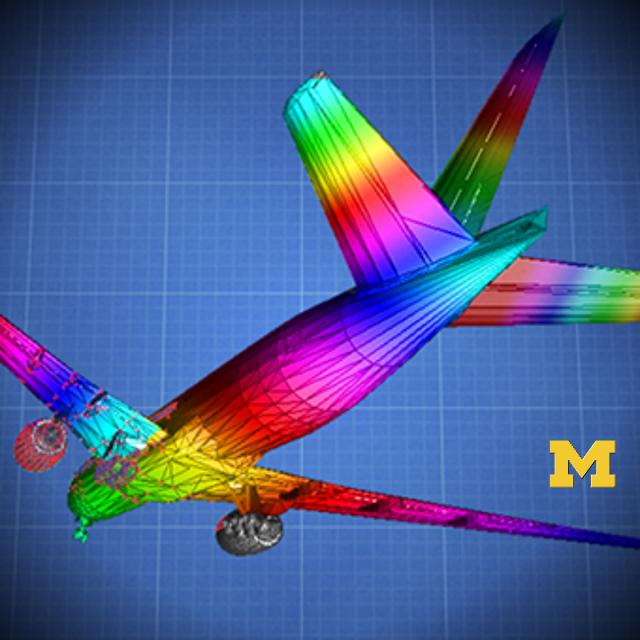
Cela fait à peine plus d’un siècle que les avions volent. Et, de fait, le vol défie souvent l’intuition de l’animal terrestre que nous sommes. Comment vole un avion et comment éviter qu’il échappe au contrôle du pilote ? Jusqu’où peut-il s’élever dans le ciel ? Autant de questions auxquelles ce MOOC s’efforcera de répondre avec passion, simplicité et rigueur scientifique, en s’appuyant sur des explications visuelles, des mises en situation réalistes, des simulations et en se limitant au formalisme mathématique accessible à un élève de terminale scientifique.

Contenu du MOOC-Avion

Objectifs pédagogiques:
A l’issue du cours, les participants seront capables de :

  • Définir et utiliser à bon escient les grandeurs de la mécanique du vol (incidence, pente, assiette, etc.)
  • Comprendre comment un avion vole et décrire les forces qui s’exercent sur lui à l’équilibre et lors de manœuvres en vol
  • Décrire et modéliser l’origine des forces aérodynamiques sur une aile
  • Décrire l’atmosphère standard et expliquer l’effet de l’altitude sur les caractéristiques de vol d’un avion
  • Expliquer l’origine des limites du domaine de vol d’un avion
  • Dimensionner grossièrement les surfaces portantes d’un avion et la puissance de son moteur
  • Évaluer la distance de décollage et sa pente de montée notamment en cas de panne d’un des moteurs

Disciplines abordées

  • Mécanique du vol (mécanique des solides)
  • Aérodynamique

Prérequis nécessaires
Etant donné le niveau défini ci-dessus, des prérequis seront nécessaires dont :

  • La notion de force et de moment (rotation autour d’un axe)
  • Le principe fondamental de la dynamique
  • L’énergie mécanique
  • La notion de dérivée
Go to Class
MOOC List is learner-supported. When you buy through links on our site, we may earn an affiliate commission.

Related Courses

ConstruiREcycler (FUN) FUN
Université de Liège

ConstruiREcycler (FUN)

Le recyclage n'est pas un luxe ou une mode mais une nécessité, qui provient d'une constatation fort simple : nous vivons dans un monde limité. Contrairement à ce que nous avons cru fort longtemps et surtout dans les "golden sixties", notre activité humaine n'est pas infiniment développable, car bornée par des limites en termes d'énergie, de ressources naturelles, d'espace ou simplement de capacité d'adaptation de la nature.

No sessions available
5-12 Weeks
Cómo autoconstruir tu vivienda (Coursera) Coursera
Universidad Nacional Autónoma de México

Cómo autoconstruir tu vivienda (Coursera)

Aprenderás las bases y los procedimientos precisos paso a paso para que puedas llevar a cabo la autoconstrucción de una vivienda básica, segura y económica para ti y tu familia; también te será de gran utilidad si estás buscando aprender a reparar, mejorar la estructura de tu vivienda e incluso si buscas autoemplearte.

Jun 22nd 2026
4 Weeks
Statistique pour l'ingénieur (FUN) FUN
Institut Mines-Telecom

Statistique pour l'ingénieur (FUN)

Les méthodes statistiques sont largement répandues dans presque tous les secteurs de l’activité humaine : sciences et techniques, économie, sciences humaines et sociales. Elles font partie des connaissances de base de l’ingénieur. Parmi les innombrables applications dans le domaine industriel, on peut citer le contrôle de qualité, la fiabilité, l’analyse des résultats de mesure, la prévision et la planification.

No sessions available
5-12 Weeks
Engineering Systems in Motion: Dynamics of Particles and Bodies in 2D Motion (Coursera) Coursera
Georgia Institute of Technology

Engineering Systems in Motion: Dynamics of Particles and Bodies in 2D Motion (Coursera)

This course is an introduction to the study of bodies in motion as applied to engineering systems and structures. We will study the dynamics of particle motion and bodies in rigid planar (2D) motion. This will consist of both the kinematics and kinetics of motion. Kinematics deals with the geometrical aspects of motion describing position, velocity, and acceleration, all as a function of time. Kinetics is the study of forces acting on these bodies and how it affects their motion.

Jun 15th 2026
5-12 Weeks
Nanotechnology: A Maker’s Course (Coursera) Coursera
Duke University,University of North Carolina,North Carolina State University

Nanotechnology: A Maker’s Course (Coursera)

How can we create nano-structures that are 10,000 times smaller than the diameter of a human hair? How can we “see” at the nano-scale? Through instruction and lab demonstrations, in this course you will obtain a rich understanding of the capabilities of nanotechnology tools, and how to use this equipment for nano-scale fabrication and characterization.

Jun 15th 2026
5-12 Weeks
Cybersecurity Policy for Aviation and Internet Infrastructures (Coursera) Coursera
University of Colorado System

Cybersecurity Policy for Aviation and Internet Infrastructures (Coursera)

In this course we will examine the aviation and Internet infrastructures, and various policies that have been developed to help guide and strengthen their cybersecurity programs. The aviation and Internet infrastructures are also considered "lifeline infrastructure" as part of the transportation and communications sectors. Both subsectors are overseen by the Department of Homeland Security National Protection and Programs Directorate which manages the DHS National Infrastructure Protection Program.

Jun 15th 2026
4 Weeks
MBSE: Model-Based Systems Engineering (Coursera) Coursera
University at Buffalo,The State University of New York

MBSE: Model-Based Systems Engineering (Coursera)

This Model-Based Systems Engineering (MBSE) course and the Digital Thread courses featured earlier in this specialization bring together the concepts from across digital manufacturing and design, forming a vision in which the geometry of a product is just one way of describing it. MBSE is where the model resulting from the evolution of system requirements, design, analysis, verification and validation activities is the focus of design and manufacturing.

Jun 22nd 2026
4 Weeks
Advanced Engineering Systems in Motion: Dynamics of Three Dimensional (3D) Motion (Coursera) Coursera
Georgia Institute of Technology

Advanced Engineering Systems in Motion: Dynamics of Three Dimensional (3D) Motion (Coursera)

This course is an advanced study of bodies in motion as applied to engineering systems and structures. We will study the dynamics of rigid bodies in 3D motion. This will consist of both the kinematics and kinetics of motion. Kinematics deals with the geometrical aspects of motion describing position, velocity, and acceleration, all as a function of time. Kinetics is the study of forces acting on these bodies and how it affects their motion.

Jun 15th 2026
5-12 Weeks
Digitalisation in Space Research (Coursera) Coursera
Technische Universität München - TUM

Digitalisation in Space Research (Coursera)

This course provides an overview of the most important digital applications in the field of aerospace research. The course instructors discuss how digitalisation is impacting and changing both satellite-based and manned spaceflight research. One unit is specifically devoted to exploring the use of artificial intelligence in the evaluation of satellite data.

Jun 15th 2026
3 Weeks
Engineering Practices for Building Quality Software (Coursera) Coursera
University of Minnesota

Engineering Practices for Building Quality Software (Coursera)

Agile embraces change which means that team should be able to effectively make changes to the system as team learns about users and market. To be good at effectively making changes to the system, teams need to have engineering rigor and excellence else embracing change becomes very painful and expensive. In this course, you will learn about engineering practices and processes that agile and traditional teams use to make sure the team is prepared for change. In additional, you will also learn about practices, techniques and processes that can help team build high quality software. You will also learn how to calculate a variety of quantitative metrics related to software quality.

Jun 22nd 2026
4 Weeks
English for Science, Technology, Engineering, and Mathematics (Coursera) Coursera
University of Pennsylvania

English for Science, Technology, Engineering, and Mathematics (Coursera)

Welcome to English for Science, Technology, Engineering, and Mathematics, a course created by the University of Pennsylvania, and funded by the U.S. Department of State Bureau of Educational and Cultural Affairs, Office of English Language Programs. This course is designed for non-native English speakers who are interested in improving their English skills in the sciences. In this course, you will explore some of the most innovative areas of scientific study, while expanding your vocabulary and the language skills needed to share scientific information within your community.

Jun 15th 2026
5-12 Weeks