Introduction to Engineering Mechanics (Coursera)

Introduction to Engineering Mechanics (Coursera)

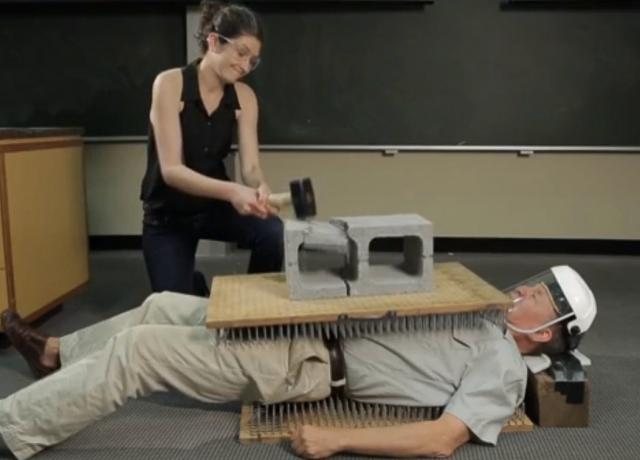
This course is an introduction to learning and applying the principles required to solve engineering mechanics problems. Concepts will be applied in this course from previous courses you have taken in basic math and physics. The course addresses the modeling and analysis of static equilibrium problems with an emphasis on real world engineering applications and problem solving.

Class Deals by MOOC List - Click here and see Coursera's Active Discounts, Deals, and Promo Codes.

The copyright of all content and materials in this course are owned by either the Georgia Tech Research Corporation or Dr. Wayne Whiteman. By participating in the course or using the content or materials, whether in whole or in part, you agree that you may download and use any content and/or material in this course for your own personal, non-commercial use only in a manner consistent with a student of any academic course.
Any other use of the content and materials, including use by other academic universities or entities, is prohibited without express written permission of the Georgia Tech Research Corporation. Interested parties may contact Dr. Wayne Whiteman directly for information regarding the procedure to obtain a non-exclusive license.

Syllabus

Week 1
Forces and Particle Equilibrium
In this section, students will learn the definition of a force and how to represent a force as a vector in two (2D) and three (3D) dimensions. Students will learn the concept of particle equilibrium and equilibrium of systems of particles. Concepts will be reinforced with example problems.

Week 2
Define and Calculate Moments
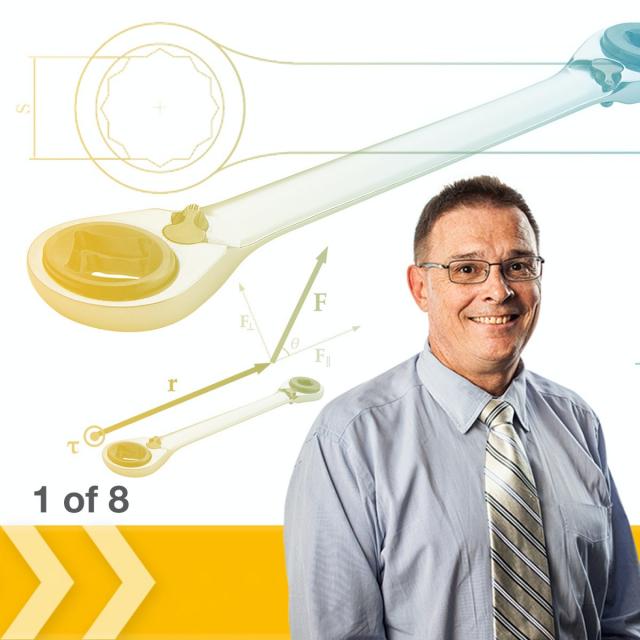
In this section, students will learn the definition of a moment. Students will calculate the moment of a force about a point, line or axis, and moment due to a couple.

Week 3
Equilibrium and Equivalence of Force Systems
In this section, students will learn the equilibrium equations in two (2D) and three (3D) dimensions. Students will solve equivalent system problems. System force results will be defined and calculated.

Week 4
Free Body Diagrams and Equilibrium Analysis Techniques
In this section, students will learn to analyze general equilibrium problems. Free Body Diagrams (FBD) will be defined. Concepts will be reinforced with example problems.

Week 5
Application of Static Equilibrium Equations
In this section, students will apply the equilibrium equations to solve two (2D) and three (3D) real world engineering problems. There will be an extensive use of example problems to reinforce concepts from the course.

Go to Class
MOOC List is learner-supported. When you buy through links on our site, we may earn an affiliate commission.

Related Courses

Exploring Light: Hands-on Activities and Strategies for Teachers (Coursera) Coursera
Exploratorium

Exploring Light: Hands-on Activities and Strategies for Teachers (Coursera)

This is an Exploratorium teacher professional development course taught by Teacher Institute staff, open to any science teacher (particularly middle or high school level) and science enthusiast. This is a hands-on workshop that explores topics and strategies teachers can use to help their students become active investigators of light.

Sep 6th 2026
4 Weeks
Materials Data Sciences and Informatics (Coursera) Coursera
Georgia Institute of Technology

Materials Data Sciences and Informatics (Coursera)

This course aims to provide a succinct overview of the emerging discipline of Materials Informatics at the intersection of materials science, computational science, and information science. Attention is drawn to specific opportunities afforded by this new field in accelerating materials development and deployment efforts.

Sep 7th 2026
5-12 Weeks
Ingeniería de Tráfico (Coursera) Coursera
Pontificia Universidad Católica de Chile

Ingeniería de Tráfico (Coursera)

El curso presenta en primer lugar las principales relaciones que caracterizan la circulación de vehículos y que dan pie a la teoría de circulación de vehículos sobre redes de transporte. Posteriormente se discutirán aspectos relativos al control de tráfico en intersecciones, sean estas de prioridad o semaforizadas. Finalmente, discutiremos sobre las características que presentan algunos modelos dinámicos de tráfico bastante utilizados en la actualidad.

Sep 7th 2026
4 Weeks
Image and video processing: From Mars to Hollywood with a stop at the hospital (Coursera) Coursera
Duke University

Image and video processing: From Mars to Hollywood with a stop at the hospital (Coursera)

In this course, you will learn the science behind how digital images and video are made, altered, stored, and used. We will look at the vast world of digital imaging, from how computers and digital cameras form images to how digital special effects are used in Hollywood movies to how the Mars Rover was able to send photographs across millions of miles of space.

Sep 7th 2026
5-12 Weeks
Wind resources for renewable energies (Coursera) Coursera
École Polytechnique

Wind resources for renewable energies (Coursera)

The main goal of this course is to get the necessary knowledge on atmospheric and fluid dynamics in order to quantify the wind resource of a local or regional area. We’ll learn about basic meteorology, the specific dynamics of turbulent boundary layers and some standard techniques to estimate wind resources regardless of the type of turbine used or the level of efficiency achieved.

Sep 7th 2026
4 Weeks
Writing Skills for Engineering Leaders (Coursera) Coursera
Rice University

Writing Skills for Engineering Leaders (Coursera)

Engineering leaders must write extensively for their jobs, and their writing needs to be professional, reader-focused, and error-free. What leaders write in particular can affect productivity and the bottom line, so the written communication that leaders create must be clear and concise. In this course, you’ll learn essential writing skills that you can apply in your daily activities on the job as an engineering leader.

Sep 14th 2026
4 Weeks
Mécanique de Newton (Coursera) Coursera
École Polytechnique Fédérale de Lausanne

Mécanique de Newton (Coursera)

À l’École Polytechnique Fédérale de Lausanne, un cours de mécanique fait partie de la formation de tous les futurs ingénieurs et scientifiques. Il a pour but de leur apprendre à transcrire sous forme mathématique un phénomène physique, afin de pouvoir en formuler une analyse raisonnée. Cette partie couvrira notamment la cinématique du point matériel, la balistique dans le champ de la pesanteur et l’oscillateur harmonique.

Sep 7th 2026
5-12 Weeks
The Finite Element Method for Problems in Physics (Coursera) Coursera
University of Michigan

The Finite Element Method for Problems in Physics (Coursera)

This course is an introduction to the finite element method as applicable to a range of problems in physics and engineering sciences. The treatment is mathematical, but only for the purpose of clarifying the formulation. The emphasis is on coding up the formulations in a modern, open-source environment that can be expanded to other applications, subsequently.

Sep 7th 2026
13-24 Weeks
Introduction to Basic Vibrations (Coursera) Coursera
Korea Advanced Institute of Science and Technology - KAIST

Introduction to Basic Vibrations (Coursera)

Introduction to Basic Vibrations starts with the fundamental principle of vibrations with a single and double degree of freedom systems. These fundamental vibration systems provide a solid platform not only to understand general vibrations but also to apply or use them into simple mechanical problems.

Sep 7th 2026
5-12 Weeks
Material Behavior (Coursera) Coursera
Georgia Institute of Technology

Material Behavior (Coursera)

Have you ever wondered why ceramics are hard and brittle while metals tend to be ductile? Why some materials conduct heat or electricity while others are insulators? Why adding just a small amount of carbon to iron results in an alloy that is so much stronger than the base metal? In this course, you will learn how a material’s properties are determined by the microstructure of the material, which is in turn determined by composition and the processing that the material has undergone.

Sep 7th 2026
5-12 Weeks
Advanced Engineering Systems in Motion: Dynamics of Three Dimensional (3D) Motion (Coursera) Coursera
Georgia Institute of Technology

Advanced Engineering Systems in Motion: Dynamics of Three Dimensional (3D) Motion (Coursera)

This course is an advanced study of bodies in motion as applied to engineering systems and structures. We will study the dynamics of rigid bodies in 3D motion. This will consist of both the kinematics and kinetics of motion. Kinematics deals with the geometrical aspects of motion describing position, velocity, and acceleration, all as a function of time. Kinetics is the study of forces acting on these bodies and how it affects their motion.

Sep 7th 2026
5-12 Weeks
Interpersonal Communication for Engineering Leaders (Coursera) Coursera
Rice University

Interpersonal Communication for Engineering Leaders (Coursera)

This course covers communication skills that engineering leaders use every day to motivate, inspire, and support the people in their organizations. Speaking and writing are basic leadership communication skills. (We covered these topics in the Specialization course 1 and 3.) However, leaders also need to be skillful interpersonal communicators.

Sep 14th 2026
4 Weeks