Modelos comerciales circulares para sistemas alimentarios urbanos sostenibles (FutureLearn)

Modelos comerciales circulares para sistemas alimentarios urbanos sostenibles (FutureLearn)

Descubra cómo los modelos comerciales circulares transforman los sistemas alimentarios urbanos.
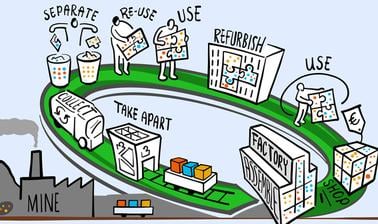
Explore cómo la economía circular puede fomentar sistemas alimentarios urbanos. En un contexto donde la población mundial alcanzará los 9 mil millones de personas en 2050, con casi el 70% de ellas concentradas en zonas urbanas y que requerirán tres veces más recursos de los que usamos actualmente, la “economía lineal” tradicional ya no funciona.

Class Deals by MOOC List - Click here and see FutureLearn's Active Discounts, Deals, and Promo Codes.

En este curso, aprenderá a diseñar y planificar sistemas alimentarios circulares para alcanzar ciudades resilientes, inteligentes y sostenibles.
Exploraremos la función de catalizador de las ciudades para fomentar políticas alimentarias saludables e inclusivas, adoptando el pensamiento sistémico, la innovación institucional y enfoques participativos para cumplir con los ODS de 2030.

Syllabus

Week 1: Pensamiento y actuación circulares en el contexto de los ODS: ¿por qué y para quién?
Week 2: Diseño de sistemas alimentarios circulares: desafíos y oportunidades
Week 3: Desbloqueo de la creación de valor mediante modelos comerciales circulares
Week 4: Participación efectiva de las partes interesadas del sistema alimentario

Learning on this course
You can take this self-guided course and learn at your own pace. On every step of the course you can meet other learners, share your ideas and join in with active discussions in the comments.
What will you achieve?
By the end of the course, you‘ll be able to...

  • Explorar los principios, conceptos y evaluaciones de la economía circular en el contexto de los ODS
  • Identificar y evaluar desafíos y oportunidades al diseñar sistemas alimentarios circulares
  • Evaluar cómo las políticas alimentarias urbanas pueden reforzar los vínculos entre las zonas urbanas y rurales y guiar la transición hacia sistemas alimentarios urbanos sostenibles
  • Desarrollar y evaluar los modelos comerciales circulares y su papel en la creación de combinaciones de productos y servicios para alcanzar la circularidad alimentaria
  • Desarrollar habilidades y herramientas prácticas para difundir conocimientos y educar a terceros sobre la circularidad alimentaria urbana para fomentar sistemas alimentarios sostenibles

Who is the course for?
Este curso está diseñado principalmente para legisladores, instituciones públicas, intermediarios y educadores. Igualmente, resultará de interés para cualquier persona interesada en cuestiones de sostenibilidad y sistemas alimentarios urbanos.
Go to Class
MOOC List is learner-supported. When you buy through links on our site, we may earn an affiliate commission.

Related Courses

Beyond Systems Thinking (edX) EdX
ETH Zurich,ETHx

Beyond Systems Thinking (edX)

We need cultural and mental transformation to deal with the current global polycrisis. This MOOC is the second of four MOOCs to hybridize science, design, and transformative praxis. This joint learning journey is a fluid, intervention-driven, synergistic process addressing complex challenges with a regional focus. It entails a critical look at systems thinking, tools to navigate complexity, basics of social network analysis, resilience assessment, circularities, and systemic innovation.

Self Paced
Self-Paced
Waste Management and Critical Raw Materials (edX) EdX
Delft University of Technology,DelftX

Waste Management and Critical Raw Materials (edX)

Learn about waste management and its key role in saving critical raw materials. Gain practical knowledge of the circular economy, recycling, refurbishment, and remanufacturing as a means of identifying new business opportunities. How can we ensure the continuous supply of the increasingly scarce raw materials that are needed to make the products we use every day? In this course, we will look at the potential benefits of circular procurement and how recycling technologies and more efficient ways of collecting and recycling critical raw materials (CRMs) can make your business and production more resource resilient.

Self Paced
Self-Paced
Future Food: Sustainable Food Systems for the 21st Century (FutureLearn) FutureLearn
University of Exeter

Future Food: Sustainable Food Systems for the 21st Century (FutureLearn)

Find out what sustainability means for food and explore the challenges of our journey towards a more sustainable food future. Learn how culture, sustainability, and technology is changing the food system. Food production has transformed our planet. 40% of the land’s surface is used for agriculture, soils and freshwater are under threat, and fisheries are over-exploited.

Available Now
4 Weeks
Sustainability and the Circular Economy (Coursera) Coursera
University of Colorado Boulder,Siemens

Sustainability and the Circular Economy (Coursera)

As the world’s population continues to rise toward an expected 10 billion citizens by 2050, it is imperative that business practices change to ensure a high quality of life is possible for all of us, both human and non-human. Today’s learners are very aware of this. Moreover, they are highly motivated and have the extraordinary capacity to create a future that provides both economic success and a more enduring, resilient, and sustainable planet. If you are one of these learners, then Sustainability and the Circular Economy is a course for you.

Aug 24th 2026
5-12 Weeks
Entreprendre dans l'économie circulaire (FUN) FUN
Phenix

Entreprendre dans l'économie circulaire (FUN)

Dans un contexte de raréfaction des ressources naturelles et de prise de conscience de l’impact des activités humaines sur l’environnement, l’engagement dans une démarche écologique est souvent perçue comme un frein à la performance économique. A travers ce MOOC, nous présentons l’économie circulaire comme un levier d’innovation et de création de valeur économique à fort impact positif.

Oct 15th 2021
4 Weeks
A Nutritional Approach to Agriculture and Food Security (FutureLearn) FutureLearn
University of Leeds

A Nutritional Approach to Agriculture and Food Security (FutureLearn)

Develop skills to apply and evaluate innovative solutions that place nutrition at the heart of a sustainable food system. Modern agriculture and global food systems have become very complex and do not always provide people with affordable and nutritious food. This course presents current research, which aims to place nutrition at the heart of the food system.

Self Paced
2 Weeks
A Circular Economy of Metals: Towards a Sustainable Societal Metabolism (Coursera) Coursera
Leiden University

A Circular Economy of Metals: Towards a Sustainable Societal Metabolism (Coursera)

Metals are present everywhere around us and are one of the major materials upon which our economies are built. Economic development is deeply coupled with the use of metals. During the 20th century the variety of metal applications in society grew rapidly. In addition to mass applications such as steel in buildings and aluminium in planes, more and more different metals are in use for innovative technologies such as the use of the specialty metal indium in LCD screens. A lot of metals will be needed in the future. It will not be easy to provide them. In particular in emerging economies, but also in industrialized countries, the demand for metals is increasing rapidly. Mining and production activities expand, and with that also the environmental consequences of metal production. In this course, we will explore those consequences and we will also explore options to move towards a more sustainable system of metals production and use.

Sep 7th 2026
5-12 Weeks
Sustainable Packaging in a Circular Economy (edX) EdX
Delft University of Technology,DelftX

Sustainable Packaging in a Circular Economy (edX)

Learn how to apply the principles of the circular economy to sustainable packaging systems. It has become almost impossible to imagine what our lives would be like without the many benefits of packaging - just think about the different packaging and single-use items you use on a daily basis. Yet as our global population grows in size and affluence, both our collective demand for packaging materials and the waste we generate as a result will increasedramatically.

Self Paced
Self-Paced
Circular Economy: An Introduction (edX) EdX
Delft University of Technology,DelftX

Circular Economy: An Introduction (edX)

Ready to make a difference? Learn how to contribute to a sustainable economic system by implementing novel business and design approaches! Our global society is not sustainable. We all know about the challenges we’re facing: waste, climate change, resource scarcity, loss of biodiversity. At the same time, we want to sustain our economies and offer opportunities for a growing world population. This course is about providing solutions we really believe in: a Circular Economy.

Self Paced
Self-Paced
Economía Circular en los procesos logísticos (edX) EdX
LOGYCAX,LOGYCA

Economía Circular en los procesos logísticos (edX)

La economía circular es una alternativa que busca redefinir el crecimiento organizacional, con énfasis en los beneficios para toda la sociedad. Esto implica separar la actividad económica del consumo de recursos finitos y eliminar los residuos del sistema desde el diseño. Existen diferentes modelos que nos enseñan a utilizar este concepto, pero en este curso podrá encontrar como aplicar estos modelos en procesos logísticos de la mano de las empresas y expertos que lo han investigado.

Self Paced
Self-Paced
Sustainable Food Systems: A Mediterranean Perspective (edX) EdX
SDGAcademyX,SDG Academy

Sustainable Food Systems: A Mediterranean Perspective (edX)

How do we produce more, better quality, and safer food while simultaneously achieving social and environmental goals? The Mediterranean region is one of the most biodiverse in the world, home to a complex and intricate patchwork of cultures, climates, and cuisines. Food systems in the region -- represented worldwide by the "Mediterranean diet" -- are equally complex, demanding analysis across the political, social, cultural, economic and nutritional spectrums from landscape to table.

Self Paced
Self-Paced