We need cultural and mental transformation to deal with the current global polycrisis. This MOOC is the second of four MOOCs to hybridize science, design, and transformative praxis. This joint learning journey is a fluid, intervention-driven, synergistic process addressing complex challenges with a regional focus. It entails a critical look at systems thinking, tools to navigate complexity, basics of social network analysis, resilience assessment, circularities, and systemic innovation.
Class Deals by MOOC List - Click here and see EdX's Active Discounts, Deals, and Promo Codes.
Climate change, biodiversity loss, pan-syndemics, and energy dependencies are some of today's most pressing complex challenges. Much of our economies are exhaustive, vulnerable, and unfair. We must actively restore and regenerate ecosystems while transforming our economies to become more circular and just. We require new knowledge systems and cultures leading to transformative action as the human impact on earth needs to be fundamentally redesigned.
Scientific knowledge and reasoning are fundamental tools to guide policy decisions, especially in times of crises. Limitations of reductionist science are evident due to the lack of widespread action in addressing today's highly complex challenges, which are self-emergent, unpredictable, span across nested scales, depend on societal behavioral transitions, and lack data.
Design offers creative ways of intervening iteratively, responding to a current problem by prototyping future pathways. Designerly praxis benefits from science, for example, by directing interventions and leveraging relationships based on quantitative data. Neither science's analytical and descriptive tools nor the iterative design process alone are adequate for addressing complex challenges. Combining both cultures and methods of reasoning as a fluid, intervention-based, and synergistic process is beneficial for fostering the urgently required regenerative, transformative action.
This MOOC series, "Designing Resilient Regenerative Systems” offers four consecutive MOOCs that address these urgent and complex challenges. Participants emerge on a learning journey including an emphasis on holistic worldviews, concepts like regeneration and resilience, befriending complexity and uncertainty, methods and hybrid practices of science and design, connecting more with our inner self, and becoming bio-regional weavers within communities of learning and praxis.
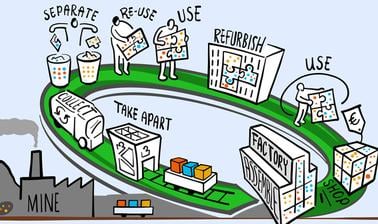
This second MOOC focuses on scientific and designerly ways of dealing with complexity. By developing a critical perspective on systems thinking, participants embody their practice of navigating in complexity by continuously zooming out and in as a view from above. A functional understanding of transformative resilience is complemented with an introduction to social network analysis. We learn about circularities and how to design for circularity, leading us to the final theme of how to innovate in complex systems - systemic innovation.
What you'll learn
This MOOC series is about creating positive impact on complex systems. It is about navigating complexity and uncertainty with new tools and practices, such as “organic emergence:” flexible ways to engage with unpredictable complexity based on tools and social trust, to cope with sudden challenges, and to reveal hidden opportunities. Extending your supportive social networks in your region and a global context is one significant benefit of this program.
In this second MOOC, “Beyond Systems Thinking,” you acquire a critical understanding of systems thinking and develop your toolset for dealing with complexity. You learn to embody “view from above” practices, a continuous zoom-in-zoom-out technique to navigate in complexity - physically and theoretically. You deepen a functional, transformative perspective on resilience and learn the basics of social network analysis, a powerful method to design in complexity. You extend the current notion of a circular economy to multiple types of circular flows and their applicability across spatial and governance scales. Finally, you explore different examples of systemic innovation and relate such illustrations with your own “Quest,” your endeavour, in your regional context.
Exciting real-world illustrations will take you to living systems labs in Hemsedal, Norway; Annecy, France; Ostana, Italy; and Mallorca, Spain. This offers a comparative understanding of communities and regions undergoing sustainability transitions across different contexts, cultures, climates, and geographies.
The MOOCs’ didactics are designed to combine time- and place-independent virtual learning through pre-recorded conversations, both accessible as movies and audio files, readings, and practical engagement in nature. Virtual content stimulates physical and social interaction in the participants' bio-region. Systemic Cycles takes us on a conscious exploration of place and circularities on a bicycle to playfully learn systemic design methods, weave together local and regional networks, and explore the inner self through physical activity. An accompanying visual mapping process called Gigamapping is a designerly way to co-create your learning journey and connect across the MOOC series to your final transformative design project. Your personal QUEST guides you through your learning journey. At the end of this course, you will be a better leader for transformative change towards regeneration.
Prerequisites:
You should:
- be curious to expand from your own expertise and life situation
- be open for new thinking, philosophical discourse, designerly practice, and real-world infusion
- be motivated to find your role in contributing to a more resilient and regenerative world
- be willing to enact within the region you live in, physically and actively connect with various stakeholders.
- be open to challenge yourself mentally, physically, socially.
The didactics of MOOC 2 are designed to be accessible to a very diverse audience for current science or engineering students in diverse disciplines, design students, architects, landscape planners, urban planners, and people of praxis, for those of us who have been working for many years and who want to re-connect, expand and re-direct. It is an asset and highly recommended to have taken MOOC 1, but we will provide a bridge to recap some of the essence of the first course to guide you along the trajectories of MOOC 2.