Upcycling and the Circular Economy: Ghanaian Creative Solutions to Global Textile Waste (FutureLearn)

Upcycling and the Circular Economy: Ghanaian Creative Solutions to Global Textile Waste (FutureLearn)

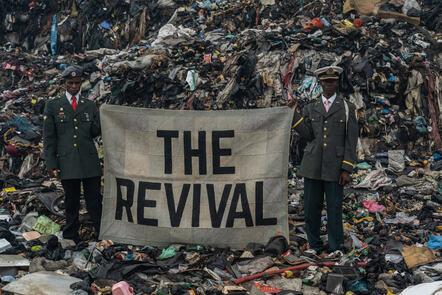
Explore the environmental impact of fast fashion in Ghana and discover localised solutions to a global issue. Learn to create collective change with Ghanaian creatives at THE REVIVAL. Almost three-quarters of all textile waste is incinerated or sent to landfill. On this two-week course, you’ll discover the global impact of fast fashion. You’ll explore how THE REVIVAL, a collective of Ghanaian creatives, are using artistic ingenuity to resolve textile waste challenges in their community and use this as inspiration to create your own localised solutions.

Class Deals by MOOC List - Click here and see FutureLearn's Active Discounts, Deals, and Promo Codes.

Investigate a global perspective of circular economy
In the UK alone, over a million tonnes of clothing ends up as waste.
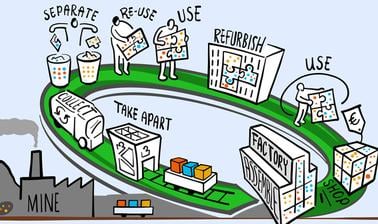
You’ll examine what happens to waste textiles and how a circular economy can transform fashion waste by generating jobs, reducing inequality, and minimising the environmental impact of the fashion industry.
Using real-world case studies to contextualise your learning, you’ll be able to develop your own approach to conscious fashion and take responsibility for your fashion choices.

Explore upcycling culture and develop creative upcycling ideas
You’ll learn practical tips for upcycling, discovering how community level actions impact global fashion consumption.
Sharing your ideas, you’ll engage with other learners, developing upcycling ideas and projects with an ethical purpose.

Develop an understanding of sustainable fashion using ethnographic research
The work of THE REVIVAL is extensively featured in the Eileen Fisher Foundation & Pentatonic Textile Waste Crisis report (launching 6th July).
You’ll learn about their ethnographic, creative approach to creating change and its wider implications for fashion sustainability and global textile waste.
By the end of this course, you’ll understand circular economies as a response to global textile waste. You’ll be equipped with the knowledge to develop a community of changemakers and inspired to upcycle fashion into one of a kind treasures.

Syllabus

Week 1: Who is a circular economy for?
Week 2: Upcycling for Transformation

What will you achieve?
By the end of the course, you‘ll be able to...

  • Apply contemporary visual arts and upcycling culture as a tool to shape popular consciousness and foster positive fashion action around the globe
  • Describe the cultural, economic and environmental impacts of fast fashion and foreign "fashion aid/textile donations" in Ghana
  • Explore how THE REVIVAL built a global, textile waste enterprise through organic, digital collaboration and trust
  • Living-the-data: introduction to concept of ‘ethnography’ and story-based research powered by communities, for communities

Who is the course for?
This course is designed for anyone with an interest in fashion and sustainability. It is particularly suited to creatives, professionals in the fashion industry, and environmental activists.

Go to Class
MOOC List is learner-supported. When you buy through links on our site, we may earn an affiliate commission.

Related Courses

Understanding Fashion: From Business to Culture (FutureLearn) FutureLearn
Institut Français de la mode - IFM

Understanding Fashion: From Business to Culture (FutureLearn)

From its impact on culture and society to consumer behaviour, discover the business of fashion with Institut Francais de la Mode. Study fashion and culture with fashion industry experts from Chanel and YSL. Over almost 150 years, the fashion industry has transformed many aspects of Western culture. On this course, you’ll explore the interaction of fashion, society and business with IFM professor, Benjamin Simmenauer.

May 16th 2022
4 Weeks
How to Build a Sustainable Fashion Business (FutureLearn) FutureLearn
Creative Skillset,Ethical Fashion Forum

How to Build a Sustainable Fashion Business (FutureLearn)

Learn from leading entrepreneurs what it takes to create a successful fashion business, with a social or environmental ethos. We’re the Ethical Fashion Forum, the global industry body for sustainable fashion. Since 2006, we’ve been helping fashion professionals achieve commercial success, while maximising benefits to communities and minimising negative environmental impacts.

No sessions available
5-12 Weeks
A Circular Economy of Metals: Towards a Sustainable Societal Metabolism (Coursera) Coursera
Leiden University

A Circular Economy of Metals: Towards a Sustainable Societal Metabolism (Coursera)

Metals are present everywhere around us and are one of the major materials upon which our economies are built. Economic development is deeply coupled with the use of metals. During the 20th century the variety of metal applications in society grew rapidly. In addition to mass applications such as steel in buildings and aluminium in planes, more and more different metals are in use for innovative technologies such as the use of the specialty metal indium in LCD screens. A lot of metals will be needed in the future. It will not be easy to provide them. In particular in emerging economies, but also in industrialized countries, the demand for metals is increasing rapidly. Mining and production activities expand, and with that also the environmental consequences of metal production. In this course, we will explore those consequences and we will also explore options to move towards a more sustainable system of metals production and use.

Sep 7th 2026
5-12 Weeks
Circular Economy for a Sustainable Built Environment (edX) EdX
Delft University of Technology,DelftX

Circular Economy for a Sustainable Built Environment (edX)

Learn how the principles of the Circular Economy can be applied to the built environment ranging from products and buildings to metropolitan and regional development strategies. In this course you will become familiar with circularity as a systemic, multi-disciplinary approach, concerned with the different scale, from material to product, building, city, and region.

Self Paced
Self-Paced
Assessing Cultural Climate (Coursera) Coursera
Rice University

Assessing Cultural Climate (Coursera)

Assessment is an integral part of any strategic effort. This course provides a familiarization of assessment practices and provides learners with various traditional and nontraditional methods of measurement to assist in making informed improvements to their DE&I initiatives. You will also expand your knowledge in creating bias-free and inclusive evaluation tools with special emphasis placed on assessing organizational climate and culture.

Aug 31st 2026
5-12 Weeks
Engineering Design for a Circular Economy (edX) EdX
Delft University of Technology,DelftX

Engineering Design for a Circular Economy (edX)

Discover and develop sustainable design and engineering methods to improve the reuse, repair, remanufacturing, and recycling of products for a circular economy. Products and equipment all around us are made of materials: look around you and you will see phones, computers, cars, and buildings. We face challenges in securing the supply of materials and the impact this has on the planet. Innovative product design can help us find solutions to these challenges. This course will explore new ways of designing products.

Self Paced
Self-Paced
Fashion Values: Cultures (FutureLearn) FutureLearn
London College of Fashion

Fashion Values: Cultures (FutureLearn)

Use storytelling to contribute to equitable, inclusive and diverse cultures in and through fashion. Reimagine fashion as a powerful medium to explore and amplify cultures. On this four-week course from London College of Fashion, you’ll learn how to find and tell stories of the ingenuity and creativity of fashion in its many cultural forms.

Dec 5th 2022
4 Weeks
Waste Management and Critical Raw Materials (edX) EdX
Delft University of Technology,DelftX

Waste Management and Critical Raw Materials (edX)

Learn about waste management and its key role in saving critical raw materials. Gain practical knowledge of the circular economy, recycling, refurbishment, and remanufacturing as a means of identifying new business opportunities. How can we ensure the continuous supply of the increasingly scarce raw materials that are needed to make the products we use every day? In this course, we will look at the potential benefits of circular procurement and how recycling technologies and more efficient ways of collecting and recycling critical raw materials (CRMs) can make your business and production more resource resilient.

Self Paced
Self-Paced
Economía Circular en los procesos logísticos (edX) EdX
LOGYCAX,LOGYCA

Economía Circular en los procesos logísticos (edX)

La economía circular es una alternativa que busca redefinir el crecimiento organizacional, con énfasis en los beneficios para toda la sociedad. Esto implica separar la actividad económica del consumo de recursos finitos y eliminar los residuos del sistema desde el diseño. Existen diferentes modelos que nos enseñan a utilizar este concepto, pero en este curso podrá encontrar como aplicar estos modelos en procesos logísticos de la mano de las empresas y expertos que lo han investigado.

Self Paced
Self-Paced
Working for a sustainable future: concepts and approaches (Coursera) Coursera
Lund University

Working for a sustainable future: concepts and approaches (Coursera)

In this course, participants are introduced to key notions and concepts evolving in sustainability science that are relevant to all, independent to one's work or field of interest. After having completed the course, participants will have a better understanding of the vocabulary used today and should demonstrate the ability to reflect critically to integrate different perspectives of environmental, social, and economic sustainability to their specific area of interest or research.

Sep 7th 2026
5-12 Weeks
Circular Economy: An Introduction (edX) EdX
Delft University of Technology,DelftX

Circular Economy: An Introduction (edX)

Ready to make a difference? Learn how to contribute to a sustainable economic system by implementing novel business and design approaches! Our global society is not sustainable. We all know about the challenges we’re facing: waste, climate change, resource scarcity, loss of biodiversity. At the same time, we want to sustain our economies and offer opportunities for a growing world population. This course is about providing solutions we really believe in: a Circular Economy.

Self Paced
Self-Paced
Fashion Values: Society (FutureLearn) FutureLearn
London College of Fashion

Fashion Values: Society (FutureLearn)

Examine the relationship between fashion and society, using fashion activism to challenge social injustice. Understand the links between fashion and society through a range of perspectives. Fashion and society are deeply intertwined through everyday actions, behaviours and business models, and can be both empowering and exploitative.

Mar 28th 2022
4 Weeks