EdX

Changing Minds: Geographic Discoveries and New Worlds through the Eyes of a Renaissance Jewish Scholar (edX)

Changing Minds: Geographic Discoveries and New Worlds through the Eyes of a Renaissance Jewish Scholar (edX)

This course will situate a manuscript in the context of the world from which it was produced so that we better understand both. The Italian Renaissance was a time of scientific discovery and artistic revolution, it was also a time of world exploration, religious ferment, and technological changes such as the broad dissemination of print. By understanding a single thinker, Jewish polymath Abraham ben Mordecai Farissol, and one of his most important manuscripts, Iggeret Orhot ‘Olam , in context, this course will offer a fresh.

Class Deals by MOOC List - Click here and see EdX's Active Discounts, Deals, and Promo Codes.

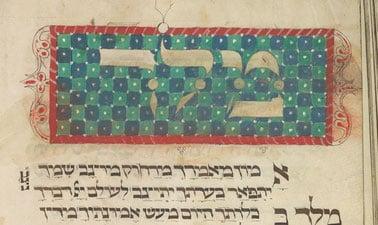
This course will explore the world of the Jewish renaissance scholar Abraham ben Mordecai Fairissol and his manuscript A Letter on the Paths of the World ( Iggeret Orhot ‘Olam )— Farissol, a product of the northern Italian Renaissance, wrote this geographical treatise about a world seen anew through advances in science, exploration, and trade. The manuscript gives us insight into the place of Jews in the northern Italian Renaissance and demonstrates the ways they were at once deeply embedded in the changing intellectual landscape of the day, but also striving to assert distinctive Jewish belonging in this vibrant intellectual world. Among other things, this text is the first mention in Hebrew of the discovery of the Americas.

What you'll learn

  • You will learn about Abraham Farissol and his text A Letter on the Paths of the World ( Iggeret Orhot ‘Olam )
  • You will get a sense for the political, social, intellectual and urban environment of Ferrara during the Renaissance, and the place of Jews in that environment.
  • The impact of new science on traditional religious thought

Syllabus

  1. Abraham Farissol and His Ferraran Environment
  2. Illuminating Nature
  3. Travel, Humanist Education, and the New Meaning of Geography
  4. What are the Aims and Content of the Iggeret Orhot ‘Olam?
  5. The Main Sources of Iggeret Orhot ‘Olam
  6. How Was the Work Circulated? Who Was Interested? And Who Was the Copyist of the Schoenberg Manuscript? The Evidence from the Manuscript Itself
Go to Class
MOOC List is learner-supported. When you buy through links on our site, we may earn an affiliate commission.

Related Courses

The Holocaust - An Introduction (II): The Final Solution (Coursera) Coursera
Tel Aviv University,Yad Vashem

The Holocaust - An Introduction (II): The Final Solution (Coursera)

The Holocaust was an inconceivable historical event, which forever robbed Western culture of its innocence. As civilized human beings, we fail to understand how events of such horror could have taken place, and how an idea so inhumanly warped could have spread like wildfire through an entire continent, instigating the systematic annihilation of millions of Jews.

Nov 2nd 2026
3 Weeks
Israel State and Society  (Coursera) Coursera
Hebrew University of Jerusalem

Israel State and Society (Coursera)

Israel is a country that draws a lot of public attention around the globe. Nevertheless, both those who support Israel and those who are critical of its geopolitical standing and policies, usually have a very limited knowledge about the Israeli society and its political system. This course presents Israel from multiple perspectives - political, social, economic and cultural - in an attempt to expose the learners to a cutting edge academic research on the country.

Oct 19th 2026
13-24 Weeks
The Medieval Icelandic Sagas (edX) EdX
University of Iceland,UIcelandX

The Medieval Icelandic Sagas (edX)

Learn about the Icelandic Sagas, the characteristic literary genre of Medieval Iceland comprising roughly 40 texts. The Medieval Icelandic Sagas is an introductory course on the single most characteristic literary genre of Medieval Iceland. Mainly written in the 13th century, the Icelandic Sagas are comprised of roughly 40 texts of varying length.

Self Paced
Self-Paced
First Nights: Monteverdi’s L’Orfeo and the Birth of Opera (edX) EdX
HarvardX,Harvard University

First Nights: Monteverdi’s L’Orfeo and the Birth of Opera (edX)

Learn about Claudio Monteverdi’s L’Orfeo, one of the first operas ever written. Claudio Monteverdi’s L’Orfeo premiered in Mantua in 1607, and continues to be regarded as one of the most important examples of early opera. With L’Orfeo, Monteverdi helped to establish the techniques and traditions that continue to inform the genre of opera to this day.

Self Paced
Self-Paced
The Qur'an Between Judaism and Christianity (FutureLearn) FutureLearn
The University of Nottingham

The Qur'an Between Judaism and Christianity (FutureLearn)

Get an introduction to the history of the Qur'an, and its relationship with Judaism and Christianity. Explore the relationship between the Qur'an, Judaism and Christianity. This online course will illustrate how the Qur’an situates itself as part of, and as a correction to, the religious discourse of the Jewish and Christian communities of Late Antique Arabia.

Jan 10th 2022
4 Weeks
Early Modern Scottish Palaeography: Reading Scotland's Records (FutureLearn) FutureLearn
University of Glasgow

Early Modern Scottish Palaeography: Reading Scotland's Records (FutureLearn)

Travel back in time through Scottish history by examining early modern Scottish handwriting. Explore Scottish history and learn more about using historical sources. Palaeography is the study of ancient handwriting and a vital skill in the historian’s toolkit. It is essential when conducting research on early modern Scotland – a period of profound political, religious and social change the effects of which can still be felt today.

Self Paced
3 Weeks
Writing and Editing: Polishing a Manuscript | Learn with Wattpad (Skillshare) Skillshare
Skillshare

Writing and Editing: Polishing a Manuscript | Learn with Wattpad (Skillshare)

Join one of Wattpad's most successful writers Ali Novak for a fun, straightforward class on editing and revising your writing. While writing a draft is a feat in itself, revising and editing your work is when your story takes shape and the real writing begins! In this 25-minute class, Ali walks through the process of polishing a manuscript for publication.

Self Paced
Self-Paced
Invasions, Rebellions, and the Fall of Imperial China (edX) EdX
HarvardX,Harvard University

Invasions, Rebellions, and the Fall of Imperial China (edX)

An overview of modern Chinese history, including the fall of the Qing and the end of imperial China. In the 18th century, the Qing Dynasty is at its height; it is the wealthiest, most powerful, most civilized state on earth. And yet the 19th century brought enormous challenges for the Qing and for the place we call China. By the 20th century, a 2,000-year imperial tradition is gone. What happened?

Self Paced
Self-Paced
Shakespeare's The Merchant of Venice: Shylock (edX) EdX
HarvardX,Harvard University

Shakespeare's The Merchant of Venice: Shylock (edX)

An exploration of the magnetic and ambivalent character of Shylock in William Shakespeare’s The Merchant of Venice. In the first act of William Shakespeare’s The Merchant of Venice , the Jewish moneylender Shylock proposes a “merry sport” to the merchant Antonio: he will lend Antonio the money he needs if Antonio agrees to let Shylock take a pound of his flesh should he default. Shylock calls this contract a “merry bond,” and Shakespeare’s First Folio calls the play a comedy. But what does Shylock want from the bond, and how merry does the play ultimately prove?

Self Paced
Self-Paced
Christianity Through Its Scriptures (edX) EdX
HarvardX,Harvard University

Christianity Through Its Scriptures (edX)

Learn about Christianity through a study of its sacred scriptures. We will explore how diverse Christians have interpreted these writings and practiced their teachings over a 2000 year, global history. Christianity is a global religion. From modest beginnings 2,000 years ago, it has grown to encompass nearly a third of the human population. Diverse in languages, cultures, histories and creeds, Christians nonetheless share a common collection of sacred scripture called the Bible.

Self Paced
Self-Paced