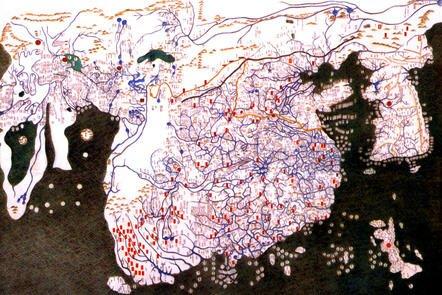
Lips and Teeth: Korea and China in Modern Times (FutureLearn)

Offered by Yonsei University,
Lips and Teeth: Korea and China in Modern Times (FutureLearn)

Explore the historical evolution of China and the Korean Peninsula and discover the implications for today.

Class Deals by MOOC List - Click here and see FutureLearn's Active Discounts, Deals, and Promo Codes.

As countries across Asia - and the globe - wrestle with the impact of China’s rise, nowhere are the opportunities and threats of a wealthy and powerful China felt more keenly than next door, on the Korean Peninsula.
Understanding the history and current reality behind Sino-Korean relations - countries long-described as being as close yet as different as “lips and teeth” - opens up a window onto perhaps the key geopolitical transformation of the present age.
This free online course from Yonsei University in Seoul will cover lot of ground chronologically, focussing on watershed moments that include: the Imjin War (1592-1598); the First Sino-Japanese War (1894-1895); the Korean War (1950-1953); and the end of the Cold War (1991).
We will then turn our historical gaze to the present, focusing on the current leaders of China, and North and South Korea. We will look at the ways in which the extraordinary family histories of Xi Jinping, Kim Jong-un and Park Geun-hye embody the complex relationship between lips and teeth.
Painting on a broad historical canvas, we will learn why Chinese and Koreans have insisted on remaining as close as “lips and teeth,” and yet how difficult that ideal is to achieve in reality.
The educator for this course is John Delury, Professor of Chinese history and Sino-Korean relations at Yonsei University, and co-author of the acclaimed book, “Wealth & Power: China’s Long March to the 21st Century.”
Go to Class
MOOC List is learner-supported. When you buy through links on our site, we may earn an affiliate commission.

Related Courses

中國人文經典導讀 (Coursera) Coursera
The Chinese University of Hong Kong

中國人文經典導讀 (Coursera)

本課程對象為對中國文化有興趣的同學。 課程目的為通過四個不同特色的主題,討論中國文化的四個主要面向。每個主題選取兩篇經典文本作為核心閱讀,並與延伸閱讀做互文探討,以新角度解讀經典文本的意義,展現中國文化的複雜性、多元性。文本難度與大學一年級國文程度相當。

Aug 24th 2026
5-12 Weeks
The amazing world of the ethnic groups of Yunnan Province (Coursera) Coursera
Shanghai Jiao Tong University

The amazing world of the ethnic groups of Yunnan Province (Coursera)

Yunnan, abbreviated as Yun and called Dian for short, is a multi-ethnic province which has historically been situated in the southwest frontier of China. Over time, the ethnic minorities evolved into splendid cultures, each with their own unique social life, religious beliefs and customs. The course is taught in English and provides an introduction to 25 ethnic minorities in Yunnan Province, namely the Yi, Bai, Hani, Dai, Zhuang, Miao, Hui, Lisu, Lahu, Wa, Naxi, Yao, Jingpo, Tibetan, Bulang, Buyi, Achang, Pumi, Mongolian, Nu, Jinuo, De'ang, Shui, Man and Dulong nationalities.

Sep 7th 2026
5-12 Weeks
Cosmopolitan Tang: Aristocratic Culture in China (edX) EdX
HarvardX,Harvard University

Cosmopolitan Tang: Aristocratic Culture in China (edX)

Explore the reunification of China under the Tang with a focus on aristocratic culture — from poetry to calligraphy to literature. By the Tang period, China was divided into northern and southern dynasties with different rulers and political systems. The north was conquered by relatively unsophisticated barbarians, but in the south, the aristocratic families established a refined appreciation of writing and literature.

Self Paced
Self-Paced
China’s First Empires and the Rise of Buddhism (edX) EdX
HarvardX,Harvard University

China’s First Empires and the Rise of Buddhism (edX)

Learn about the Qin and Han dynasties, and how Buddhism and ideas of self-realization influenced the medieval period. This course, the second in a collection on Chinese history and culture, addresses how the Qin dynasty conquered China and established a new system of government and how the Han dynasty built a stable, centralized empire that lasted for hundreds of years. We cover the early history of Buddhism in China and how the rising feudal aristocracy responded to the loss of empire by looking inward.

Self Paced
Self-Paced
Many Faces: Understanding the Complexities of Chinese Culture (FutureLearn) FutureLearn
University of Exeter

Many Faces: Understanding the Complexities of Chinese Culture (FutureLearn)

Develop a clearer understanding of modern China by exploring the role of art, literature and the 'noble hero' in Chinese culture. Look beyond the clichés and stereotypes of art and literature in Chinese culture. Chinese culture has not been explored in as much depth as Chinese history and politics. By uncovering the richness and diversity of Chinese culture, you can gain a broader understanding of modern China as a whole.

Available Now
4 Weeks
Sino-Japanese Interactions Through Rare Books (FutureLearn) FutureLearn
Keio University

Sino-Japanese Interactions Through Rare Books (FutureLearn)

Learn about the role of books in the relationship between the cultures of Japan and China, with this free online course. Books have played a major role in the formation of Japan’s culture, particularly those brought from China. On this course we’ll examine how big an impact these books have had, as well as looking at how books and religion are connected in Japan and East Asia, and the history of publishing in Japan.

Self Paced
3 Weeks
In Search for the Origins of Korean Philosophy (Coursera) Coursera
Sungkyunkwan University - SKKU

In Search for the Origins of Korean Philosophy (Coursera)

This course will give you an insight into the formative years of “Korean” culture and thought and uncover together who were the earliest people we could describe as being “Korean.” Korea is unique, but not of a single origin. Through this course, you will rediscover “Korea” today as a unique linguistic-cultural continuum. And from this, you may gain a deeper understanding of yourself by acknowledging the various factors that have influenced you to form your mature identity.

Sep 7th 2026
5-12 Weeks