The Limits of Human Perception (Coursera)

The Limits of Human Perception (Coursera)

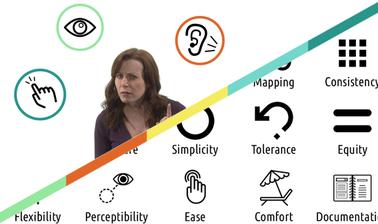
Course 3 explores the perceptual capacities and limitations of humans and computers. It discusses various types of visual, auditory, and tactile displays and how they can be used to create effective interfaces.

Class Deals by MOOC List - Click here and see Coursera's Active Discounts, Deals, and Promo Codes.

This course is part of the Human Factors & Usability Engineering: Designing for Humans Specialization.

What you'll learn
You will be able to compare and contrast different types of perceptual displays and understand the trade-offs in designing effective interfaces.

Syllabus

Course Introduction
In Course 3, we will focus on perceptual capacities and limitations. You will explore the basic functions of vision, including static and dynamic visual acuity, depth perception, peripheral vision, and stereoacuity. Additionally, you will compare and contrast different types of visual displays to understand their impact on user experience. The course will also cover the fundamental functions of the human auditory and somatosensory systems, providing insights into how we perceive sound and touch. You will examine various types of auditory and tactile displays and their implications for designing effective interfaces.

Module 1: Human Vision
Understanding how human vision works is crucial in designing effective user interfaces and optimizing user experiences. In this module, we will also examine important aspects of vision such as acuity, brightness, color, and glare. Furthermore, we will study the role of eye movements in visual perception, as well as depth perception and motion processing.

Module 2: Visual Displays
Module 2 of this course explores the principles and considerations involved in designing effective visual displays. It delves into the concepts of object perception, visual design principles, and the role of affordances in design.

Module 3: The Human Auditory System
Module 3 focuses on the topic of the human auditory system. It explores the anatomy and functions of the auditory system, the properties of sound waves, and the perception of complex sounds. Additionally, it delves into the sense of touch, the receptors involved, and the perception of different tactile qualities.

Module 4: Auditory and Tactile Displays
Module 4 of this course explores the importance and applications of using modalities other than vision in interface design. It delves into the benefits of auditory and tactile displays and how they can enhance user experience and safety.

Go to Class
MOOC List is learner-supported. When you buy through links on our site, we may earn an affiliate commission.

Related Courses

Human-Centered Design for Work at a Distance: Prototype Solutions (edX) EdX
The University of British Columbia,UBCx

Human-Centered Design for Work at a Distance: Prototype Solutions (edX)

Draw from human-centered design tools learned in Human-Centered Design for Work at a Distance: Toolbox Essentials to identify and solve real-world case studies for individuals reinventing their work at a distance. This course builds on the teachings in Human-Centered Design for Work at a Distance: Toolbox Essentials. It must be completed before enrolling in this course.

Self Paced
Self-Paced
Build Better Products with a Human-Centered Product Backlog (openSAP) OpenSAP
SAP

Build Better Products with a Human-Centered Product Backlog (openSAP)

Join this free online course to learn how to build better products by balancing human needs, business values, and technical feasibilities with a human-centered product backlog. The world is becoming more complex and digital transformation is radically changing people’s lives. This in turn leads to rising expectations for products and services that are expected to help users get their job done – both at work and in their private lives. Hence, product organizations have to change the way they build products.

Jun 21st 2022
4 Weeks
Mobile Application Experiences Part 2: Mobile App Design (edX) EdX
MIT,MITx

Mobile Application Experiences Part 2: Mobile App Design (edX)

Learn to create your own mobile app using methods from Mobile Human Computer Interaction (HCI). Transform your mobile app idea into a usable, tested product design. Want to create the next big app, grounded in the needs of real users? This course will teach you Human Computer Interaction (HCI) methods to better understand current behavior in a domain, and then design, develop, and deploy your own application.

No sessions available
4 Weeks
Usable Security (Coursera) Coursera
University of Maryland, College Park

Usable Security (Coursera)

This course focuses on how to design and build secure systems with a human-centric focus. We will look at basic principles of human-computer interaction, and apply these insights to the design of secure systems with the goal of developing security measures that respect human performance and their goals within a system.

May 18th 2026
5-12 Weeks
Mobile Design and Usability for iOS (Udacity) Udacity
Udacity,Facebook

Mobile Design and Usability for iOS (Udacity)

Learn how to design an intuitive, user-centered mobile app. Featuring Facebook's experts in User Research and Product Design, this course walks you through the steps to design a new mobile product that puts users first. You'll learn how to use data collected from users to guide prototyping, and conduct user testing with a production app to guide a future redesign.

Self Paced
Self-Paced
Advanced Neurobiology II (Coursera) Coursera
Peking University

Advanced Neurobiology II (Coursera)

Hello everyone! Welcome to advanced neurobiology! Neuroscience is a wonderful branch of science on how our brain perceives the external world, how our brain thinks, how our brain responds to the outside of the world, and how during disease or aging the neuronal connections deteriorate. We’re trying to understand the molecular, cellular nature and the circuitry arrangement of how nervous system works.

May 18th 2026
5-12 Weeks
Human-Computer Interaction (Udacity) Udacity
Georgia Institute of Technology,Udacity

Human-Computer Interaction (Udacity)

This course is an introductory course on human-computer interaction, covering the principles, techniques, and open areas of development in HCI. The class covers three broad categories of topics within human-computer interaction: (a) the principles and characteristics of the interaction between humans and computers; (b) the techniques for designing and evaluating user-centered systems; and (c) current areas of cutting-edge research and development in human-computer interaction.

Self Paced
Self-Paced
eHealth: Combining Psychology, Technology and Health (FutureLearn) FutureLearn
University of Twente

eHealth: Combining Psychology, Technology and Health (FutureLearn)

How can technology make you healthy? Learn about the design, application, implementation and evaluation of eHealth. eHealth refers to the use of technologies to improve well-being, health, and healthcare. It is an umbrella term that captures concepts about the health context, technology, and people. In this free online course, we will provide you with insight into the domain of eHealth, describe methods to develop eHealth, and explain theories that enable behaviour change and facilitate implementation.

Available now
5-12 Weeks