EdX

Human-Computer Interaction III: Ethics, Needfinding & Prototyping (edX)

Human-Computer Interaction III: Ethics, Needfinding & Prototyping (edX)

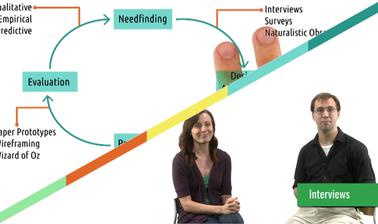
Build on your knowledge of HCI’s core principles by learning to design interfaces in the real world. Begin with the ethics of human subjects research, then learn critical methods for requirements gathering and brainstorming design alternatives. In this course, you’ll begin by learning the design life cycle. This is the process by which we investigate user needs, brainstorm potential designs, create prototypes, and evaluate those prototypes. This life cycle provides the structure for the third and fourth courses in this professional certificate.

Class Deals by MOOC List - Click here and see EdX's Active Discounts, Deals, and Promo Codes.

A key part of the design life cycle, however, is human subjects research. In interface design, this involves asking users for information about what they do and what they need, and then asking them for feedback on the prototypes that you develop. In HCI more broadly, this may involve testing different ideas with users to see what facilitates the best user experience. Whenever we interact with users, though, we need to keep in mind users’ rights to privacy and transparency, and so we begin this course with a discussion of ethics in HCI. This is grounded in the university Institutional Review Board process, but also investigates the role of ethics in HCI in industry as well.
From there, you’ll move on to needfinding and requirements gathering. It is always tempting to jump straight into designing an interface based on our intuitive understanding of a task or need, but successful interface design always starts with an understanding of the users: who are they, what they do, and what they need. This involves both interacting directly with them via surveys and interviews, as well as observing them at a distance or even attempting the tasks ourselves. This concludes with an understanding of the requirements of any interface we create.
From there, you’ll move on to brainstorming design alternatives. Again, it is often tempting to jump straight to the design we have in mind, but successful interface design starts with the results of needfinding and attempts a more grounded investigation of possible solutions. Through this lesson, you’ll learn techniques for managing effective brainstorming sessions and approaches to exploring the ideas that are created including artifacts like user personas, interaction timelines, and storyboards.
Finally, you’ll conclude by learning about prototyping. Implementing an interface is a complicated process, and there is a risk that we may invest lots of time into an interface that is doomed to fail because we do not get user feedback on the idea. The goal of prototyping is to get an idea in front of users as quickly as possible to validate and improve it before we move on to the high pressures of implementation.
By the end of this course, you’ll have an understanding of the design life cycle and its first three major stages: needfinding, brainstorming, and prototyping. You’ll also understand the ethical implications of HCI research and how to safeguard users’ rights.
This course is part of the Human-Computer Interaction Professional Certificate.

What you'll learn

  • The structure of the design life cycle: needfinding, brainstorming, prototyping, and evaluation.
  • The value of research ethics and the importance of emphasizing the user’s rights.
  • The role of Institutional Review Boards in governing university research.
  • The importance of ethics in industry and the mechanisms for ensuring they are maintained.
  • The importance of needfinding in the design life cycle.
  • Mechanisms for active needfinding, including surveys, interviews, and focus groups.
  • Approaches to personal needfinding, including participant observation and apprenticeship.
  • Ways to observe organic interaction, such as naturalistic observation or investigation of hacks and workarounds.
  • The data inventory, a structure for ensuring you understand your user and their problems.
  • Approaches to brainstorming design ideas, both individually and in groups.
  • Methods for further exploring design ideas, such as user personas and storyboards.
  • The spectrum of prototyping, from low-fidelity to high-fidelity.
  • The importance of low-fidelity prototypes in getting early feedback.
  • Approaches to low-fidelity prototyping, such as paper prototypes and Wizard of Oz.
  • Multi-level prototyping, or prototyping at variouslevels of abstraction.
Go to Class
MOOC List is learner-supported. When you buy through links on our site, we may earn an affiliate commission.

Related Courses

Responsible Innovation: Ethics, Safety and Technology (edX) EdX
Delft University of Technology,DelftX

Responsible Innovation: Ethics, Safety and Technology (edX)

How to deal with risks and ethical questions raised by development of new technologies. There is no doubt that technological innovation is one of the key elements driving human progress. However, new technologies also raise ethical questions, have serious implications for society and the environment and pose new risks, often unknown and unknowable before the new technologies reach maturity.

This course is archived
5-12 Weeks
Historia de la ética (edX) EdX
Universidad Carlos III de Madrid - UC3M,UC3Mx

Historia de la ética (edX)

Una mirada hacia el pasado de la ética para poder afrontar mejor los problemas del futuro. Una visión crítica de la ética y la moral sin olvidar el sentido del humor. Cada día debemos afrontar diferentes problemas éticos a los que no tenemos claro qué respuesta dar como sociedad. Es importante conocer la definición de la ética y la moral para poder afrontar estos problemas. Este curso de filosofía y ética nos permitirá hacer un repaso por el origen de la ética, este es un ejercicio muy útil para poder replantear nuestros problemas éticos actuales y comprender mejor las implicaciones de nuestras decisiones basados en la ética y la moral.

Self Paced
Self-Paced
Ergonomics in Design (edX) EdX
The Hong Kong University of Science and Technology - HKUST,HKUSTx

Ergonomics in Design (edX)

The course is designed to provide a basic understanding of ergonomics in design through the introduction of human anatomy, anthropometry, and modeling techniques with the aim of improving safety, productivity, comfort and health of people. Ergonomics is the application of scientific information about people in order to design products and systems so that they are safe, productive, comfortable and healthy for people to use.

Self Paced
Self-Paced
Global Health: Ebola, COVID, and Beyond (edX) EdX
University System of Maryland - USM,USMx,University of Maryland, Baltimore,University of Maryland Global Campus - UMGC,UMB,UMGC

Global Health: Ebola, COVID, and Beyond (edX)

Become part of the global health community and prepare yourself to join teams providing care. This introductory course, first delivered in September 2016, explores how multidisciplinary teams can work more effectively together to address global health needs. Whether you seek a career in international health or medicine, volunteer to serve those less fortunate, or work in an institutional setting such as a clinic, hospital, or public health agency, it is important to understand the sources and movement of diseases.

No sessions available
5-12 Weeks
Ethical Decision-Making: Labor and Production Dilemmas (edX) EdX
Georgetown University,GeorgetownX

Ethical Decision-Making: Labor and Production Dilemmas (edX)

Labor and production standards, meant to ensure the safety of workers and consumers, are neither universally accepted nor always enforced. Where local governments fail to act, global corporations may receive pressure to step in. In this course, you will consider ethical questions about the role of international businesses in preventing harm abroad.

No sessions available
5-12 Weeks
The Ethics of Memory (edX) EdX
Brown University

The Ethics of Memory (edX)

Learn how our personal and collective memories evolve over time, and why memory and memorializing matter. What is memory? What’s the utility in exploring it and risking the activation of painful memories? What remembrance do we owe people we have lost and how is that reflected in the monuments we create to memorialize them? Why do different groups of people interpret the same event differently—even when the facts are not disputed?

No sessions available
3 Weeks
Unreal Engine Interactive 3D: Sequencer-Cinematography, Interfaces, Visual Effects, Pipelines, and Production (edX) EdX
Rochester Institute of Technology,RITx

Unreal Engine Interactive 3D: Sequencer-Cinematography, Interfaces, Visual Effects, Pipelines, and Production (edX)

Learn techniques in cinematography, Interface design, visual effects, collaboration and organization, basic optimization and publishing, as well as exciting emerging connections. In this course, you will learn about the Unreal Sequencer as we focus on cinematography. We will set up cameras, lenses, track and jibs to frame shots and create cinematics. You will learn the Unreal Motion Graphics (UMG) for user interface design, and together we will build a Heads Up Display (HUD) as well as an “in-game” interface (useful for VR and AR).

Self Paced
Self-Paced
Navigating Legal & Commercial Aspects of Sports (edX) EdX
Hamad Bin Khalifa University - HBKU,HBKUx

Navigating Legal & Commercial Aspects of Sports (edX)

Leading academics in their respective fields will introduce you to the dynamic world of sports law and related business principles. You will develop an overall understanding of the key legal and commercial aspects of sports. You will gain useful insights into their application based on actual scenarios involving athletes and teams. You will test your learning by applying it to hypothetical problems involving sports.

Self Paced
Self-Paced
The Software Architect Code: Building the Digital World (edX) EdX
Universidad Carlos III de Madrid - UC3M,UC3Mx

The Software Architect Code: Building the Digital World (edX)

An introductory course aimed at helping you to discover and develop your software talents to succeed within the digital world. Enhance your software skills and capabilities from a software innovation perspective. Do you have a career in the software industry? Are you a founder of a technical startup or even a business executive willing to know what kind of qualified job applicants do you need to recruit? Or are you a software developer who want to unveil your skills in order to build innovative software products with added value? Join us for this 8-week course to find out.

Self Paced
Self-Paced