EdX

Human-Computer Interaction I: Fundamentals & Design Principles (edX)

Human-Computer Interaction I: Fundamentals & Design Principles (edX)

Learn the principles of Human-Computer Interaction to create intuitive, usable interfaces, with established design principles like feedback cycles, direct manipulation, affordances, signifiers, and more. This course takes you through the first eight lessons of CS6750: Human-Computer Interaction as taught in the Georgia Tech Online Master of Science in Computer Science program.

Class Deals by MOOC List - Click here and see EdX's Active Discounts, Deals, and Promo Codes.

In this course, you’ll take the first steps toward being a solid HCI practitioner and researcher. You’ll learn the fundamentals of how HCI relates to fields like user experience design, user interface design, human factors engineering, and psychology. You’ll also learn how human-computer interaction has influence across application domains like healthcare and education; technology development like virtual and augmented reality; and broader ideas like context-sensitive computing and information visualization.
You’ll then dive into the fundamentals of human-computer interaction. You’ll learn three views of the user’s role in interface design: the behaviorist ‘processor’ view, the cognitivist ‘predictor’ view, and the situationist ‘participant’ view. You’ll discover how these different views of the user’s role affect the scope we use to evaluate interaction. These perspectives will be crucial as you move forward in designing interfaces to ensure you’re considering what goes on inside the user’s head, as well as in the environment around them.
You’ll then learn the gulfs of execution and evaluation, which determine how easily the user can accomplish their goals in a system and how well they can understand the results of their actions. All of user interface design can be seen as taking steps to bridge these gulfs. You’ll also investigate the notion of direct manipulation, which shortens the distance between the user and the objects they are manipulating in the interface. With these tools, you’ll be well-equipped to start designing effective interfaces.
You’ll then take a deeper dive into what humans are even capable of accomplishing. You’ll learn the limitations of human sensing and memory and how we must be aware of the cognitive load we introduce on the user while using our interfaces. Cognitive load can have an enormous impact on a user’s satisfaction with an interface, and must be kept in mind as you begin your career as a designer.
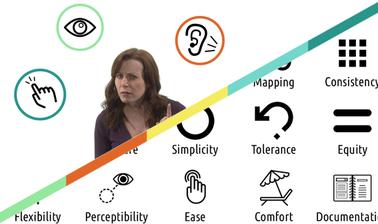
You’ll finally conclude with an overview of the major design principles in human-computer interaction. Curated from the work of Don Norman, Jakob Nielsen, Ronald Mace, Larry Constantine, and Lucy Lockwood, these design principles cover revolutionary ideas in the design of interfaces: discoverability, affordances, perceptibility, constraints, error tolerance, and more. These principles are crucial whether you move forward as a designer, an evaluator, a front-end engineer, or any other role in technology design.
By the end of the course, you’ll have an understanding of where HCI sits in the broader field, a grasp of the goals of HCI, and a foundation in core principles that inform interface design.
This course is part of the Human-Computer Interaction Professional Certificate.

What you'll learn

  • The overall goals of human-computer interaction.
  • The relationship between HCI, user experience design, human factors engineering, and psychology.
  • The relevance of HCI to domains like healthcare, education, and cybersecurity.
  • The trends in HCI technology including virtual reality, augmented reality, and robotics.
  • The emerging ideas in HCI research, such as context-sensitive computing, gesture-based interaction, and social computing.
  • The three main schools of thought in HCI: the processor, predictor, and participant views.
  • The feedback cycle in user interaction, including gulfs of execution and evaluation.
  • The notion of directness in interaction, and the role of direct manipulation.
  • The strengths and limitations of the human user, including sensation and memory.
  • The role of design principles and heuristics in user interface design.
  • The most important principles for design, including discoverability, affordances, perceptibility, and error tolerance.

Go to Class
MOOC List is learner-supported. When you buy through links on our site, we may earn an affiliate commission.

Related Courses

Human-Computer Interaction II: Cognition, Context & Culture (edX) EdX
Georgia Institute of Technology,GTx

Human-Computer Interaction II: Cognition, Context & Culture (edX)

Get into the user’s mind and understand the role of mental models and representations, then investigate how to design interfaces that integrate with and influence the world around us. This course takes you through lessons 9 through 13 of CS6750: Human-Computer Interaction as taught in the Georgia Tech Online Master of Science in Computer Science program.

Self Paced
Self-Paced
3D Interaction Design in Virtual Reality (Coursera) Coursera
University of London,Goldsmiths, University of London

3D Interaction Design in Virtual Reality (Coursera)

This course will teach you about one of the most important aspects of VR, how you interact with a VR world. Virtual Reality is completely different from an on screen app or game. You are completely immersed in a VR world, so it doesn't make sense to interact only through buttons or menus. You will get the most out of VR if you can interact with the world just as you would with the real world: with your natural body movements.

Jun 22nd 2026
4 Weeks
Foundations of User Experience (UX) Design (Coursera) Coursera
Google

Foundations of User Experience (UX) Design (Coursera)

Foundations of User Experience (UX) Design is the first of a series of seven courses that will equip you with the skills needed to apply to entry-level jobs in user experience design. UX designers focus on the interactions that people have with products like websites, mobile apps, and physical objects. UX designers make those everyday interactions usable, enjoyable, and accessible. The role of an entry-level UX designer might include empathizing with users, defining their pain points, coming up with ideas for design solutions, creating wireframes, prototypes, and mockups, and testing designs to get feedback.

Jun 25th 2026
4 Weeks
Design for Recycling of Electronics in a Circular Economy (edX) EdX
Delft University of Technology,DelftX

Design for Recycling of Electronics in a Circular Economy (edX)

Discover the latest developments in Design for Recycling (DfR) of electrical and electronic equipment (EEE) and the application of recycled plastics into new products. Electronic products bring countless benefits to society, but their production and waste treatment also lead to numerous negative environmental and economic impacts. Since E-waste is the world’s fastest growing waste stream, governments are setting ambitious targets to help this industry transition towards a circular economy.

Nov 10th 2021
4 Weeks
Field Operations and Administrative Tools in Construction Management (edX) EdX
University of Maryland, College Park,University System of Maryland - USM,USMx,UMD

Field Operations and Administrative Tools in Construction Management (edX)

Learn the Construction Management tools needed to manage the people and the project, including estimating and scheduling. These tools combined with methods of control will ensure effective feedback and create a powerful system for delivery on-schedule and under budget.

Self Paced
Self-Paced
Groundscape Architecture Lab. Carpark Futures (edX) EdX
École Polytechnique Fédérale de Lausanne,EPFLx

Groundscape Architecture Lab. Carpark Futures (edX)

Developing architectural and design knowledge for the urban underground. ‘Groundscape’ is a new word coined by architect Dominique Perrault to integrate underground spaces into architecture knowledge. The general focus of this course is to provide students with underground design strategies that respond to contemporary urban challenges. Indeed, The underground of cities has become one of the most innovative and radical terrains of experimentation for future urban development by providing much needed spaces capable of optimizing existing city centers, by making them more resilient, responsible, durable and beautiful.

Self Paced
Self-Paced
Stability and Design of Structural Members (edX) EdX
Purdue University,PurdueX

Stability and Design of Structural Members (edX)

Learn fundamental concepts of buckling analysis and design of structural members for stability concerns for beam and column elements. Buckling can be a controlling limit state for many structural elements. This course will cover the intersection of buckling and member design – specifically the behavior of columns and beam elements.

No sessions available
5-12 Weeks
Introducción al diseño de hardware con Verilog (edX) EdX
Galileo University,GalileoX

Introducción al diseño de hardware con Verilog (edX)

Aprende el lenguaje de descripción de hardware Verilog, utilizado en la industria en el diseño de hardware digital y microprocesadores a la medida. En la actualidad, el hardware de soporte en sistemas digitales se suele diseñar en un solo circuito integrado FPGA (Field Programmable Gate Array), en parte debido al abundante espacio físico que ocuparía una implementación con varios circuitos integrados dedicados para este fin.

Self Paced
Self-Paced
Parametric Designs in Revit (edX) EdX
RUDN University,RUDNx

Parametric Designs in Revit (edX)

You will get a systematic view of the course, learn the basics of parametric designs as a new tool for learning and transforming the world of architecture, the key to the success of modern architecture, demanded by managers who change their companies for the better. Together with practitioners and experts, you will explore the possibilities of innovational designs in architecture. This course represents the study and practical use of topics that are the fundamental basis of architecture.

Sef Paced
Self-Paced
Designing for Textiles (edX) EdX
Smithsonian,SmithsonianX

Designing for Textiles (edX)

The Designing for Textiles workshop provides those who work in traditional crafts-based media with an introduction, or refresher, to design education through the lens of Armenian textiles. Based on an in-person training program that took place in 2018 through the My Armenia program, this workshop is a series of lessons and extension activities that build upon one another and encourage you to innovate in your own textiles-based design work.

Self Paced
Self-Paced