Human-Centered Design: Building and Testing Prototypes (openHPI)

Human-Centered Design: Building and Testing Prototypes (openHPI)

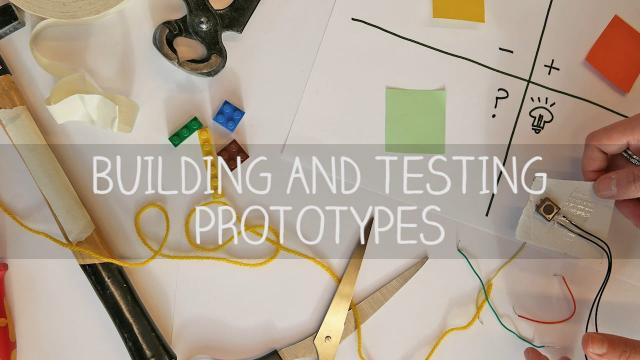
Learn to build simple but effective prototypes, prepare testing scenarios and gain valuable feedback from potential users. This course introduces you to the basics of prototyping, planning and running real testing scenarios.

This course introduces you to helpful skills for making an idea tangible and testing it with potential users. We take a task-based approach to build these skills. You will learn to take an idea to the next level and build a simple prototype, plan a testing scenario and collect feedback. This MOOC builds on the 2018 “From Synthesis to Creative Ideas” course, but you can also take it as a stand-alone MOOC. The assignments are designed for individual work.

Learning Objectives

  • build simple prototypes for user testing
  • plan and conduct user testings
  • cluster and analyze tester feedback
  • evaluate tester feedback
  • evaluate the quality of your peers' work and provide constructive feedback

Course Structure

WELCOME AND INTRODUCTION / Week 1
During the welcome week, you have the chance to introduce yourself and to discover the learning environment with a warm-up game.

PROTOTYPING / Week 2
In this week, we focus on prototypes: why and how do we build them? You will learn about going from an idea to a prototype, different types of prototypes, and prototyping techniques.

TESTING/ Week 3
In this week, we focus on the skill of conducting user tests with prototypes. You will learn to prepare a testing scenario, to structure tester feedback, and to filter aspects for iteration.

WRAP UP / Week 4 (and beyond)
During the wrap-up week, we provide a summary of the course content. We will discuss assignment results, showcase assignment examples, and describe the next steps in a design thinking project.


Go to Class
MOOC List is learner-supported. When you buy through links on our site, we may earn an affiliate commission.

Related Courses

Conduct UX Research and Test Early Concepts (Coursera) Coursera
Google

Conduct UX Research and Test Early Concepts (Coursera)

Conduct UX Research and Test Early Concepts is the fourth course in a certificate program that will equip you with the skills you need to apply to entry-level jobs in user experience (UX) design. In this course, you will learn how to plan and conduct a usability study to gather feedback about designs. Then, you will modify your low-fidelity designs based on insights from your research. Current UX designers and researchers at Google will serve as your instructors, and you will complete hands-on activities that simulate real-world UX design scenarios. Learners who complete the seven courses in this certificate program should be equipped to apply for entry-level jobs as UX designers.

Nov 2nd 2026
4 Weeks
Design Thinking: Prototyping and User Testing (edX) EdX
Rochester Institute of Technology,RITx

Design Thinking: Prototyping and User Testing (edX)

Learn the importance of prototyping and user testing solutions before going to market and how to assess and evaluate solutions post-launch. Creating prototypes puts a proposed solution into action. In this course, you will learn the value of prototypes and user testing as critical components of the design thinking process.

Self Paced
Self-Paced
UX (User Experience) Capstone (Coursera) Coursera
University of Michigan

UX (User Experience) Capstone (Coursera)

In this UX capstone course, you’ll conduct a multi-stage user experience project to design a product from scratch. You will employ interviews, inspection methods, and user testing, along with ideation, design, and prototyping methods to gain and communicate valuable insight that can be used to deliver a compelling product.

Nov 9th 2026
5-12 Weeks
Creative Design, Prototyping, and Testing (Coursera) Coursera
University of Maryland, College Park

Creative Design, Prototyping, and Testing (Coursera)

Designing the customer and user experience is essential to creating great products today. Gone is the old paradigm of “form follows function” model of design. The process must be iterative and follow the best product design and development processes. While designing a great user experience can be a lengthy and expensive process, there are approaches to doing it faster and smarter, without compromising results.

Nov 2nd 2026
4 Weeks
Design-Led Strategy: Design thinking for business strategy and entrepreneurship (Coursera) Coursera
The University of Sydney

Design-Led Strategy: Design thinking for business strategy and entrepreneurship (Coursera)

This course is for entrepreneurial managers who are looking for tools and techniques to introduce exciting, innovative products or services to market quickly and informed by high-quality customer insights. It is applicable to a range of organizations from small-medium sized enterprises through to corporates, and across a range of industrial segments.

Nov 23rd 2026
5-12 Weeks
Adding Electronics to Rapid Prototypes (Coursera) Coursera
Arizona State University

Adding Electronics to Rapid Prototypes (Coursera)

Hello, everyone! Welcome to this course on Adding Electronics to Rapid Prototypes. This is part of the Rapid Prototyping and Tooling specialization. In this course, I’ll cover the basics of electric circuits, breadboards, and multimeters. I’ll then discuss different options for connecting electrical components as well as discuss different types of motors and actuators. Finally, I’ll end this course by discussing microcontrollers and how to use them to make even more sophisticated prototypes.

Nov 9th 2026
5-12 Weeks
User Experience & Interaction Design for AR/VR/MR/XR (Coursera) Coursera
University of Michigan

User Experience & Interaction Design for AR/VR/MR/XR (Coursera)

This second course in the XR for Everybody specialization looks at how to design new user experiences for XR technologies. The course provides learners with a design thinking mindset and equips them with a fundamental toolbox for creating XR applications using rapid prototyping. It starts with a broad overview of the complete XR design process, discussing different paths to becoming an XR creator, what is generally involved in making XR experiences, and how to best get started.

Nov 9th 2026
4 Weeks
Leadership Through Design Innovation (Coursera) Coursera
Northwestern University

Leadership Through Design Innovation (Coursera)

Today’s workplace calls for a new style of leadership to embolden and accelerate innovation. Design offers a novel way of discovering opportunities and bringing new approaches to life in ways that benefit all stakeholders. Learn how to engage with end users, effectively frame problems, identify potential solutions, and build prototypes to test assumptions and learn what works (and doesn’t). Then dive into a range of ways large and small to bring design innovation into your organization.

Nov 9th 2026
4 Weeks
Human Factors in AI (Coursera) Coursera
Duke University

Human Factors in AI (Coursera)

This third and final course of the AI Product Management Specialization by Duke University's Pratt School of Engineering focuses on the critical human factors in developing AI-based products. The course begins with an introduction to human-centered design and the unique elements of user experience design for AI products.

Nov 9th 2026
4 Weeks