EdX

Neuronal Dynamics (edX)

Neuronal Dynamics (edX)

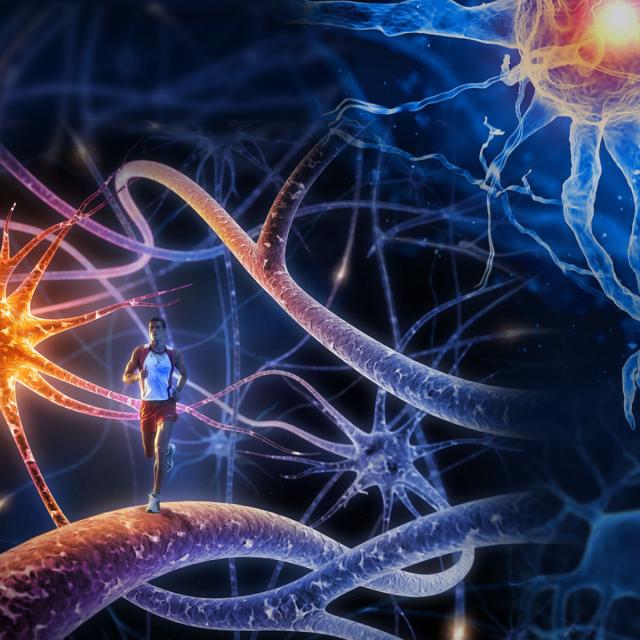
The activity of neurons in the brain and the code used by these neurons is described by mathematical neuron models at different levels of detail.

Class Deals by MOOC List - Click here and see EdX's Active Discounts, Deals, and Promo Codes.

This course gives an introduction to the field of theoretical and computational neuroscience with a focus on models of single neurons. Neurons encode information about stimuli in a sequence of short electrical pulses (spikes). Students will learn how mathematical tools such as differential equations, phase plane analysis, separation of time scales, and stochastic processes can be used to understand the dynamics of neurons and the neural code.

What you'll learn
How mathematical tools such as differential equations, phase plane analysis, separation of time scales, and stochastic processes can be used to understand the dynamics of neurons and the neural code

Syllabus

Week 1: A first simple neuron model
Week 2: Hodgkin-Huxley models and biophysical modeling
Week 3: Two-dimensional models and phase plane analysis
Week 4: Two-dimensional models (cont.)/ Dendrites
Week 5: Variability of spike trains and the neural code
Week 6: Noise models, noisy neurons and coding
Week 7: Estimating neuron models for coding and decoding

Suggested Readings:
Neuronal Dynamics: From Single Neurons to Networks and Models of Cognition

Go to Class
MOOC List is learner-supported. When you buy through links on our site, we may earn an affiliate commission.

Related Courses

Crafting Realities: Work, Happiness, and Meaning (edX) EdX
Indian Institute of Management, Bangalore,IIMBx

Crafting Realities: Work, Happiness, and Meaning (edX)

Learn to create and experience your work as a joyful and meaningful activity - for yourself and others. This course draws upon positive psychology, neuroscience, sociology, and philosophy to guide participants in proactively crafting their own work experience. It weaves inputs from these various fields into a series of lectures and experiential exercises.

Self Paced
Self-Paced
AP® Psychology - Course 2: How the Brain Works (edX) EdX
The University of British Columbia,UBCx

AP® Psychology - Course 2: How the Brain Works (edX)

Learn how your brain works and the basics of neuroscience, genetics and consciousness. This psychology course will show you how the brain works. You will learn the basics of neuroscience, genetics and evolutionary psychology. We will also cover the visual system and other sensory systems. The course concludes with coverage of the variety of states of consciousness.

No session available
5-12 Weeks
Introducción a la Neurociencia (Coursera) Coursera
Universidad de Palermo

Introducción a la Neurociencia (Coursera)

¿Qué es la neurociencia? ¿Cuáles son sus objetivos? ¿Cómo está compuesto y cómo funciona tu cerebro? ¿De qué modo incide sobre tus conductas y comportamientos? ¿Cómo se interrelacionan el cerebro y la mente? ¿Qué son los neurotransmisores y qué tipos de neurotransmisores existen? ¿Qué son las neuronas?

Jun 8th 2026
3 Weeks
The Neuroscience of Leading High-Performance Teams (Coursera) Coursera
University of Colorado Boulder

The Neuroscience of Leading High-Performance Teams (Coursera)

In a demanding business world, team performance matters. At a time in history when teams are less engaged and more unmotivated than ever before, this course we will help give you the competitive edge you are looking for. What if your teams were more motivated and engaged? What if we found a way to harness the primal power of storytelling to influence and collaborate with others? What if we created an environment of psychological safety and trust for the teams we lead?

Jun 15th 2026
5-12 Weeks
Fundamental Neuroscience for Neuroimaging (Coursera) Coursera
Johns Hopkins University

Fundamental Neuroscience for Neuroimaging (Coursera)

Neuroimaging methods are used with increasing frequency in clinical practice and basic research. Designed for students and professionals, this course will introduce the basic principles of neuroimaging methods as applied to human subjects research and introduce the neuroscience concepts and terminology necessary for a basic understanding of neuroimaging applications.

Jun 15th 2026
4 Weeks
Understanding the Brain: The Neurobiology of Everyday Life (Coursera) Coursera
University of Chicago

Understanding the Brain: The Neurobiology of Everyday Life (Coursera)

Learn how the nervous system produces behavior, how we use our brain every day, and how neuroscience can explain the common problems afflicting people today. We will study functional human neuroanatomy and neuronal communication, and then use this information to understand how we perceive the outside world, move our bodies voluntarily, stay alive, and play well with others.

Jun 1st 2026
5-12 Weeks
Managing Happiness (edX) EdX
HarvardX,Harvard University

Managing Happiness (edX)

Managing Happiness encourages you to explore the science of happiness, allowing you to find your truest self. Through cutting-edge survey tools, the best research, and trends in social science, neuroscience, and philosophy to help learners unlock the strategies to create a more purposeful life, full of long-lasting enjoyment and satisfaction.

Self Paced
Self-Paced
Computational Neuroscience (Coursera) Coursera
University of Washington

Computational Neuroscience (Coursera)

This course provides an introduction to basic computational methods for understanding what nervous systems do and for determining how they function. We will explore the computational principles governing various aspects of vision, sensory-motor control, learning, and memory. Specific topics that will be covered include representation of information by spiking neurons, processing of information in neural networks, and algorithms for adaptation and learning.

Jun 22nd 2026
5-12 Weeks
Cellular Mechanisms of Brain Function (edX) EdX
École Polytechnique Fédérale de Lausanne,EPFLx

Cellular Mechanisms of Brain Function (edX)

This course aims for a mechanistic description of mammalian brain function at the level of individual nerve cells and their synaptic interactions. Brain and behavior are inextricably linked in neuroscience. The function of the brain is to govern behavior, and the aim of this course is to causally link biophysical mechanisms with simple behaviors studied in mice.

Self Paced
Self-Paced
Fundamentals of Neuroscience, Part 2: Neurons and Networks (edX) EdX
HarvardX,Harvard University

Fundamentals of Neuroscience, Part 2: Neurons and Networks (edX)

Discover what makes your brain tick in this second part of a four-part introductory series in Neuroscience. Neurons in isolation are fascinating and complicated, but the real magic of neuroscience happens in the interaction between neurons. In this course, we examine how neurons pass signals to one another and how complex dynamics can result from just a few neurons arranged in relatively simple circuits.

Self Paced
Self-Paced
Behavioral Neuroscience: Foundations of Compulsive Behaviors (edX) EdX
University of Alaska Fairbanks,AlaskaX

Behavioral Neuroscience: Foundations of Compulsive Behaviors (edX)

The first MOOC to teach behavioral neuroscience research using laboratory mice. Learn responsible conduct of research and how to collect scientific data using two different tests that measure compulsions, and interpret and discuss the results in the context of obsessive-compulsive disorder in humans.

Self Paced
Self-Paced