Arch of Titus: Rome and the Menorah (Coursera)

Offered by Yeshiva University,
Arch of Titus: Rome and the Menorah (Coursera)

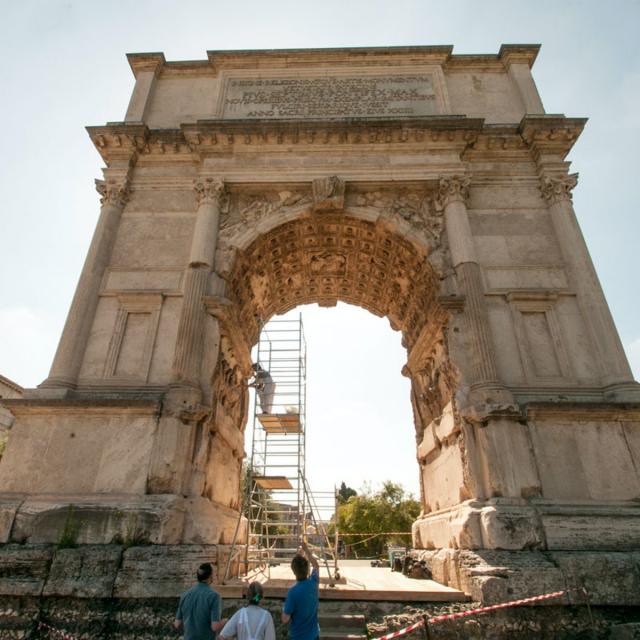
The Arch of Titus: Rome and the Menorah explores one of the most significant Roman monuments to survive from antiquity, from the perspectives of Roman, Jewish and later Christian history and art. The Arch of Titus commemorates the destruction of Jerusalem by the emperor Titus in 70 CE, an event of pivotal importance for the history of the Roman Empire, of Judaism, of Christianity and of modern nationalism. Together with your guide, Professor Steven Fine, you will examine ancient texts and artifacts, gaining skills as a historian as you explore the continuing significance of the Arch of Titus from antiquity to the very present.

Class Deals by MOOC List - Click here and see Coursera's Active Discounts, Deals, and Promo Codes.

Course members will accompany Professor Fine on virtual "fieldtrips" to museums and historical sites in Los Angeles and New York where you will "meet" curators, scholars and artists. You will attend an academic colloquium and even "participate" in office hours. Students will participate in the latest advancement in the study of the Arch - the restoration of its original colors. You will learn how color was used in Roman antiquity and apply that knowledge to complete your own 'color restoration' of the Arch of Titus menorah relief.

Syllabus

WEEK 1
Why the Arch of Titus Matters
This module introduces the Arch of Titus and the larger themes of the course. Students will begin to view the Arch from the perspectives of Roman and Jewish history, of the victors and the vanquished, and the continuing history of this artifact. They will be sensitized to the presence of imagery related to the Arch in the larger culture, and be able to identity some of that imagery.

WEEK 2
The Arch of Titus as a Work of Art
This module explores the Arch of Titus as an artifact. Students will learn to look closely at this and other historical monuments in order to draw out the meanings of its iconography. They will see the Arch and especially its carved relief panels through selected refracting lenses.

WEEK 3
The Arch of Titus in History
Roman and Talmudic sources on Titus's triumphal parade in 71 CE will be the focus of this module. Students will read these ancient texts critically and assess the historical value for understanding the Arch and its later reception.

WEEK 4
The Arch of Titus from Antiquity to the Modern Era
Students will explore Jewish and Christian perspectives of the Arch and be able to explain how these perceptions affected their experience and interpretation of this artifact. Conversations with scholars and museum "visits" demonstrate a broad range of contemporary perspectives on the Arch and the continued significance of its iconography.

WEEK 5
The Arch of Titus in the Modern World
We will explore the ways that moderns have viewed and used the Arch, through the close reading of primary visual and literary sources. "Fieldtrips" and conversations contextualize the search for Arch imagery in our world, and demonstrate ways to recognize this iconography. Students will write a narrative of the Arch in modern times based upon primary literary sources.

WEEK 6
The Arch of Titus: Restoring its Color
Recent advances in the study of the original color, polychromy, of ancient Roman art will be presented. Students will learn the reasons for this rethinking of ancient art, and apply this learning to their own restorations of the polychrome of the Arch of Titus menorah panel.
Go to Class
MOOC List is learner-supported. When you buy through links on our site, we may earn an affiliate commission.

Related Courses

The Holocaust - An Introduction (II): The Final Solution (Coursera) Coursera
Tel Aviv University,Yad Vashem

The Holocaust - An Introduction (II): The Final Solution (Coursera)

The Holocaust was an inconceivable historical event, which forever robbed Western culture of its innocence. As civilized human beings, we fail to understand how events of such horror could have taken place, and how an idea so inhumanly warped could have spread like wildfire through an entire continent, instigating the systematic annihilation of millions of Jews.

Aug 10th 2026
3 Weeks
The History of Modern Israel - Part II: Challenges of Israel as a sovereign state (Coursera) Coursera
Tel Aviv University

The History of Modern Israel - Part II: Challenges of Israel as a sovereign state (Coursera)

This course deals with the Israeli politics, economy, society and culture, since its creation in 1948 till today. It analyzes the construction of the Israeli historical narrative as an identity-building narrative, intending to inculcate a collective memory to a diverse society. We will focus on key events and essential components that shaped the Israeli society from the fifties till the present. We will also discuss the changes that the Israeli society experiences in its almost seventy years of existence and how it affects its politics and culture.

Aug 17th 2026
5-12 Weeks
Magic in the Middle Ages (Coursera) Coursera
University of Barcelona

Magic in the Middle Ages (Coursera)

Magical thought has always attracted human imagination. In this course we will introduce you to the Middle Ages through a wide conception of magic. Students will have an approach to medieval culture, beliefs and practices from the perspective of History and History of Science. Popular magic, as well as learned magic (alchemy, geomancy and necromancy) will be addressed. Moreover, we will also deal with how eastern practices and texts influenced western culture. In July 2016, the course will contain a brand-new module devoted to astrology. Magic in the Middle Ages offers a captivating overview of medieval society and promotes reflection about certain stereotypes associated with this period.

Aug 17th 2026
5-12 Weeks
Global Diplomacy – Diplomacy in the Modern World (Coursera) Coursera
University of London,SOAS University of London

Global Diplomacy – Diplomacy in the Modern World (Coursera)

The Global Diplomacy course is a unique offering to the MOOC environment. Bringing together cutting edge research in the broad fields of Diplomatic and International Studies, award winning distance learning delivery and the instructors previous experience of delivering a successful MOOC. Please see the volume Global Diplomacy: Theories, Types and Models authored with Dr Alison Holmes, (Westview, 2016), and the Understanding Research Methods MOOC from Coursera.

Aug 10th 2026
5-12 Weeks
William Shakespeare's Twelfth Night: Comedy, Conflict, and Community (Coursera) Coursera
University of Colorado Boulder

William Shakespeare's Twelfth Night: Comedy, Conflict, and Community (Coursera)

This course introduces and explores William Shakespeare’s classic comedy, Twelfth Night. Interviews with actors who appeared in the Colorado Shakespeare Festival’s 2019 production of Twelfth Night, as well as lectures by scholars and theater professionals who work and teach at the University of Colorado Boulder, offer students insight into Shakespeare’s artistic vision and its applications.

Aug 17th 2026
5-12 Weeks
Soul Beliefs: Causes and Consequences - Unit 2: Belief Systems (Coursera) Coursera
Rutgers University

Soul Beliefs: Causes and Consequences - Unit 2: Belief Systems (Coursera)

Throughout history, the vast majority of people around the globe have believed they have, however defined, a “soul.” While the question of whether the soul exists cannot be answered by science, what we can study are the causes and consequences of various beliefs about the soul and its prospects of surviving the death of the body. Why are soul and afterlife beliefs so common in human history? Are there adaptive advantages to assuming souls exist?

Aug 3rd 2026
5-12 Weeks
Organising an Empire: The Assyrian Way (Coursera) Coursera
Ludwig-Maximilians-Universität München

Organising an Empire: The Assyrian Way (Coursera)

Discover the mighty kingdom of Assyria, which came to be the world’s first great empire three thousand years ago. From the 9th to the 7th centuries BC, during the imperial phase of Assyria’s long history, modern day northern Iraq was the central region of a state reaching from the Mediterranean Sea to the Persian Gulf, and incorporating what is now Iraq, Syria, and Lebanon, as well as half of Israel, and wide parts of south-eastern Turkey, and Western Iran.

Aug 10th 2026
5-12 Weeks
Structuring Values in Modern China (Coursera) Coursera
The Chinese University of Hong Kong

Structuring Values in Modern China (Coursera)

This sequence of four courses will propose a multi-disciplinary approach to the study of Chinese cultural history conceived of as a succession of modes of rationality (philosophical, bureaucratic, and economic). The focus will be on the moments of paradigm shift from one mode of rationality to another. For each of these moments, cultural facts and artifacts—thought, literature, ritual—will be examined in relationship to changing social, political, and economic systems.

Aug 17th 2026
5-12 Weeks
History of Rock, Part Two (Coursera) Coursera
University of Rochester

History of Rock, Part Two (Coursera)

This course, part 2 of a 2-course sequence, examines the history of rock, primarily as it unfolded in the United States, from the early 1970s to the early 1990s. This course covers the music of Led Zeppelin, the Allman Brothers, Carole King, Bob Marley, the Sex Pistols, Donna Summer, Michael Jackson, Madonna, Prince, Metallica, Run-DMC, and Nirvana, and many more artists, with an emphasis both on cultural context and on the music itself. We will also explore how developments in the music business and in technology helped shape the ways in which styles developed.

Aug 3rd 2026
5-12 Weeks
Exploring Beethoven’s Piano Sonatas Part 2 (Coursera) Coursera
Curtis Institute of Music

Exploring Beethoven’s Piano Sonatas Part 2 (Coursera)

Welcome to Part 2 of Exploring Beethoven's Piano Sonatas! I'm delighted to launch another set of new lectures of this course as Part 2. As before, this class is meant for people of all levels of experience with Beethoven's music (including no experience at all!). Remember that you are able to watch the lectures as many times as you like, at whatever pace is comfortable for you.

Aug 10th 2026
5-12 Weeks