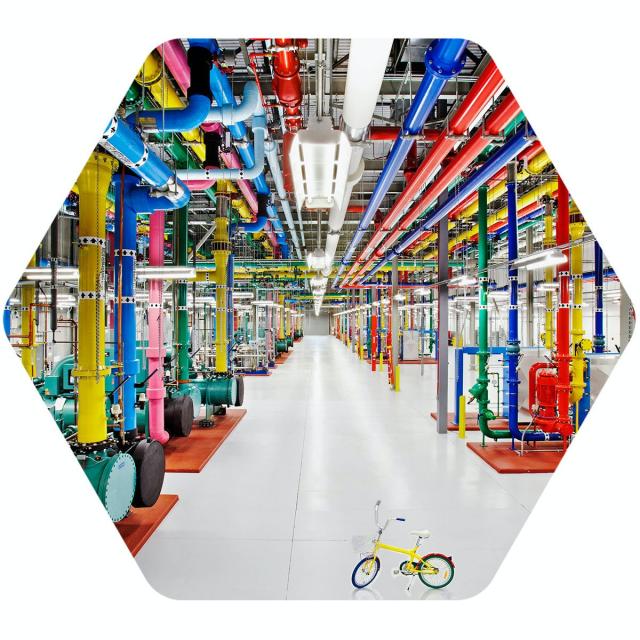
Google Cloud Platform Fundamentals: Core Infrastructure (Coursera)

Offered by Google,
Google Cloud Platform Fundamentals: Core Infrastructure (Coursera)

This course introduces you to important concepts and terminology for working with Google Cloud Platform (GCP). You learn about, and compare, many of the computing and storage services available in Google Cloud Platform, including Google App Engine, Google Compute Engine, Google Kubernetes Engine, Google Cloud Storage, Google Cloud SQL, and BigQuery. You learn about important resource and policy management tools, such as the Google Cloud Resource Manager hierarchy and Google Cloud Identity and Access Management. Hands-on labs give you foundational skills for working with GCP.

Class Deals by MOOC List - Click here and see Coursera's Active Discounts, Deals, and Promo Codes.

Note:
•Google services are currently unavailable in China.
Completing this course will count towards your learning in any of the following programs:

Syllabus

WEEK 1
Welcome to GCP Fundamentals
Module 1: Introduction to Google Cloud Platform
Lab: Free trial
Module 2: Getting Started with Google Cloud Platform
Lab: Getting Started
Module 3: Google App Engine and Google Cloud Datastore
Lab: App Engine
Module 4: Google Cloud Platform Storage Options
Lab: Cloud Storage
Module 5: Google Container Engine
Lab: Container Engine
Module 6: Google Compute Engine and Networking
Lab: Compute Engine
Module 7: Big Data and Machine Learning
Lab: BigQuery
Appendix: Next Steps, Support, and Resources

Go to Class
MOOC List is learner-supported. When you buy through links on our site, we may earn an affiliate commission.

Related Courses

The Importance of Listening (Coursera) Coursera
Northwestern University

The Importance of Listening (Coursera)

In this second MOOC in the Social Marketing Specialization - "The Importance of Listening" - you will go deep into the Big Data of social and gain a more complete picture of what can be learned from interactions on social sites. You will be amazed at just how much information can be extracted from a single post, picture, or video.

Jun 8th 2026
4 Weeks
Graph Analytics for Big Data (Coursera) Coursera
University of California, San Diego

Graph Analytics for Big Data (Coursera)

Want to understand your data network structure and how it changes under different conditions? Curious to know how to identify closely interacting clusters within a graph? Have you heard of the fast-growing area of graph analytics and want to learn more? This course gives you a broad overview of the field of graph analytics so you can learn new ways to model, store, retrieve and analyze graph-structured data.

Jun 8th 2026
5-12 Weeks
Practical Machine Learning (Coursera) Coursera
Johns Hopkins University

Practical Machine Learning (Coursera)

One of the most common tasks performed by data scientists and data analysts are prediction and machine learning. This course will cover the basic components of building and applying prediction functions with an emphasis on practical applications. The course will provide basic grounding in concepts such as training and tests sets, overfitting, and error rates.

Jun 8th 2026
4 Weeks
Big Data Modeling and Management Systems (Coursera) Coursera
University of California, San Diego

Big Data Modeling and Management Systems (Coursera)

Once you’ve identified a big data issue to analyze, how do you collect, store and organize your data using Big Data solutions? In this course, you will experience various data genres and management tools appropriate for each. You will be able to describe the reasons behind the evolving plethora of new big data platforms from the perspective of big data management systems and analytical tools.

Jun 8th 2026
5-12 Weeks
Preparing for the Google Cloud Professional Data Engineer Exam (Coursera) Coursera
Google Cloud

Preparing for the Google Cloud Professional Data Engineer Exam (Coursera)

From the course: "The best way to prepare for the exam is to be competent in the skills required of the job." This course uses a top-down approach to recognize knowledge and skills already known, and to surface information and skill areas for additional preparation. You can use this course to help create your own custom preparation plan. It helps you distinguish what you know from what you don't know. And it helps you develop and practice skills required of practitioners who perform this job.

Jun 13th 2026
5-12 Weeks
Machine Learning: Regression (Coursera) Coursera
University of Washington

Machine Learning: Regression (Coursera)

Case Study - Predicting Housing Prices. In our first case study, predicting house prices, you will create models that predict a continuous value (price) from input features (square footage, number of bedrooms and bathrooms,...). This is just one of the many places where regression can be applied. Other applications range from predicting health outcomes in medicine, stock prices in finance, and power usage in high-performance computing, to analyzing which regulators are important for gene expression.

Jun 8th 2026
5-12 Weeks
Sequence Models (Coursera) Coursera
DeepLearning.AI

Sequence Models (Coursera)

This course will teach you how to build models for natural language, audio, and other sequence data. Thanks to deep learning, sequence algorithms are working far better than just two years ago, and this is enabling numerous exciting applications in speech recognition, music synthesis, chatbots, machine translation, natural language understanding, and many others.

Jun 8th 2026
3 Weeks
Cloud Networking (Coursera) Coursera
University of Illinois at Urbana-Champaign

Cloud Networking (Coursera)

In the cloud networking course, we will see what the network needs to do to enable cloud computing. We will explore current practice by talking to leading industry experts, as well as looking into interesting new research that might shape the cloud network’s future. This course will allow us to explore in-depth the challenges for cloud networking—how do we build a network infrastructure that provides the agility to deploy virtual networks on a shared infrastructure, that enables both efficient transfer of big data and low latency communication, and that enables applications to be federated across countries and continents? Examining how these objectives are met will set the stage for the rest of the course.

Jun 8th 2026
5-12 Weeks
Big Data, Genes, and Medicine (Coursera) Coursera
The State University of New York

Big Data, Genes, and Medicine (Coursera)

This course distills for you expert knowledge and skills mastered by professionals in Health Big Data Science and Bioinformatics. You will learn exciting facts about the human body biology and chemistry, genetics, and medicine that will be intertwined with the science of Big Data and skills to harness the avalanche of data openly available at your fingertips and which we are just starting to make sense of.

Jun 8th 2026
5-12 Weeks
Machine Learning: Classification (Coursera) Coursera
University of Washington

Machine Learning: Classification (Coursera)

Case Studies: Analyzing Sentiment & Loan Default Prediction. In our case study on analyzing sentiment, you will create models that predict a class (positive/negative sentiment) from input features (text of the reviews, user profile information,...). In our second case study for this course, loan default prediction, you will tackle financial data, and predict when a loan is likely to be risky or safe for the bank.

Jun 8th 2026
5-12 Weeks
Configuration Management and the Cloud (Coursera) Coursera
Google

Configuration Management and the Cloud (Coursera)

In this course, you’ll learn how to apply automation to manage fleets of computers. You’ll understand how to automate the process for deploying new computers, keeping those machines updated, managing large-scale changes, and a lot more. We'll discuss managing both physical machines running in our offices and virtual machines running in the Cloud.

Jun 9th 2026
4 Weeks
Text Retrieval and Search Engines (Coursera) Coursera
University of Illinois at Urbana-Champaign

Text Retrieval and Search Engines (Coursera)

Recent years have seen a dramatic growth of natural language text data, including web pages, news articles, scientific literature, emails, enterprise documents, and social media such as blog articles, forum posts, product reviews, and tweets. Text data are unique in that they are usually generated directly by humans rather than a computer system or sensors, and are thus especially valuable for discovering knowledge about people’s opinions and preferences, in addition to many other kinds of knowledge that we encode in text.

Jun 8th 2026
5-12 Weeks