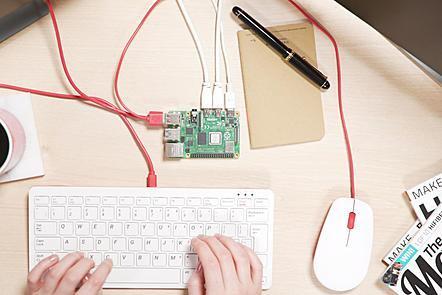
Getting Started with Your Raspberry Pi (FutureLearn)

Getting Started with Your Raspberry Pi (FutureLearn)

Discover how to set up and control your new Raspberry Pi, as well as how to use it for everyday tasks and to learn how to code. Start your Raspberry Pi journey with this introductory course. The Raspberry Pi is an accessible and versatile mini-computer – let the Raspberry Pi Foundation guide you on how to get started on your journey of exploring its many uses and applications.

Class Deals by MOOC List - Click here and see FutureLearn's Active Discounts, Deals, and Promo Codes.

On this course, you’ll learn how to get your Raspberry Pi ready to use, before exploring what you can do with it. You’ll see how you could use your Raspberry Pi for everyday tasks, to help you to learn to code, and to get started with physical computing.
Ultimately, you’ll learn how to connect to your Raspberry Pi remotely, and how to take control of your Raspberry Pi as a systems administrator. You’ll also discover more resources to continue your Raspberry Pi journey.
Supported by Micron Technology.

What topics will you cover?

  • The Raspberry Pi Operating System
  • The Raspberry Pi Desktop
  • Adding and using software on your Raspberry Pi
  • Everyday computing with your Raspberry Pi
  • Connecting more hardware
  • Getting started with coding
  • The Unix command line
  • Remote access and security

Learning on this course
You can take this self-guided course and learn at your own pace. On every step of the course you can meet other learners, share your ideas and join in with active discussions in the comments.

What will you achieve?
By the end of the course, you‘ll be able to...

  • Perform an installation of the Raspberry Pi operating system using the Raspberry Pi Imager
  • Modify your setup by connecting additional components and installing new software
  • Explain how your Raspberry Pi can be used for learning to program and getting started with physical computing
  • Apply your knowledge of basic system administration to take more control of your Raspberry Pi

Who is the course for?
This course is for beginners who want to learn how to use their new Raspberry Pi, and have no experience with Unix-based systems.

What software or tools do you need?
You’ll need a Raspberry Pi (we recommend a Raspberry Pi 4), along with a keyboard, mouse, power supply, micro SD card, and a suitable cable for connecting your Raspberry Pi to your screen. All of these are included in the Raspberry Pi 4 Desktop Kit

Go to Class
MOOC List is learner-supported. When you buy through links on our site, we may earn an affiliate commission.

Related Courses

Design Computing: 3D Modeling in Rhinoceros with Python/Rhinoscript (Coursera) Coursera
University of Michigan

Design Computing: 3D Modeling in Rhinoceros with Python/Rhinoscript (Coursera)

Why should a designer learn to code? As our world is increasingly impacted by the use of algorithms, designers must learn how to use and create design computing programs. Designers must go beyond the narrowly focused use of computers in the automation of simple drafting/modeling tasks and instead explore the extraordinary potential digitalization holds for design culture/practice.

Jun 22nd 2026
5-12 Weeks
Introduction to CSS3 (Coursera) Coursera
University of Michigan

Introduction to CSS3 (Coursera)

The web today is almost unrecognizable from the early days of white pages with lists of blue links. Now, sites are designed with complex layouts, unique fonts, and customized color schemes. This course will show you the basics of Cascading Style Sheets (CSS3). The emphasis will be on learning how to write CSS rules, how to test code, and how to establish good programming habits.

Jun 22nd 2026
4 Weeks
Understanding Computer Systems (FutureLearn) FutureLearn
Raspberry Pi Foundation

Understanding Computer Systems (FutureLearn)

Understand how the components of a computer system interact with each other on this online course for computing teachers. Learn what really happens when you turn a computer on. Understanding how a computer works after you press the power button is key to working with technology effectively. On this course, you will explore what happens inside the machine and learn how computers turn inputs into outputs.

Nov 1st 2021
3 Weeks
Improving Computing Classroom Practice Through Action Research (FutureLearn) FutureLearn
Raspberry Pi Foundation,National Centre for Computing Education

Improving Computing Classroom Practice Through Action Research (FutureLearn)

Learn how to run your own action research project to improve the computing pedagogy and practices in your classroom. Apply action research to your teaching and become a more reflective practitioner. Through this course, you will become familiar with the process of classroom action research, and plan your own classroom-based investigation.

Feb 7th 2022
2 Weeks
Laravel Additional Security (Coursera) Coursera
Infosec

Laravel Additional Security (Coursera)

This course focuses on ways to keep your Laravel database secure. It starts with supporting request and response security. First, we’ll discuss how Laravel supports semantic request verbs while still being compatible with browsers. Then, tools to protect against cross-site request forgery and cross-site scripting protection are examined. Then it describes the best practices for applying specific security-related headers to responses are reviewed.

Jun 22nd 2026
1 Week
Teaching Physical Computing with Raspberry Pi and Python (FutureLearn) FutureLearn
Raspberry Pi Foundation

Teaching Physical Computing with Raspberry Pi and Python (FutureLearn)

Explore the exciting world of physical computing and create electronic circuits that you can control with code. Learn the benefits of using physical computing with your students. On this course from the Raspberry Pi Foundation, you will be introduced to the world of physical computing. You will use input devices to capture data, process that data with the Python programming language, and then use output devices to get information back out from your computer.

Mar 6th 2023
3 Weeks
Exploring C (Coursera) Coursera
University of Michigan

Exploring C (Coursera)

The C programming language is heavily influential in the world of coding and helps run some of the most powerful computer programs in the world. In Exploring C, examine the historical context and impact of C on the development of programming over the past 50 years. In this course, you’ll compare and contrast C with the programming language Python, review how to code in C and gain an understanding of the nuances of computer programming.

Jun 22nd 2026
5-12 Weeks
Python Basics: Selection and Iteration (Coursera) Coursera
Codio

Python Basics: Selection and Iteration (Coursera)

Code and run your first python program in minutes without installing anything! This course is designed for learners with no coding experience, providing a solid foundation of not just python, but core Computer Science topics that can be transferred to other languages. The modules in this course cover printing, operators, iteration (i.e., loops), and selection (i.e., conditionals).

Jun 22nd 2026
4 Weeks
Interfacing with the Raspberry Pi (Coursera) Coursera
University of California, Irvine

Interfacing with the Raspberry Pi (Coursera)

The Raspberry Pi uses a variety of input/output devices based on protocols such as HDMI, USB, and Ethernet to communicate with the outside world. In this class you will learn how to use these protocols with other external devices (sensors, motors, GPS, orientation, LCD screens etc.) to get your IoT device to interact with the real world.

Jun 22nd 2026
4 Weeks
Programming Pedagogy in Secondary Schools: Inspiring Computing Teaching (FutureLearn) FutureLearn
Raspberry Pi Foundation,National Centre for Computing Education

Programming Pedagogy in Secondary Schools: Inspiring Computing Teaching (FutureLearn)

Examine a range of pedagogical approaches suitable for teaching computing in Key Stage 3 (Grade 6–8 in the USA). Transform your teaching by developing your pedagogical approach. In the first two weeks of this course, you’ll be introduced to a range of pedagogical approaches suitable for Key Stage 3. You’ll look at a range of pedagogies aimed at developing your students’ computational thinking skills, from unplugged approaches to PRIMM, and more. You’ll also investigate worked examples and targeted tasks such as Parson’s Problems.

Mar 6th 2023
3 Weeks
Statistical Shape Modelling: Computing the Human Anatomy (FutureLearn) FutureLearn
University of Basel

Statistical Shape Modelling: Computing the Human Anatomy (FutureLearn)

Learn the technology of modelling, as used in computational face recognition or in surgeries, with this free online course. Statistical shape models are one of the most important technologies in computer vision and medical image analysis. With this technology, the computer learns the characteristic shape variations of an object or organ. The model resulting from this analysis may then be used in implant design, image analysis, surgery planning and many other fields.

Feb 21st 2022
5-12 Weeks