An Introduction to Interactive Programming in Python (Part 2) (Coursera)

Offered by Rice University,
An Introduction to Interactive Programming in Python (Part 2) (Coursera)

This two-part course is designed to help students with very little or no computing background learn the basics of building simple interactive applications. Our language of choice, Python, is an easy-to learn, high-level computer language that is used in many of the computational courses offered on Coursera. To make learning Python easy, we have developed a new browser-based programming environment that makes developing interactive applications in Python simple.

Class Deals by MOOC List - Click here and see Coursera's Active Discounts, Deals, and Promo Codes.

These applications will involve windows whose contents are graphical and respond to buttons, the keyboard and the mouse. In part 2 of this course, we will introduce more elements of programming (such as list, dictionaries, and loops) and then use these elements to create games such as Blackjack. Part 1 of this class will culminate in building a version of the classic arcade game "Asteroids". Upon completing this course, you will be able to write small, but interesting Python programs. The next course in the specialization will begin to introduce a more principled approach to writing programs and solving computational problems that will allow you to write larger and more complex programs.
Course 2 of 7 in the Fundamentals of Computing Specialization

Syllabus

WEEK 1
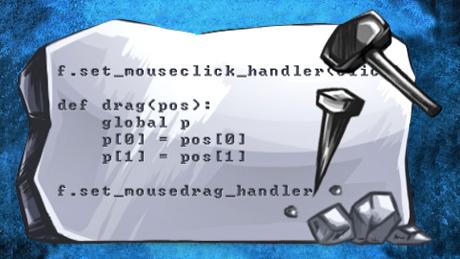
Week 5 - Mouse input, list methods, dictionaries
Read mouse input, learn about list methods and dictionaries, draw images

WEEK 2
Week 6 - Classes and object-oriented programming
Learn the basics of object-oriented programming in Python using classes, work with tiled images

WEEK 3
Week 7 - Basic game physics, sprites
Understand the math of acceleration and friction, work with sprites, add sound to your game

WEEK 4
Week 8 - Sets and animation
Learn about sets in Python, compute collisions between sprites, animate sprites
Go to Class
MOOC List is learner-supported. When you buy through links on our site, we may earn an affiliate commission.

Related Courses

Comparing Genes, Proteins, and Genomes (Bioinformatics III) (Coursera) Coursera
University of California, San Diego

Comparing Genes, Proteins, and Genomes (Bioinformatics III) (Coursera)

Once we have sequenced genomes in the previous course, we would like to compare them to determine how species have evolved and what makes them different. In the first half of the course, we will compare two short biological sequences, such as genes (i.e., short sequences of DNA) or proteins. We will encounter a powerful algorithmic tool called dynamic programming that will help us determine the number of mutations that have separated the two genes/proteins.

Aug 17th 2026
5-12 Weeks
Introduction to Software, Programming, and Databases (Coursera) Coursera
IBM

Introduction to Software, Programming, and Databases (Coursera)

There are many types of software and understanding software can be overwhelming. This course aims to help you understand more about the types of software and how to manage software from an information technology (IT) perspective. This course will help you understand the basics of software, cloud computing, web browsers, development and concepts of software, programming languages, and database basics.

Aug 17th 2026
5-12 Weeks
Kotlin for Java Developers (Coursera) Coursera
JetBrains

Kotlin for Java Developers (Coursera)

The Kotlin programming language is a modern language that gives you more power for your everyday tasks. Kotlin is concise, safe, pragmatic, and focused on interoperability with Java code. It can be used almost everywhere Java is used today: for server-side development, Android apps, and much more. This course aims to share with you the power and the beauty of Kotlin.

Aug 17th 2026
5-12 Weeks
Advanced Modeling for Discrete Optimization (Coursera) Coursera
University of Melbourne,The Chinese University of Hong Kong

Advanced Modeling for Discrete Optimization (Coursera)

Optimization is a common form of decision making, and is ubiquitous in our society. Its applications range from solving Sudoku puzzles to arranging seating in a wedding banquet. The same technology can schedule planes and their crews, coordinate the production of steel, and organize the transportation of iron ore from the mines to the ports. Good decisions in manpower and material resources management also allow corporations to improve profit by millions of dollars.

Aug 17th 2026
5-12 Weeks
Big Data Analysis with Scala and Spark (Coursera) Coursera
École Polytechnique Fédérale de Lausanne

Big Data Analysis with Scala and Spark (Coursera)

Manipulating big data distributed over a cluster using functional concepts is rampant in industry, and is arguably one of the first widespread industrial uses of functional ideas. This is evidenced by the popularity of MapReduce and Hadoop, and most recently Apache Spark, a fast, in-memory distributed collections framework written in Scala. In this course, we'll see how the data parallel paradigm can be extended to the distributed case, using Spark throughout.

Aug 17th 2026
4 Weeks
Learn JavaScript (Coursera) Coursera
Scrimba

Learn JavaScript (Coursera)

This is perhaps the most interactive JavaScript course ever recorded. It contains 140+ coding challenges, meaning that you will finally build that ever-so-important JavaScript muscle memory. You will solve the challenges directly in the browser thanks to Scrimba's interactive video technology, so there's not setup needed. Say goodbye to "tutorial hell" and get ready to start feeling your JavaScript superpowers grow exponentially.

Aug 17th 2026
4 Weeks
Selenium WebDriver with Python (Coursera) Coursera
Whizlabs

Selenium WebDriver with Python (Coursera)

“Selenium WebDriver with Python” is a foundational course that aims to provide a comprehensive understanding of Selenium and its components. It also helps in understanding how Selenium WebDriver Operates. This course begins by demonstrating an environment setup for Selenium WebDriver with Python. A brief description of locating Web elements and web Interactions is provided in this course. This course covers an overview of testing frameworks with Selenium WebDriver. Some advanced topics such as Handling Popup, Alerts, Multiple Browser Tabs, Mouse and Keyboard interactions are also highlighted in this course.

Aug 17th 2026
3 Weeks
Miracles of Human Language: An Introduction to Linguistics (Coursera) Coursera
Leiden University,Meertens Instituut - KNAW

Miracles of Human Language: An Introduction to Linguistics (Coursera)

Everywhere, every day, everybody uses language. There is no human society, no matter how small or how isolated, which does not employ a language that is rich and diverse. This course introduces you to linguistics, featuring interviews with well-known linguists and with speakers of many different languages. Join us to explore the miracles of human language!

Aug 17th 2026
5-12 Weeks
Design Computing: 3D Modeling in Rhinoceros with Python/Rhinoscript (Coursera) Coursera
University of Michigan

Design Computing: 3D Modeling in Rhinoceros with Python/Rhinoscript (Coursera)

Why should a designer learn to code? As our world is increasingly impacted by the use of algorithms, designers must learn how to use and create design computing programs. Designers must go beyond the narrowly focused use of computers in the automation of simple drafting/modeling tasks and instead explore the extraordinary potential digitalization holds for design culture/practice.

Aug 17th 2026
5-12 Weeks