Generative Design for Industrial Applications (Coursera)

Offered by Autodesk,
Generative Design for Industrial Applications (Coursera)

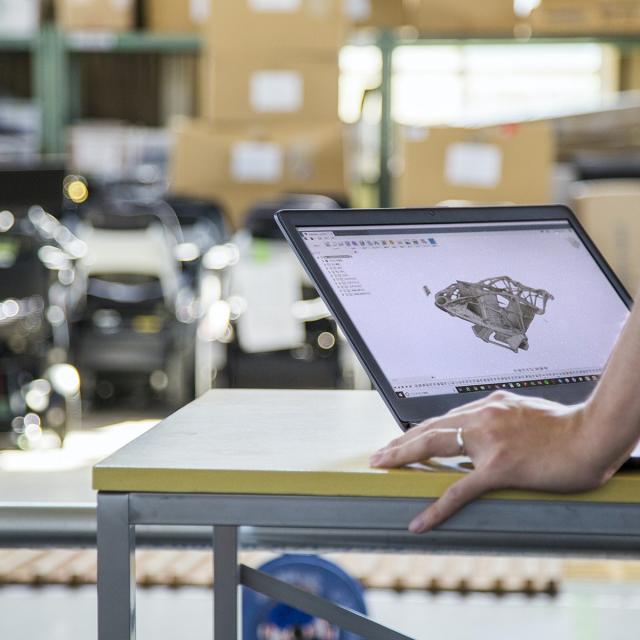
The foundation of engineering design is exploration and iteration. Design is rarely a perfectly linear and straightforward process. In this course, we explore a design for a traditional manufacturing method and use generative design to create the perfect iteration of it. From that point, we'll reverse engineer the generative design and recreate it for a traditional manufacturing method and explore the option of fabricating the generative version to weigh the pros and cons of each.

Class Deals by MOOC List - Click here and see Coursera's Active Discounts, Deals, and Promo Codes.

Want to take your learning to the next level? Complete the Autodesk Generative Design for Manufacturing Specialization, and you’ll unlock an additional Autodesk Credential as further recognition of your success! The Autodesk Credential comes with a digital badge and certificate, which you can add to your resume and share on social media platforms like LinkedIn, Facebook, and Twitter. Sharing your Autodesk Credential can signal to hiring managers that you’ve got the right skills for the job and you’re up on the latest industry trends like generative design.

What You Will Learn

  • Describe the reverse engineering design process and workflow in Fusion 360.
  • Summarize the trends that are influencing the design industry.
  • Demonstrate knowledge and skills in more advanced Fusion 360 CAD and generative design skills.

Course 3 of 4 in the Autodesk Generative Design for Manufacturing Specialization.

Syllabus

WEEK 1
Working with an Initial Design
In Week 1, we’ll explore taking a design and identifying an optimal manufacturing method as well as the addition and creation of features for a specific manufacturing method.

WEEK 2
Defining a Generative Setup and Reviewing Outcomes
In Week 2, we’ll overview the final setup of a generative design study, solving it, and the creation of a generative design outcome.

WEEK 3
Reverse Engineering a Generative Design
In Week 3, we’ll focus on comparing an original design to a generative design. Using the generative design to make informed decisions about a design path and ultimately creating a new generative inspired design. We’ll also look at performing a static simulation to ensure our new design meets the criteria set in our generative design study.

WEEK 4
Reviewing and Refining a Design
In Week 4, we’ll compare the three simulation study results and capture any pertinent design data that needs to be adjusted for a final design. Finally, we’ll explore the creation of images and exploded view drawings for manufacture.

Go to Class
MOOC List is learner-supported. When you buy through links on our site, we may earn an affiliate commission.

Related Courses

Digital Manufacturing: Introduction and Smart Design (Coursera) Coursera
L&T EduTech

Digital Manufacturing: Introduction and Smart Design (Coursera)

This course has been created for Mechanical, Manufacturing, and Mechatronics Engineers. The "Digital Manufacturing and Industry 4.0" course is intended for those who want to comprehend and navigate the transformative concepts and technologies that shape modern Industry. Throughout this course, participants will learn about the fundamental principles of digital manufacturing, the path to Industry 4.0, and the emerging technology that drives smart design and production processes through three modules.

Jun 22nd 2026
3 Weeks
Introduction to Engineering Design (Coursera) Coursera
Starweaver

Introduction to Engineering Design (Coursera)

In today's fast-paced technological environment, understanding the fundamentals of engineering design is crucial for aspiring engineers and professionals alike. This comprehensive course serves as a primer, introducing participants to key concepts and methodologies essential for designing innovative solutions to complex problems. It provides an overview of the engineering design process, emphasizing the integration of creativity and functionality in problem-solving.

Jun 22nd 2026
4 Weeks
Ideal Gases (Coursera) Coursera
University of Colorado Boulder

Ideal Gases (Coursera)

Course 3 of Statistical Thermodynamics, Ideal Gases, explores the behavior of systems when intermolecular forces are not important. This done by evaluating the appropriate partition functions for translational, rotational, vibrational and/or electronic motion. We start with pure ideal gases including monatomic, diatomic and polyatomic species.

Jun 22nd 2026
3 Weeks
Material Processing (Coursera) Coursera
Georgia Institute of Technology

Material Processing (Coursera)

Have you ever wondered why ceramics are hard and brittle while metals tend to be ductile? Why some materials conduct heat or electricity while others are insulators? Why adding just a small amount of carbon to iron results in an alloy that is so much stronger than the base metal? In this course, you will learn how a material’s properties are determined by the microstructure of the material, which is in turn determined by composition and the processing that the material has undergone.

Jun 22nd 2026
2 Weeks
Quantum Mechanics (Coursera) Coursera
University of Colorado Boulder

Quantum Mechanics (Coursera)

Course 2 of Statistical Thermodynamics presents an introduction to quantum mechanics at a level appropriate for those with mechanical or aerospace engineering backgrounds. Using a postulatory approach that describes the steps to follow, the Schrodinger wave equation is derived and simple solutions obtained that illustrate atomic and molecular structural behavior. More realistic behavior is also explored along with modern quantum chemistry numerical solution methods for solving the wave equation.

Jun 22nd 2026
3 Weeks
Particle Dynamics (Coursera) Coursera
Korea Advanced Institute of Science and Technology - KAIST

Particle Dynamics (Coursera)

This course teaches dynamics, one of the basic mechanics subjects of Mechanical Engineering. Students would be able to organize their knowledge about force and motion, work-energy, impulse-momentum in view of Newton's 2nd law and its integration over time and displacement. The Engineering Dynamics consists of two parts: particle dynamics and rigid body dynamics.

Jun 22nd 2026
13-24 Weeks
Fundamentals of waves and vibrations (Coursera) Coursera
École Polytechnique

Fundamentals of waves and vibrations (Coursera)

Waves are everywhere. On water of course, but also in the air as you hear a plane, and under your feet during an earthquake certainly. Vibrations, too, are everywhere In your bike as you go over a bump, in you guitar as you play, and of course in your smartphone. You can guess that there is something in common behind all this. This is exactly the purpose of this course !

Jun 8th 2026
5-12 Weeks
Modern Robotics, Course 1: Foundations of Robot Motion (Coursera) Coursera
Northwestern University

Modern Robotics, Course 1: Foundations of Robot Motion (Coursera)

Do you want to know how robots work? Are you interested in robotics as a career? Are you willing to invest the effort to learn fundamental mathematical modeling techniques that are used in all subfields of robotics? If so, then the "Modern Robotics: Mechanics, Planning, and Control" specialization may be for you. This specialization, consisting of six short courses, is serious preparation for serious students who hope to work in the field of robotics or to undertake advanced study. It is not a sampler.

Jun 15th 2026
4 Weeks
Introduction to Basic Vibrations (Coursera) Coursera
Korea Advanced Institute of Science and Technology - KAIST

Introduction to Basic Vibrations (Coursera)

Introduction to Basic Vibrations starts with the fundamental principle of vibrations with a single and double degree of freedom systems. These fundamental vibration systems provide a solid platform not only to understand general vibrations but also to apply or use them into simple mechanical problems.

Jun 15th 2026
5-12 Weeks