EdX

Fundamentals of Current Flow (edX)

Offered by Purdue University, PurdueX,
Fundamentals of Current Flow (edX)

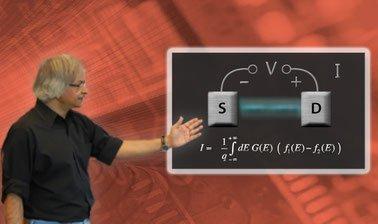
Gain a new perspective on electron flow in solids with this insightful introduction. Very different from what is taught in standard courses, "Fundamentals of Current Flow" provides a unified conceptual framework for ballistic and diffusive transport of both electrons and phonons - essential information for understanding nanoelectronic devices.

Class Deals by MOOC List - Click here and see EdX's Active Discounts, Deals, and Promo Codes.

The traditional description of electronic motion through a solid is based on diffusive transport, which means that the electron takes a random walk from the source to the drain of a transistor, for example. However, modern nanoelectronic devices often have channel lengths comparable to a mean free path so that electrons travel ballistically, or "like a bullet."

This course is part of the Nanoscience and Technology MicroMasters.

What you'll learn

  • Ballistic and diffusive conductance
  • Density of states
  • Number of modes
  • Conductivity
  • Landauer formula

Syllabus

Week 1: The New Perspective
1.1 Introduction
1.2 Two Key Concepts
1.3 Why Electrons Flow
1.4 Conductance Formula
1.5 Ballistic (B) Conductance

Week 2: The New Perspective (Continued)
1.6 Diffusive (D) Conductance
1.7 Connecting B to D
1.8 Angular Averaging
1.9 Drude Formula
1.10 Summing Up

Week 3: Energy Band Model
2.1. Introduction
2.2. E(p) or E(k) Relation
2.3. Counting States
2.4. Density of States
2.5. Number of Modes

Week 4: Energy Band Model (Continued)
2.6. Electron Density (n)
2.7. Conductivity vs. n
2.8 - 2.9 Bonus Lectures; NOT covered on exams
2.10 Summing Up

Week 5: What and Where is the Voltage
3.1 Introduction
3.2 A New Boundary Condition
3.3 Quasi-Fermi Levels (QFL's)
3.4 Current from QFL's
3.5 Landauer Formulas
3.6 - 3.10 Bonus Lectures; NOT covered on exams


Go to Class
MOOC List is learner-supported. When you buy through links on our site, we may earn an affiliate commission.

Related Courses

Manufacturing Systems II (edX) EdX
MIT,MITx

Manufacturing Systems II (edX)

Learn how to analyze manufacturing systems to optimize performance and control costs and better understand the flow of material and information. Manufacturing systems are complex systems that require analytical analysis. Managers and practitioners use a wide variety of methods to analyze and optimize the performance of manufacturing systems and control costs.

Mar 6th 2024
5-12 Weeks
Railway Engineering: An Integral Approach (edX) EdX
Delft University of Technology,DelftX

Railway Engineering: An Integral Approach (edX)

Discover the science and complexity behind the exciting world of metro, tram and railway systems. Have you ever wondered what it takes to get your train on the right platform at the scheduled time every day? Understanding the complexity behind today’s sophisticated railway systems will give you a better insight into how this safe and reliable transportation system works. We will show you the many factors which are involved and how multiple people, behind the scenes, have a daily task that enables you to get from home to work. Journey with us into the world of rail - a complex system that connects people, cities and countries.

Apr 10th 2024
5-12 Weeks
Fundamentals of Semiconductor Characterization (Coursera) Coursera
Arizona State University

Fundamentals of Semiconductor Characterization (Coursera)

The goal of this course is to review the fundamentals of semiconductor materials, p-n junction diodes, and MOS capacitors. There are many semiconductor technologies based on different material systems, but the most important is complementary metal-oxide-semiconductor, or CMOS for short. This course will focus on semiconductor materials and devices relevant to CMOS manufacturing, but the concepts can be applied much more broadly.

Jun 22nd 2026
4 Weeks
Introduction to Semiconductor Packaging (Coursera) Coursera
Arizona State University

Introduction to Semiconductor Packaging (Coursera)

This course will cover various aspects of microelectronics and nanoelectronics. This field aims to advance and improve the functionality of electronic devices by scaling transistors to smaller feature sizes. The course will introduce you to essential concepts such as length scales, transistor actions, and feature sizes of integrated circuits.

Jun 15th 2026
5-12 Weeks
Applied Quantum Computing III: Algorithm and Software (edX) EdX
Purdue University,PurdueX

Applied Quantum Computing III: Algorithm and Software (edX)

Learn domain-specific quantum algorithms and how to run them on present-day quantum hardware. This course is part III of the series of Quantum computing courses, which covers aspects from fundamentals to present-day hardware platforms to quantum software and programming. The goal of part III is to discuss some of the key domain-specific algorithms that are developed by exploiting the fundamental quantum phenomena (e.g. entanglement)and computing models discussed in part I.

Mar 25th 2024
5-12 Weeks
Introduction to Analytics Modeling (edX) EdX
Georgia Institute of Technology,GTx

Introduction to Analytics Modeling (edX)

Learn essential analytics models and methods and how to appropriately apply them, using tools such as R, to retrieve desired insights. Analytical models are key to understanding data, generating predictions, and making business decisions. Without models it’s nearly impossible to gain insights from data.

May 13th 2024
13-24 Weeks
Management in Engineering: Strategy and Leadership (edX) EdX
MIT,MITx

Management in Engineering: Strategy and Leadership (edX)

Analyze challenging real-life business cases that engineering managers face on a variety of topics. Apply management tools and relevant skills to manage innovation. This course was formerly known as Management in Engineering II. As part of the Principles of Manufacturing MicroMasters program, this course aims to provide exposure to key principles and practices used in engineering management.

Jan 9th 2024
5-12 Weeks
Supply Chain Technology and Systems (edX) EdX
MIT,MITx

Supply Chain Technology and Systems (edX)

Learn how technology is used in supply chain systems from fundamental concepts to innovative applications. There are underlying fundamental principles and concepts that apply to all supply chains, which can be expressed in relatively straightforward models. However, to actually implement them across a real supply chain requires the use of technology across multiple systems. Supply chains have a long history of using technology to improve efficiency and effectiveness. The shear scale and scope of most supply chains require many distinct systems to interact with each other.

Jun 26th 2024
13-24 Weeks