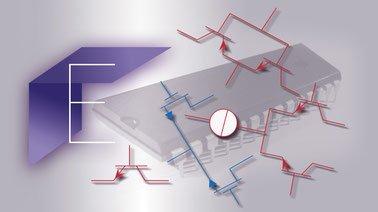
This course develops a simple framework for understanding the essential physics of transistors, including modern nanoscale transistors. Important technology considerations and circuit applications are also discussed. The transistor has been called the greatest invention of the 20th century - it enabled the electronics systems that have shaped the world we live in. Today's nanotransistors are a high volume, high impact success of the nanotechnology revolution.
Class Deals by MOOC List - Click here and see EdX's Active Discounts, Deals, and Promo Codes.
This is a course on how this scientifically interesting and technologically important device operates. The course is designed for anyone seeking a sound, physical, intuitive understanding of how modern transistors operate. Important technology considerations and applications of transistors are also discussed. The focus is on MOSFETs for digital logic, but analog applications and other types of transistors are briefly considered.
This course is broadly accessible to students with only a very basic knowledge of semiconductor physics and electronic circuits. Topics include device metrics for digital and analog circuits, traditional MOSFET theory, the virtual source model, 1D and 2D electrostatics, Landauer/transmission approach to nanotransistors, the limits of MOSFETs, as well as a quick look at HEMTs, bipolar transistors, and compact circuit models. The course should be useful for advanced undergraduates, beginning graduate students, as well as practicing engineers and scientists.
This course is part of a Purdue initiative that aims to complement the expertise that students develop with the breadth at the edges needed to work effectively in today's multidisciplinary environment. These serious short courses require few prerequisites and provide a general framework that can be filled in with self-study when needed.
Students taking this course will be required to complete two (2) proctored exams using the edX online Proctortrack software.
Completed exams will be scanned and sent using Gradescope for grading by Professor Lundstrom.
Fundamentals of Transistors is one course in a growing suite of unique, 1-credit-hour short courses being developed in an edX/Purdue University collaboration. Students may elect to pursue a verified certificate for this specific course alone or as one of the six courses needed for the edX/Purdue MicroMasters program in Nanoscience and Technology. For further information and other courses offered and planned, please see the Nanoscience and Technology page. Courses like this can also apply toward a Purdue University MSECE degree for students accepted into the full master’s program.
This course is part of the Nanoscience and Technology MicroMasters.
What you'll learn
- MOSFET IV characteristics and device metrics and how to analyze measured transistor characteristics and extract key device parameters.
- The physical operation of transistors and the traditional theory of the MOSFET.
- 1D/2D/3D MOS electrostatics and the need for advanced MOSFET structures such as the FinFET.
- How modern transport theory (the transmission approach) is applied to nanoscale MOSFETs.
- How other transistors, such as HEMTs and bipolar transistors, operate.
- What a physics-based compact model is and the role they play in electronic design.
Prerequisites: A basic understanding of semiconductors as typically taught in an undergraduate or beginning graduate level semiconductor device course is assumed. No familiarity with electronics or transistors is assumed, but those with such a background will gain an understanding of how nanoscale transistors differ from their micrometer scale cousins.
Syllabus
Unit 1: Transistors and Circuits
L1.1: The MOSFET as a Black Box
L1.2: Digital Circuits
L1.3: Analog/RF Circuits
L1.4: MOSFET Device Metrics
L1.5: Compact Models
L1.6: Unit 1 Recap
Unit 2: Essential Physics of the MOSFET
L2.1: Energy Band Diagram Review
L2.2: Energy Band View of MOSFETs
L2.3: MOSFET IV Theory
L2.4: The Square Law MOSFET
L2.5: The Virtual Source model
L2.6: Unit 2 Recap
Unit 3: MOS Electrostatics
L3.1: The Energy Band Diagram Approach
L3.2: The Depletion Approximation
L3.3: Gate Voltage and Surface Potential
L3.4 Flat-Band Voltage
L3.5: MOS CV
L3.6: The Mobile Charge vs. Surface Potential
L3.7: The Mobile Charge vs. Gate Voltage
L3.8: 2D MOS Electrostatics
L3.9: The VS model revisited
L3.10: Unit 3 Recap
Unit 4: Transmission theory of the MOSFET
L4.1: Landauer Approach
L4.2: Landauer at Low and High Bias
L4.3 The Ballistic MOSFET
L4.4 Velocity at the Virtual Source
L4.5: Transmission Theory of the MOSFET
L4.6: The VS model Revisited
L4.7: Analysis of Experiments
L4.8: Unit 4 Recap
Unit 5: Additional Topics
L5.1: Limits of MOSFETs
L5.2: Power MOSFETs
L5.3: High Electron Mobility Transistors (HEMTs)
L5.4: Review of PN Junctions
L5.5: Heterostructure Bipolar Transistors (HBTs)
L5.6: A Second Look at Compact models
L5.7: Unit 5 RecapL5.5: Compact models - another look