Fibonacci Numbers and the Golden Ratio (Coursera)

Fibonacci Numbers and the Golden Ratio (Coursera)

Learn the mathematics behind the Fibonacci numbers, the golden ratio, and how they are related. These topics are not usually taught in a typical math curriculum, yet contain many fascinating results that are still accessible to an advanced high school student. The course culminates in an explanation of why the Fibonacci numbers appear unexpectedly in nature, such as the number of spirals in the head of a sunflower.

Class Deals by MOOC List - Click here and see Coursera's Active Discounts, Deals, and Promo Codes.

What You Will Learn

  • Fibonacci numbers
  • Golden ratio
  • Fibonacci identities and sums
  • Continued fractions

Syllabus

WEEK 1
Fibonacci: It's as easy as 1, 1, 2, 3
We learn about the Fibonacci numbers, the golden ratio, and their relationship. We derive the celebrated Binet's formula, an explicit formula for the Fibonacci numbers in terms of powers of the golden ratio and its reciprical.

WEEK 2
Identities, sums and rectangles
We learn about the Fibonacci Q-matrix and Cassini's identity. Cassini's identity is the basis for a famous dissection fallacy colourfully named the Fibonacci bamboozlement. A dissection fallacy is an apparent paradox arising from two arrangements of different area from one set of puzzle pieces. We also derive formulas for the sum of the first n Fibonacci numbers, and the sum of the first n Fibonacci numbers squared. Finally, we show how to construct a golden rectangle, and how this leads to the beautiful image of spiralling squares.

WEEK 3
The most irrational number
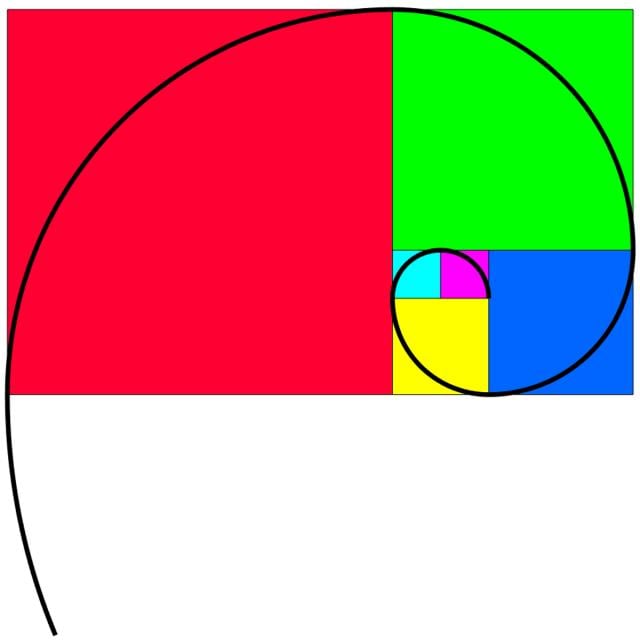
We learn about the golden spiral and the Fibonacci spiral. Because of the relationship between the Fibonacci numbers and the golden ratio, the Fibonacci spiral eventually converges to the golden spiral. You will recognise the Fibonacci spiral because it is the icon of our course. We next learn about continued fractions. To construct a continued fraction is to construct a sequence of rational numbers that converges to a target irrational number. The golden ratio is the irrational number whose continued fraction converges the slowest. We say that the golden ratio is the irrational number that is the most difficult to approximate by a rational number, or that the golden ratio is the most irrational of the irrational numbers. We then define the golden angle, related to the golden ratio, and use it to model the growth of a sunflower head. Use of the golden angle in the model allows a fine packing of the florets, and results in the unexpected appearance of the Fibonacci numbers in the sunflower.

Go to Class
MOOC List is learner-supported. When you buy through links on our site, we may earn an affiliate commission.

Related Courses

Aprendizaje de las matemáticas de primaria (Coursera) Coursera
Universidad de los Andes

Aprendizaje de las matemáticas de primaria (Coursera)

En este segundo curso de acceso gratuito* del programa especializado Educación Matemática para profesores de primaria, conocerás las cuestiones particulares sobre el aprendizaje de las matemáticas y las dificultades y los errores más frecuentes que tienen que enfrentar los estudiantes al aprenderlas. El curso tiene una duración aproximada de seis semanas, con una dedicación promedio de 4 horas semanales. Todas las evaluaciones tienen retroalimentación y podrás descargar la mayoría de los recursos del curso.

Jun 22nd 2026
5-12 Weeks
Mathematical Foundations for Cryptography (Coursera) Coursera
University of Colorado System

Mathematical Foundations for Cryptography (Coursera)

Welcome to Course 2 of Introduction to Applied Cryptography. In this course, you will be introduced to basic mathematical principles and functions that form the foundation for cryptographic and cryptanalysis methods. These principles and functions will be helpful in understanding symmetric and asymmetric cryptographic methods examined in Course 3 and Course 4. These topics should prove especially useful to you if you are new to cybersecurity. It is recommended that you have a basic knowledge of computer science and basic math skills such as algebra and probability.

Jun 22nd 2026
4 Weeks
Aléatoire : une introduction aux probabilités - Partie 1 (Coursera) Coursera
École Polytechnique

Aléatoire : une introduction aux probabilités - Partie 1 (Coursera)

Ce cours d'introduction aux probabilités a la même contenu que le cours de tronc commun de première année de l'École polytechnique donné par Sylvie Méléard. Le cours introduit graduellement la notion de variable aléatoire et culmine avec la loi des grands nombres et le théorème de la limite centrale. Les notions mathématiques nécessaires sont introduites au fil du cours et de nombreux exercices corrigés sont proposés.

Jun 15th 2026
5-12 Weeks
Initiation à la théorie des distributions (Coursera) Coursera
École Polytechnique

Initiation à la théorie des distributions (Coursera)

Une fonction discontinue peut-elle être solution d'une équation différentielle? Comment définir rigoureusement la masse de Dirac (une "fonction" d'intégrale un, nulle partout sauf en un point) et ses dérivées? Peut-on définir une notion de "dérivée d'ordre fractionnaire"? Cette initiation aux distributions répond à ces questions - et à bien d'autres.

Jun 15th 2026
5-12 Weeks
Calculus through Data & Modelling: Integration Applications (Coursera) Coursera
Johns Hopkins University

Calculus through Data & Modelling: Integration Applications (Coursera)

This course continues your study of calculus by focusing on the applications of integration. The applications in this section have many common features. First, each is an example of a quantity that is computed by evaluating a definite integral. Second, the formula for that application is derived from Riemann sums. Rather than measure rates of change as we did with differential calculus, the definite integral allows us to measure the accumulation of a quantity over some interval of input values.

Jun 22nd 2026
4 Weeks
Fundamentals of Engineering Exam Review (Coursera) Coursera
Georgia Institute of Technology

Fundamentals of Engineering Exam Review (Coursera)

The purpose of this course is to review the material covered in the Fundamentals of Engineering (FE) exam to enable the student to pass it. It will be presented in modules corresponding to the FE topics, particularly those in Civil and Mechanical Engineering. Each module will review main concepts, illustrate them with examples, and provide extensive practice problems.

Jun 15th 2026
5-12 Weeks
Information Theory (Coursera) Coursera
The Chinese University of Hong Kong

Information Theory (Coursera)

At the completion of this course, the student should be able to: demonstrate knowledge and understanding of the fundamentals of information theory; appreciate the notion of fundamental limits in communication systems and more generally all systems; develop deeper understanding of communication systems; apply the concepts of information theory to various disciplines in information science.

Jun 15th 2026
13-24 Weeks
Algebra: Elementary to Advanced - Equations & Inequalities (Coursera) Coursera
Johns Hopkins University

Algebra: Elementary to Advanced - Equations & Inequalities (Coursera)

This course is intended for students looking to create a solid algebraic foundation of fundamental mathematical concepts from which to take more advanced courses that use concepts from precalculus, calculus, probability, and statistics. This course will help solidify your computational methods, review algebraic formulas and properties, and apply these concepts model real world situations.

Jun 22nd 2026
4 Weeks
Algebra: Elementary to Advanced - Functions & Applications (Coursera) Coursera
Johns Hopkins University

Algebra: Elementary to Advanced - Functions & Applications (Coursera)

After completing this course, students will learn how to successfully apply functions to model different data and real world occurrences. This course reviews the concept of a function and then provide multiple examples of common and uncommon types of functions used in a variety of disciplines. Formulas, domains, ranges, graphs, intercepts, and fundamental behavior are all analyzed using both algebraic and analytic techniques. From this core set of functions, new functions are created by arithmetic operations and function composition.

Jun 22nd 2026
3 Weeks