Electrones en Acción: Electrónica y Arduinos para tus propios Inventos (Coursera)

Electrones en Acción: Electrónica y Arduinos para tus propios Inventos (Coursera)

Este curso introduce al alumno a la electrónica y los Arduinos, comenzando desde lo más básico de un circuito eléctrico y finalizando con el diseño de circuitos de baja complejidad empleando dispositivos electrónicos programables. Durante el curso los alumnos aprenderán los fundamentos básicos de la electricidad y de la electrónica, conocerán los diferentes bloques empleados en el diseño de un circuito electrónico, aprenderán las bases del diseño de circuitos analógicos y digitales, y serán introducidos a la programación de estos últimos empleando la plataforma Arduino.

Class Deals by MOOC List - Click here and see Coursera's Active Discounts, Deals, and Promo Codes.

El curso apunta a estudiante de último año de educación escolar y primer año de educación universitaria, o cualquier otro alumno con suficiente motivación como para llevar a cabo sus propios experimentos y seguir aprendiendo en el futuro.
Si bien no es un requisito esencial, los alumnos que tengan nociones de cálculo diferencial e integral podrán entender mejor algunos tópicos específicos, que no son estrictamente necesarios para concluir el curso.
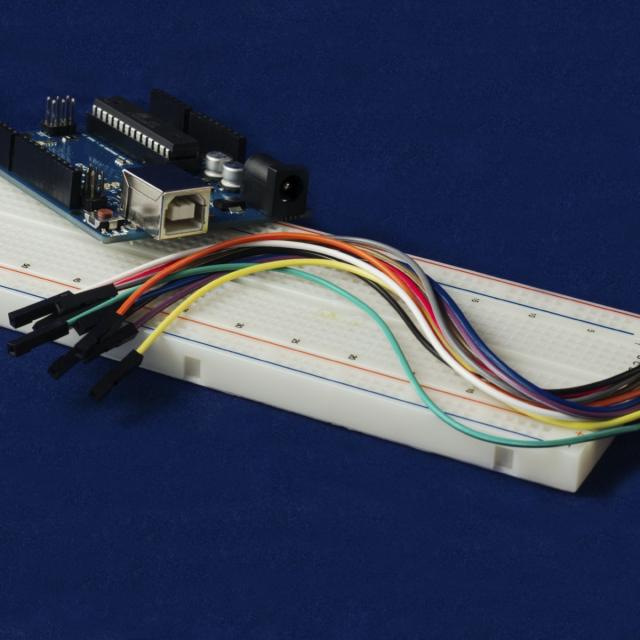
El curso incluye demostraciones de dispositivos electromecánicos sencillos controlados mediante un Arduino. Cada circuito demostrativo lleva asociado un diagrama de conexiones y un programa, ambos debidamente explicados, para facilitar que sean replicados por los alumnos empleando la plataforma Arduino.

Syllabus

WEEK 1
El mundo físico, eléctrico y digital
Este módulo es una introducción a los sistemas electrónicos en general, mostrando diferentes bloques típicos y genéricos empleados para la adquisición y procesamiento de señales, y la acción sobre el mundo.

WEEK 2
Introducción a la plataforma Arduino
Este módulo describe la plataforma Arduino, tanto en el hardware, el software, su conectividad a diferentes periféricos, y su programación.

WEEK 3
Circuitos electrónicos
Este módulo es una introducción al análisis de circuitos, con una rápida pincelada sobre diversos dispositivos electrónicos empleados en circuitos de acondicionamiento de señales y en el manejo de actuadores.

WEEK 4
Periféricos
Este módulo pretende aplicar todo lo aprendido en módulos anteriores, en el diseño de ejemplos prácticos de sistemas electrónicos programables empleando sensores y actuadores.
Go to Class
MOOC List is learner-supported. When you buy through links on our site, we may earn an affiliate commission.

Related Courses

Digital Systems: From Logic Gates to Processors (Coursera) Coursera
Universitat Autònoma de Barcelona

Digital Systems: From Logic Gates to Processors (Coursera)

This course gives you a complete insight into the modern design of digital systems fundamentals from an eminently practical point of view. Unlike other more "classic" digital circuits courses, our interest focuses more on the system than on the electronics that support it. This approach will allow us to lay the foundation for the design of complex digital systems.

Jun 8th 2026
5-12 Weeks
Introduction to Power Electronics (Coursera) Coursera
University of Colorado Boulder

Introduction to Power Electronics (Coursera)

This course introduces the basic concepts of switched-mode converter circuits for controlling and converting electrical power with high efficiency. Principles of converter circuit analysis are introduced, and are developed for finding the steady state voltages, current, and efficiency of power converters. Assignments include simulation of a dc-dc converter, analysis of an inverting dc-dc converter, and modeling and efficiency analysis of an electric vehicle system and of a USB power regulator.

Jun 1st 2026
3 Weeks
Designing Electronics for Recycling in a Circular Economy (edX) EdX
Delft University of Technology,DelftX

Designing Electronics for Recycling in a Circular Economy (edX)

Discover the latest developments in Design for Recycling (DfR) of electrical and electronic equipment (EEE) and the application of recycled plastics into new products. Electronic products bring countless benefits to society, but their production and waste treatment also lead to numerous negative environmental and economic impacts. Since E-waste is the world’s fastest growing waste stream, governments are setting ambitious targets to help this industry transition towards a circular economy.

Nov 15th 2023
4 Weeks
Semiconductor Fundamentals (edX) EdX
Purdue University,PurdueX

Semiconductor Fundamentals (edX)

From smartphones to satellites, semiconductors are everywhere. Tying together physics, chemistry, and electrical engineering, this easy-to-follow introduction provides the background needed to understand devices such as transistors and solar cells. This course provides the essential foundations required to understand the operation of semiconductor devices such as transistors, diodes, solar cells, light-emitting devices, and more.

Jan 9th 2023
5-12 Weeks
Teaching Physical Computing with Raspberry Pi and Python (FutureLearn) FutureLearn
Raspberry Pi Foundation

Teaching Physical Computing with Raspberry Pi and Python (FutureLearn)

Explore the exciting world of physical computing and create electronic circuits that you can control with code. Learn the benefits of using physical computing with your students. On this course from the Raspberry Pi Foundation, you will be introduced to the world of physical computing. You will use input devices to capture data, process that data with the Python programming language, and then use output devices to get information back out from your computer.

Mar 6th 2023
3 Weeks
Wie 'denkt' ein Computer? Vom Sandkorn bis zur Software (openHPI) OpenHPI
Hasso-Plattner-Institut

Wie 'denkt' ein Computer? Vom Sandkorn bis zur Software (openHPI)

Wie funktioniert ein Computer eigentlich? Diese Frage hast Du Dir wahrscheinlich schon einmal gestellt. Ausgehend von Transistoren und elektrischen Schaltungen finden wir heraus, woraus ein Prozessor besteht und wie er funktioniert. Dabei probieren wir selbst mit verschiedenen Simulationstools das Gelernte aus und entdecken die Welt der Rechnertechnik.

Apr 26th 2023
4 Weeks
Teaching Physical Computing to 5-11 year olds (FutureLearn) FutureLearn
Raspberry Pi Foundation,National Centre for Computing Education

Teaching Physical Computing to 5-11 year olds (FutureLearn)

Teach your young learners how to create electronic circuits, then learn to control them using block-based programming languages. Learn how to create physical computing projects using a Crumble or micro:bit. Physical computing is the process of designing, building, and programming systems that use physical components such as buttons, lights, and motors.

Mar 6th 2023
3 Weeks
Modeling and Control of Single-Phase Rectifiers and Inverters (Coursera) Coursera
University of Colorado Boulder

Modeling and Control of Single-Phase Rectifiers and Inverters (Coursera)

This is Course #5 in the Modeling and Control of Power Electronics Specialization. The course is focused on modeling and control of grid-tied power electronics. Upon completion of the course, you will be able to understand, analyze, model, and design low-harmonic rectifiers and inverters interfacing dc loads or dc power sources, such as photovoltaic arrays, to the single-phase ac power grid.

Jun 8th 2026
3 Weeks
Sensors and Sensor Circuit Design (Coursera) Coursera
University of Colorado Boulder

Sensors and Sensor Circuit Design (Coursera)

After taking this course, you will be able to: understand how to specify the proper thermal, flow, or rotary sensor for taking real-time process data; implement thermal sensors into an embedded system in both hardware and software; add the sensor and sensor interface into a microprocessor based development kit; create hardware and firmware to process sensor signals and feed data to a microprocessor for further evaluation; study sensor signal noise and apply proper hardware techniques to reduce it to acceptable levels.

Jun 1st 2026
5-12 Weeks
Electron and Ion Beam Characterization (Coursera) Coursera
Arizona State University

Electron and Ion Beam Characterization (Coursera)

Electron and ion beams are widely used for both qualitative and quantitative analysis of semiconductor materials and devices. They can be used to image structures with sub-nm resolution and to provide information about elemental composition and dopant concentration. This course describes the fundamentals of electron and ion beam characterization and includes a project that analyzes the surface roughness of a solar cell.

Jun 8th 2026
5-12 Weeks