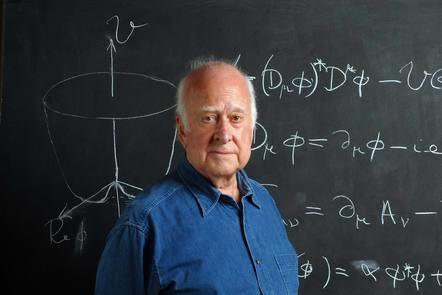
Should we be excited about the Higgs boson? Find out more about particle physics and understanding the universe. The discovery of a new fundamental particle at the Large Hadron Collider (LHC), CERN is the latest step in a long quest seeking to answer one of physics’ most enduring questions: why do particles have mass? The experiments’ much anticipated success confirms predictions made decades earlier by Peter Higgs and others, and offers a glimpse into a universe of physics beyond the Standard Model.
Class Deals by MOOC List - Click here and see FutureLearn's Active Discounts, Deals, and Promo Codes.
As Professor Peter Higgs continues his inspiring role at Edinburgh University’s School of Physics & Astronomy, the experiments at the LHC continue.
This free online course introduces the theoretical tools needed to appreciate the discovery, and presents the elementary particles that have been discovered at the tiniest scales ever explored. Beginning with basic concepts in classical mechanics, the story unfolds through relativity and quantum mechanics, describing forces, matter and the unification of theories with an understanding driven by the tools of mathematics.
Narrating the journey through experimental results which led to the discovery in 2012, the course invites you to learn from a team of world-class physicists at Edinburgh University. Learners participate in discussion of the consequences of the Higgs boson, to physics and cosmology, and towards a stronger understanding and new description of the universe.
Syllabus
Week 1: Theoretical description of physical phenomena
Week 2: From Maxwell to Einstein: the world at the atomic scale
Week 3: A theory of matter and light
Week 4: From QED to QCD and the weak force
Week 5: The Brout-Englert-Higgs mechanism and the Standard Model
Week 6: Experimental evidence for the Standard Model
Week 7: Beyond the Standard Model
What will you achieve?
By the end of the course, you‘ll be able to...
- Discuss fundamental building blocks of the Standard Model
- Explore Quantum Mechanics and Special Relativity
- Describe elementary Particle Physics