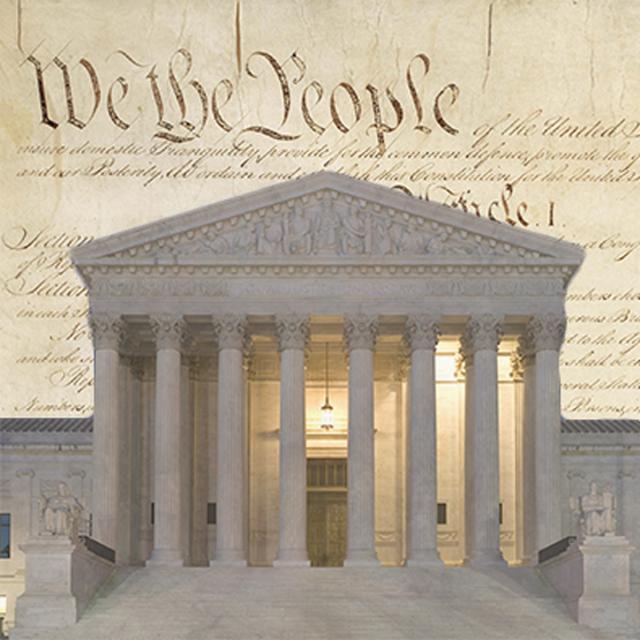
Chemerinsky on Constitutional Law - The Structure of Government (Coursera)

Chemerinsky on Constitutional Law - The Structure of Government (Coursera)

This course will highlight the construction and interpretation of the U.S. Constitution through the centuries. You'll learn the history behind the Constitution, cases that formed important precedent, and how changes in interpretation have been dependent on shifts in cultural and political climate as well as the composition of the Supreme Court.

Class Deals by MOOC List - Click here and see Coursera's Active Discounts, Deals, and Promo Codes.

We'll start with an overview of the Constitution where we'll consider questions such as "Why the Constitution?" and "What function does the Constitution serve?" Next we'll examine how the Constitution and its subsequent interpretation established the powers of the federal, legislative, and judicial branches of government and allocated powers to the states. In the last half of the course we will investigate the protection of individual rights and liberties and take a look at what rights are and are not protected and investigate several important shifts in jurisprudence.
Join me as we look at the questions both raised and answered by the Constitution and those that interpret it!
By the end of this course, you should be able to:

  • Describe how the structure of the United States government has been shaped by both the text of the Constitution and by subsequent interpretation and practice of political actors in all branches of government
  • Describe the individual liberties protected by the Constitution and account for the history and structure of their protection
  • Illustrate compromises found in the Constitution by citing examples and historic background
  • Articulate the importance of key cases such as Marbury v. Madison, McCullough v. Maryland, and Lochner v. New York
  • Explain how the outcome of cases is often dependent upon the current cultural and political climate as well as the composition of the court by citing particular cases and important shifts in the court's jurisprudence
  • Assess the relative suitability of various approaches to constitutional interpretation and analysis

Syllabus

WEEK 1
Welcome - Let's Get Started
Lecture 1 - Why the Constitution?
In this module, we'll examine two facets of the critical question, "Why the Constitution?" First we'll answer the question, "what functions does the Constitution perform?" We'll then consider the question, "why achieve these functions in the form of a written Constitution?"

WEEK 2
Lecture 2 - The Federal Judicial Power
What is the authority of judicial review? Why is it important? If the federal judiciary can declare a statute or action unconstitutional, what checks are there on this power? These are several of the questions we will endeavor to answer in this module.

WEEK 3
Lecture 3 - The Federal Legislative Power
In this module we will consider three major questions: 1.How did McCullough vs. Maryland shape the power of the legislature? 2. What are the major powers of the Congress under the Constitution? 3. To what extent do states limit the power of the Congress?

WEEK 4
Lecture 4 - The Federal Executive Power
The central questions in this module are: 1. When can a president act without express Constitutional or Congressional authority? 2. What are the Constitutional problems posed by the federal administrative agencies? 3. What is the authority of the President with regard to foreign policy?

WEEK 5
Lecture 5 - Federalism
The goal of this module is to consider two important ways that the power of states are kept in check by the federal government: preemption and the dormant commerce clause.
Conclusion
As the course draws to a final close, we would like to thank you for your participation.

Go to Class
MOOC List is learner-supported. When you buy through links on our site, we may earn an affiliate commission.

Related Courses

Basic Statistics (Coursera) Coursera
University of Amsterdam

Basic Statistics (Coursera)

Understanding statistics is essential to understand research in the social and behavioral sciences. In this course you will learn the basics of statistics; not just how to calculate them, but also how to evaluate them. This course will also prepare you for the next course in the specialization - the course Inferential Statistics. In the first part of the course we will discuss methods of descriptive statistics. You will learn what cases and variables are and how you can compute measures of central tendency (mean, median and mode) and dispersion (standard deviation and variance). Next, we discuss how to assess relationships between variables, and we introduce the concepts correlation and regression.

Jun 8th 2026
5-12 Weeks
Introduction to Economic Theories (Coursera) Coursera
Erasmus University Rotterdam

Introduction to Economic Theories (Coursera)

Wondering why economists have not predicted serious financial crises? Shocked by economic assumptions of human behavior as self-centered and focusing only on what can be measured? Asking yourself if there are no sensible economic alternatives to free markets? Then you are at the right place to learn economics! This is the first online course that teaches economics from a pluralist perspective. Economic pluralism means that a plurality of theoretical and methodological viewpoints is regarded as valuable in itself and is simply the best way in which economics can make progress in understanding the world.

Jun 8th 2026
5-12 Weeks
Inferential Statistics (Coursera) Coursera
University of Amsterdam

Inferential Statistics (Coursera)

Inferential statistics are concerned with making inferences based on relations found in the sample, to relations in the population. Inferential statistics help us decide, for example, whether the differences between groups that we see in our data are strong enough to provide support for our hypothesis that group differences exist in general, in the entire population. We will start by considering the basic principles of significance testing: the sampling and test statistic distribution, p-value, significance level, power and type I and type II errors. Then we will consider a large number of statistical tests and techniques that help us make inferences for different types of data and different types of research designs.

Jun 8th 2026
5-12 Weeks
University Teaching (Coursera) Coursera
University of Hong Kong

University Teaching (Coursera)

University Teaching is an introductory course in teaching and learning in tertiary education, designed by staff at the Centre for the Enhancement of Teaching and Learning at the University of Hong Kong. With input from instructors, guests and interviewees, including teaching award winners, students, and experts in the fields, you will be exposed to research evidence in relation to effective university teaching and practical instructional design strategies. You will also be exposed to multiple examples of effective teaching, and hear the views of teachers whose teaching has been judged to be excellent.

Jun 8th 2026
5-12 Weeks
Privacy in the Western World (Coursera) Coursera
EIT Digital

Privacy in the Western World (Coursera)

Welcome to this course about privacy. We are thrilled to see that you are interested and will provide you with a comprehensive study of this intriguiging subject. We hope this course will enthuse you to look further into privacy and personal data regulation. Especially in the light of recent events it becomes more important to know about your (alleged!?) rights and freedoms.

Jun 8th 2026
5-12 Weeks
The Sustainable Development Goals – A global, transdisciplinary vision for the future (Coursera) Coursera
University of Copenhagen

The Sustainable Development Goals – A global, transdisciplinary vision for the future (Coursera)

In 2015, the UN launched the 17 Sustainable Development Goals (SDGs). Adopted by 193 member states, the goals represent an important international step in setting humanity on a trajectory towards sustainable development. Within this course, you will get a historical overview of how sustainability has been understood, as well as a thorough introduction to the SDGs – what they are, how progress can be measured, and how the SDGs are relevant for the management of the global systems supporting humanity. The course will examine how various societal actors are responding to and implementing the SDGs.

Jun 8th 2026
3 Weeks
Design Thinking for the Greater Good: Innovation in the Social Sector (Coursera) Coursera
University of Virginia

Design Thinking for the Greater Good: Innovation in the Social Sector (Coursera)

Do you work for a nonprofit or in the social sector? Are you struggling to solve the problems and meet the needs of the people you serve? Come learn more about how design thinking, a human-centered approach to problem solving, can help you truly understand an issue, generate ideas worth testing and iterate to find solutions that make a real difference. Through global stories from areas as diverse as government, health care, and education, we’ll show you the tools, techniques and mindset needed to use design thinking to uncover new and creative solutions in the social sector.

Jun 8th 2026
4 Weeks
American Contract Law II (Coursera) Coursera
Yale University

American Contract Law II (Coursera)

Contracts I & II provides a comprehensive overview of contract law in the United States. The course covers most of the key concepts found in a first year law school class. Each lecture is based on one or more common-law cases, integrating legal doctrines with policy discussions. The course also covers key sections from the Uniform Commercial Code (UCC), which governs the sale of goods.

Jun 8th 2026
5-12 Weeks
Network Dynamics of Social Behavior (Coursera) Coursera
University of Pennsylvania

Network Dynamics of Social Behavior (Coursera)

How do revolutions emerge without anyone expecting them? How did social norms about same sex marriage change more rapidly than anyone anticipated? Why do some social innovations take off with relative ease, while others struggle for years without spreading? More generally, what are the forces that control the process of social evolution –from the fashions that we wear, to our beliefs about religious tolerance, to our ideas about the process of scientific discovery and the best ways to manage complex research organizations?

Jun 8th 2026
5-12 Weeks
A Law Student's Toolkit (Coursera) Coursera
Yale University

A Law Student's Toolkit (Coursera)

Whether you are an advanced law student looking to review the basics, or an aspiring law student looking for head start, this course will help you build the foundation you will need to succeed in law school and beyond. This course will introduce you to terminology, concepts, and tools lawyers and legal academics use to make their arguments. It will help you follow these arguments—and make arguments of your own.

Jun 8th 2026
3 Weeks
Water Resources Management and Policy (Coursera) Coursera
University of Geneva

Water Resources Management and Policy (Coursera)

Water management today is faced with new challenges such as climate change or the effects of human activity. Public and private stakeholders who are active in this field must develop new ways to better manage the water cycle "as a whole". The objective of this MOOC is to develop an understanding of the problems related to water management. Firstly, this course will define a resource and, more specifically, the resource of water.

Jun 8th 2026
5-12 Weeks
Helping Families Avoid Negative Court Involvement Teach-Out (Coursera) Coursera
Johns Hopkins University

Helping Families Avoid Negative Court Involvement Teach-Out (Coursera)

This course will teach learners how to understand when issues can become legal issues, encourage learners to recognize legal problems early, identify possible “legal soft spots” in their own situations, and act when issues are identified to avoid them escalating. This course will also teach and encourage learners to think preventatively and provide some tools to use with an eye toward preventing future legal issues.

Jun 8th 2026
1 Week