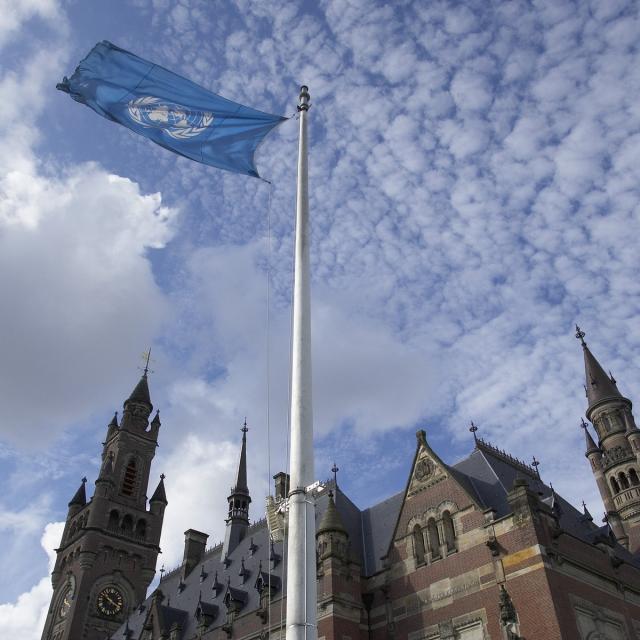
International Law in Action: A Guide to the International Courts and Tribunals in The Hague (Coursera)

Offered by Leiden University,
International Law in Action: A Guide to the International Courts and Tribunals in The Hague (Coursera)

International Law in Action explains the functions of each international court and tribunal present in The Hague, and it looks at how these institutions address contemporary problems. On the basis of selected cases, and through interviews with judges and lawyers, you will explore the role of these courts and tribunals and their potential to contribute to global justice. The first module of the course will investigate how judicial settlement is different from other more political forms of dispute settlement, such as negotiation and mediation. It offers a brief historical overview and introduces the judicial and arbitral bodies based in The Hague.

Class Deals by MOOC List - Click here and see Coursera's Active Discounts, Deals, and Promo Codes.

In the remaining modules you will learn about the functions of these courts and tribunals, and some of the challenges and prospects that they face. Three cross-cutting themes tie together all of these modules: (i) The interaction between law and politics; (ii) The continuing role of State consent; and (iii) The ability of international courts and tribunals to protect the public interest and global values.
This course offers you an opportunity to gain a better insight into the functions and features of the courts and tribunals present in The Hague. You will gain a familiarity with each court or tribunal. You will develop realistic expectations of their capacity to address contemporary problems and an awareness of their limitations. You will also be able to discuss some of their most prominent cases.
If you would like to have a better understanding of international law in action in The Hague, this is definitely the course for you!
This course is free to join and to participate in. There is the possibility to get a verified certificate for the course, which is a paid option. If you want a certificate, but are unable to pay for it, you can request financial aid via Coursera.

Syllabus

WEEK 1
An introduction to the International Courts and Tribunals in The Hague
Welcome to this first week in which we will enter the world of the international judiciary with you. We will discuss the evolution of international dispute settlement in our international legal order. The leading question is: why did people start thinking about creating international courts? We will also introduce the community of international courts present in The Hague today.

WEEK 2
The International Court of Justice (ICJ)
This week we are going to explore the principle judicial organ of the United Nations—the International Court of Justice. This Court has dual functions as an institution that settles disputes between States, and as an advice giver within the UN system. We will explore the limitations that the Court faces in its fulfilment of these functions as well as its potential as an institution, particularly in the context of disputes involving the protection of the environment. From this week onwards, you will also be able to start working on the peer assignment. All relevant information with regard to the peer assignment can be find below. We look forward to reading how you view the future of the international courts and tribunals in The Hague!

WEEK 3
The Arbitration of International Disputes
This week, we will explore the world of international arbitration. More specifically, we will focus on the Permanent court of arbitration, inter-state arbitration and investor-state arbitration. Through our videos, you will discover the history and characteristics of arbitration and you will understand how its functioning is impacted by the dynamics at play within the international and domestic societies. You will also come to realize the importance of public interests in the disputes settled through arbitration and you will learn how they are taken into account in international arbitration.

WEEK 4
International Criminal Courts and Tribunals
This week examines a relatively new type of international courts, namely international criminal courts, with a focus on the ICC. We will discuss ongoing cases and debates, including sensitive issues such as the prosecution of sitting Heads of States. We will also inquire whether the international community is in need of a new dedicated international terrorism tribunal.

WEEK 5
Conclusions of the three Course Themes
This week, we will directly focus on the three course themes that have structured our discussions in the previous modules: law and politics, state consent and global values. For each of these themes, the videos of this module will give you the opportunity to synthetize the knowledge that you have acquired over the course and to compare the various courts and tribunals that have been analyzed through the lenses of the course themes. The videos in this module will also offer you some concluding observations and insights which will stimulate you to continue to reflect on these three themes and the international courts in The Hague more generally. This week, you will also take the final exam of this course; good luck on this!
Go to Class
MOOC List is learner-supported. When you buy through links on our site, we may earn an affiliate commission.

Related Courses

Overcoming Dyslexia (Coursera) Coursera
Yale University

Overcoming Dyslexia (Coursera)

Dyslexia is everywhere, touching so many children and adults, and while science has made extraordinary progress in understanding and clarifying the condition, this incredible powerful knowledge rarely reaches those who most need to know and would greatly benefit from it. Our goal is to change all this with the Coursera you are about to view, produced by Dr. Sally Shaywitz, the Audrey G. Ratner Professor in Learning Development, both the leading scientist studying dyslexia and the most devoted advocate for helping those who are dyslexic.

Sep 5th 2026
5-12 Weeks
Human Rights for Open Societies (Coursera) Coursera
Universiteit Utrecht

Human Rights for Open Societies (Coursera)

Law

Human rights are under pressure in many places across the globe. Peaceful protests are violently quashed. Voting is tampered with. And minorities are often excluded from decision-making. All of this threatens the ideal of an open society in which each of us can be free and participate equally. A solid protection of human rights is needed for an open society to exist and to flourish. But it is often an uphill battle to work towards that ideal. Equip yourself and learn more about what human rights are and how they work.

Sep 6th 2026
5-12 Weeks
Citizenship and the Rule of Law (Coursera) Coursera
University of London

Citizenship and the Rule of Law (Coursera)

"Be you so high, the law is above you." This principle, part of the Rule of Law, has come to represent the powerful idea that even politicians and monarchs are bound by the law. However in an age of powerful corporations, international cyber-crime and popular support for authoritarian leaders, the Rule of Law is under threat worldwide.

Sep 7th 2026
5-12 Weeks
Civic Engagement in American Democracy (Coursera) Coursera
Duke University

Civic Engagement in American Democracy (Coursera)

So how does the American political system work? Who are some of the key actors? What are key concepts for a student trying to understand what’s going on? How can I as a citizen influence politics? Civic Engagement in American Democracy takes on these and other key questions. We’re Dr. Nicholas Carnes and Dr. Bruce Jentleson, the principal course instructors. Along with our Duke faculty colleagues who also contributed modules, we’ve designed the course to provide a strong foundational introduction to US politics.

Sep 7th 2026
4 Weeks
Diversity and Inclusion in Education (Coursera) Coursera
University of Glasgow

Diversity and Inclusion in Education (Coursera)

Student diversity is becoming the rule rather than the exception in education systems across the world. Students bring to classroom different characteristics such as ability and disability, socio-economic background, race, ethnicity, and cultural background, beliefs and religion, and gender characteristics. The United Nations’ Sustainable Development Goal 4 aims to ensure inclusive and equitable quality education and promote lifelong learning opportunities for all (United Nations, 2015).

Sep 7th 2026
4 Weeks
Chemerinsky on Constitutional Law - The Structure of Government (Coursera) Coursera
University of California, Irvine

Chemerinsky on Constitutional Law - The Structure of Government (Coursera)

This course will highlight the construction and interpretation of the U.S. Constitution through the centuries. You'll learn the history behind the Constitution, cases that formed important precedent, and how changes in interpretation have been dependent on shifts in cultural and political climate as well as the composition of the Supreme Court.

Sep 14th 2026
5-12 Weeks
Copyright for Educators & Librarians (Coursera) Coursera
Duke University,Emory University,University of North Carolina at Chapel Hill

Copyright for Educators & Librarians (Coursera)

Fear and uncertainty about copyright law often plagues educators and sometimes prevents creative teaching. This course is a professional development opportunity designed to provide a basic introduction to US copyright law and to empower teachers and librarians at all grade levels. Course participants will discover that the law is designed to help educators and librarians.

Sep 14th 2026
5-12 Weeks
Terrorism and Counterterrorism: Comparing Theory and Practice (Coursera) Coursera
Leiden University

Terrorism and Counterterrorism: Comparing Theory and Practice (Coursera)

Terrorism has arguably been one of the defining factors of our age. It frequently makes headlines, threatening or attacking governments, private business and ordinary citizens. And in many parts of the world, it has been one of the most important threats to peace, security and stability. But what does this exactly mean? What is the nature of this threat? Who or what is threatened, how, by whom and why? What can be done about it or how can we at least limit the impact of terrorism and make sure that terrorists do not make headlines and manage to scare us? These are just a handful of questions that will be addressed in this course that consists of three parts.

Sep 7th 2026
5-12 Weeks
Chemerinsky on Constitutional Law - Individual Rights and Liberties (Coursera) Coursera
University of California, Irvine

Chemerinsky on Constitutional Law - Individual Rights and Liberties (Coursera)

Chemerinsky on Constitutional Law: Individual Rights and Liberties will highlight the construction and interpretation of the U.S. Constitution through the centuries with an emphasis on protections of individual liberties and the evolution of equal protection. You'll learn the history behind the Constitution, cases that formed important precedent, and how changes in interpretation have been dependent on shifts in cultural and political climate as well as the composition of the Supreme Court.

Sep 7th 2026
5-12 Weeks
Introduction to Key Constitutional Concepts and Supreme Court Cases (Coursera) Coursera
University of Pennsylvania

Introduction to Key Constitutional Concepts and Supreme Court Cases (Coursera)

This course offers an introduction to the U.S. Constitution and landmark Supreme Court cases interpreting it. It explores the Constitution’s origins, its amendment over the years, and methods of constitutional interpretation. Topics include the nature and structure of the federal government, the powers of the federal government, and individual rights.

Sep 7th 2026
4 Weeks
Introduction to Environmental Law and Policy (Coursera) Coursera
University of North Carolina

Introduction to Environmental Law and Policy (Coursera)

Environmental law may be the one institution standing between us and planetary exhaustion. It is also an institution that needs to be reconciled with human liberty and economic aspirations. This course considers these issues and provides a tour though existing legal regimes governing pollution, water law, endangered species, toxic substances, environmental impact analyses, and environmental risk.

Sep 4th 2026
5-12 Weeks