FUN

Cellular neurophysiology: how neurons communicate (FUN)

Cellular neurophysiology: how neurons communicate (FUN)

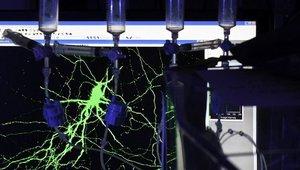
How does information circulate in the nervous system? How is the universal language of neurons, the action potential, generated? How does it travel along axons? And how does it influence other neurons? Thanks to this MOOC, you will master these basic principles of neuronal physiology.

This MOOC is especially intended for students in biological sciences, high school science teachers, graduate students, research assistants and researchers who want to understand electrophysiology basics.

With an emphasis on the experimental approach, this course will address:

  • the ion concentration gradient and membrane potential that control the movement of ions across the neuronal membrane. These ion movements create ion currents;
  • the genesis of the action potential and its propagation to the axon terminals;
  • the function of the synapse: neurotransmitter release, postsynaptic glutamate and GABA receptors, postsynaptic currents and their integration.

Course format
Every week, the chapter includes:

  • short didactic videos presenting cellular neurophysiology
  • videos of experiments performed in a research laboratory
  • additional documents for those who want to deepen some concepts
  • automatically corrected quizzes to check that you understand the key concepts
  • a forum to discuss with one another, to stay motivated and to learn even more!

Prerequisites
We strongly recommend that you know essential concepts of cell biology (cell, membrane...) and a few basics of chemistry (ions, proteins...). We will review some principles, but this course is for people who have completed a year of college/university in a scientific field. It is even better if you know some physics (the notions of current, potential, resistance), but do note that we will use only two mathematical equations in this course.
Obviously, this training also requires you to be able to use a computer and the internet and that you have enough motivation and autonomy to complete it.

Course content

Week 1: Ion gradients
Week 2: Action potential
Week 3: Neurotransmitter release
Week 4: Glutamatergic synaptic transmission
Week 5: GABAergic synaptic transmission
Week 6: Postsynaptic integration

Go to Class
MOOC List is learner-supported. When you buy through links on our site, we may earn an affiliate commission.

Related Courses

OWU2 - Universidad de la viña y del vino abierta a todos 2 (FUN) FUN
Université de Bourgogne

OWU2 - Universidad de la viña y del vino abierta a todos 2 (FUN)

Open Wine University, es la universidad de la viña y del vino abierta a todos. Creado en 2015 por la Universidad de Borgoña, el MOOC OWU1 ha sido un pionero en el campo de la viña y el vino. Hoy, este MOOC vuelve con una version OWU2 que incluye nuevos contenidos y actividades, todos plenamente disponibles en cuatro idiomas: francés, inglés, español y chino. Durante cinco semanas, los participantes descubrirán las diferentes facetas del vino gracias a un enfoque multidisciplinario.

No sessions available
5-12 Weeks
Fundamentals of Neuroscience, Part 2: Neurons and Networks (edX) EdX
HarvardX,Harvard University

Fundamentals of Neuroscience, Part 2: Neurons and Networks (edX)

Discover what makes your brain tick in this second part of a four-part introductory series in Neuroscience. Neurons in isolation are fascinating and complicated, but the real magic of neuroscience happens in the interaction between neurons. In this course, we examine how neurons pass signals to one another and how complex dynamics can result from just a few neurons arranged in relatively simple circuits.

Self Paced
Self-Paced
Synapses, Neurons and Brains (Coursera) Coursera
Hebrew University of Jerusalem

Synapses, Neurons and Brains (Coursera)

These are very unique times for brain research. The aperitif for the course will thus highlight the present “brain-excitements” worldwide. You will then become intimately acquainted with the operational principles of neuronal “life-ware” (synapses, neurons and the networks that they form) and consequently, on how neurons behave as computational microchips and how they plastically and constantly change - a process that underlies learning and memory.

Jun 1st 2026
5-12 Weeks
Computational Neuroscience (Coursera) Coursera
University of Washington

Computational Neuroscience (Coursera)

This course provides an introduction to basic computational methods for understanding what nervous systems do and for determining how they function. We will explore the computational principles governing various aspects of vision, sensory-motor control, learning, and memory. Specific topics that will be covered include representation of information by spiking neurons, processing of information in neural networks, and algorithms for adaptation and learning.

Jun 22nd 2026
5-12 Weeks
Fundamentals of Neuroscience, Part 1: The Electrical Properties of the Neuron (edX) EdX
HarvardX,Harvard University

Fundamentals of Neuroscience, Part 1: The Electrical Properties of the Neuron (edX)

Learn how electricity makes the neurons in your brain tick. Fundamentals of Neuroscience is a three-courseseries that explores the structure and function of the nervous system—from the inner workings of a single nerve cell to the staggering complexity of the brain and the social interactions they enable.

Self Paced
Self-Paced
Voyage au cœur du vivant avec les rayons X : la cristallographie (FUN) FUN
Université Paris-Saclay

Voyage au cœur du vivant avec les rayons X : la cristallographie (FUN)

L’utilisation des structures tridimensionnelles de macromolécules biologiques fait partie du quotidien d’un grand nombre de biologistes. Ces structures permettent de comprendre leur fonctionnement, de dessiner des mutants pour étudier leur fonction, de dessiner des molécules pour les bloquer ou les activer. L’approche majeure pour résoudre la structure tridimensionnelle de macromolécules biologiques est la cristallographie aux rayons X. Ce MOOC est une initiation complète à la cristallographie biologique : depuis l'histoire de la méthode jusqu'à ses outils concrets.Nous vous transmettons nos connaissances et notre expérience par le biais de vidéos théoriques et en situation.

No sessions available
5-12 Weeks
Des neurones à la psyché, Introduction aux réseaux de neurones biologiques et artificiels (FUN) FUN
Communauté Université Grenoble Alpes

Des neurones à la psyché, Introduction aux réseaux de neurones biologiques et artificiels (FUN)

La thématique du cours porte sur la compréhension des réseaux de neurones biologiques et artificiels dans une perspective théorique (liens entre neurones et psyché, avantage d’un système parallèle distribué par rapport à une machine de Turing-Von Neumann) mais aussi méthodologique (implémentation concrète de réseaux de neurones artificiels).

No session available
4 Weeks
Neurosciences : audition, langage et musique (FUN) FUN
Université libre de Bruxelles

Neurosciences : audition, langage et musique (FUN)

De la berceuse chantée au bébé jusqu’au discours enflammé du politicien et ses intonations, du chanteur sous la douche au pianiste virtuose, le langage et la musique font partie de notre vie sociale, intellectuelle et affective tout au long de notre vie. Comment ces informations sont-elles traitées par le cerveau ? Comment est-on capable de déduire l’état émotionnel d’autrui à partir de la mélodie de sa voix, sa prosodie ? Comment la voix est-elle modifiée pendant un épisode émotionnel, quels sont les mécanismes cérébraux à l’œuvre ? Est-ce que l’apprentissage de la musique modifie la structure du cerveau ?

No sessions available
5-12 Weeks
Éducation par la recherche : neurosciences à l’École III (FUN) FUN
Université Sorbonne Paris Cité

Éducation par la recherche : neurosciences à l’École III (FUN)

L’objectif de ce MOOC Éducation par la recherche : neurosciences à l'École III est de former les professeurs des écoles et du collège, les animateurs, les formateurs d'enseignants, un modèle de l’Éducation par la recherche appliqué aux neurosciences. Il s’agit notamment pour chaque participant de concevoir, mettre en oeuvre et consolider son projet Savanturiers.

No session available
5-12 Weeks
Innate Immunity (FUN) FUN
Institut Pasteur

Innate Immunity (FUN)

More than a century ago, Elie Metchnikoff established the bases of cellular innate immunity when he discovered the mechanism of phagocytosis. However, during most of the XXth century, adaptive immunity (also known as specific immunity) focused most of the interest of the researchers, until Charles Janeway and Polly Matzinger revisited the definition of immunology. What was called “non-specific immunity” was renamed “innate immunity”, and the understanding of the sensing of the exogenous or endogenous dangers signals, and their identification revolutionized our understanding of the early mechanism aimed to defend the integrity of the host against any type of attacks including pathogens.

Jan 14th 2022
5-12 Weeks