FUN

Des neurones à la psyché, Introduction aux réseaux de neurones biologiques et artificiels (FUN)

Des neurones à la psyché, Introduction aux réseaux de neurones biologiques et artificiels (FUN)

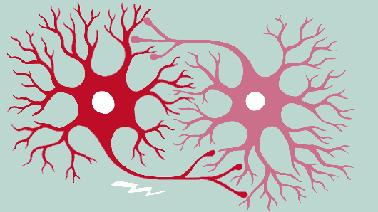
La thématique du cours porte sur la compréhension des réseaux de neurones biologiques et artificiels dans une perspective théorique (liens entre neurones et psyché, avantage d’un système parallèle distribué par rapport à une machine de Turing-Von Neumann) mais aussi méthodologique (implémentation concrète de réseaux de neurones artificiels).

Ce cours se déroulera sur quatre semaines. Chaque semaine sera composée de 2 à 4 vidéos (de 10 à 15 minutes). Des Quizz vous permettront de valider vos acquis.

Plan du cours

Semaine 1 : Les origines de la psychologie cognitive
Semaine 2 : Algorithmes d'apprentissage synaptique
Semaine 3 : Similitude entre les réseaux de neurones biologiques et artificiels : première partie
Semaine 4 : Similitude entre les réseaux de neurones biologiques et artificiels : seconde partie : Vers des réseaux artificiels conscients ?

Go to Class
MOOC List is learner-supported. When you buy through links on our site, we may earn an affiliate commission.

Related Courses

Custom Models, Layers, and Loss Functions with TensorFlow (Coursera) Coursera
DeepLearning.AI

Custom Models, Layers, and Loss Functions with TensorFlow (Coursera)

In this course, you will: • Compare Functional and Sequential APIs, discover new models you can build with the Functional API, and build a model that produces multiple outputs including a Siamese network; • Build custom loss functions (including the contrastive loss function used in a Siamese network) in order to measure how well a model is doing and help your neural network learn from training data; • Build off of existing standard layers to create custom layers for your models, customize a network layer with a lambda layer, understand the differences between them, learn what makes up a custom layer, and explore activation functions; • Build off of existing models to add custom functionality, learn how to define your own custom class instead of using the Functional or Sequential APIs, build models that can be inherited from the TensorFlow Model class, and build a residual network (ResNet) through defining a custom model class.

Jun 15th 2026
5-12 Weeks
S'initier à la Data Science et à ses enjeux (FUN) FUN
CY Cergy Paris Université

S'initier à la Data Science et à ses enjeux (FUN)

La Data Science d’un monde qui change ! La Big data, et plus généralement l’analyse de données, occupent une place de plus en plus importante au sein des stratégies de nombreuses organisations. Suivi de performance, analyse des comportements, découvertes de nouvelles opportunités de marché : les applications sont multiples, et intéressent des secteurs variés. Du e-commerce à la finance, en passant par les transports et la santé, les entreprises ont besoin de talents formés à la collecte, au stockage, mais aussi au traitement et à la modélisation des données.

Self Paced
Self-Paced
Getting Started with Machine Learning at the Edge on Arm (Coursera) Coursera
Arm

Getting Started with Machine Learning at the Edge on Arm (Coursera)

The age of machine learning has arrived! Arm technology is powering a new generation of connected devices with sophisticated sensors that can collect a vast range of environmental, spatial and audio/visual data. Typically this data is processed in the cloud using advanced machine learning tools that are enabling new applications reshaping the way we work, travel, live and play.

Jun 8th 2026
5-12 Weeks
Reinforcement Learning for Trading Strategies (Coursera) Coursera
New York Institute of Finance,Google Cloud

Reinforcement Learning for Trading Strategies (Coursera)

In the final course from the Machine Learning for Trading specialization, you will be introduced to reinforcement learning (RL) and the benefits of using reinforcement learning in trading strategies. You will learn how RL has been integrated with neural networks and review LSTMs and how they can be applied to time series data. By the end of the course, you will be able to build trading strategies using reinforcement learning, differentiate between actor-based policies and value-based policies, and incorporate RL into a momentum trading strategy.

Jun 15th 2026
3 Weeks
Introduction to Trading, Machine Learning & GCP (Coursera) Coursera
New York Institute of Finance,Google Cloud

Introduction to Trading, Machine Learning & GCP (Coursera)

In this course, you’ll learn about the fundamentals of trading, including the concept of trend, returns, stop-loss, and volatility. You will learn how to identify the profit source and structure of basic quantitative trading strategies. This course will help you gauge how well the model generalizes its learning, explain the differences between regression and forecasting, and identify the steps needed to create development and implementation backtesters. By the end of the course, you will be able to use Google Cloud Platform to build basic machine learning models in Jupyter Notebooks.

Jun 15th 2026
4 Weeks
Introduction to Computer Vision (Coursera) Coursera
University of Colorado Boulder

Introduction to Computer Vision (Coursera)

Introduction to Computer Vision guides learners through the essential algorithms and methods to help computers 'see' and interpret visual data. You will first learn the core concepts and techniques that have been traditionally used to analyze images. Then, you will learn modern deep learning methods, such as neural networks and specific models designed for image recognition, and how it can be used to perform more complex tasks like object detection and image segmentation. Additionally, you will learn the creation and impact of AI-generated images and videos, exploring the ethical considerations of such technology.

Jun 15th 2026
4 Weeks
Supervised Text Classification for Marketing Analytics (Coursera) Coursera
University of Colorado Boulder

Supervised Text Classification for Marketing Analytics (Coursera)

Marketing data often requires categorization or labeling. In today’s age, marketing data can also be very big, or larger than what humans can reasonably tackle. In this course, students learn how to use supervised deep learning to train algorithms to tackle text classification tasks. Students walk through a conceptual overview of supervised machine learning and dive into real-world datasets through instructor-led tutorials in Python. The course concludes with a major project.

Jun 8th 2026
4 Weeks
Visual Perception (Coursera) Coursera
Columbia University

Visual Perception (Coursera)

The ultimate goal of a computer vision system is to generate a detailed symbolic description of each image shown. This course focuses on the all-important problem of perception. We first describe the problem of tracking objects in complex scenes. We look at two key challenges in this context. The first is the separation of an image into object and background using a technique called change detection.

Jun 15th 2026
5-12 Weeks
Health Data Science Foundation (Coursera) Coursera
University of Illinois at Urbana-Champaign

Health Data Science Foundation (Coursera)

This course is intended for persons involved in machine learning who are interested in medical applications, or vice versa, medical professionals who are interested in the methods modern computer science has to offer to their field. We will cover health data analysis, different types of neural networks, as well as training and application of neural networks applied on real-world medical scenarios.

Jun 15th 2026
4 Weeks