EdX

The Book: Monasteries, Schools, and Notaries, Part 1: Reading the Late Medieval Marseille Archive (edX)

The Book: Monasteries, Schools, and Notaries, Part 1: Reading the Late Medieval Marseille Archive (edX)

Understand handwriting’s role in the later Middle Ages as Europe was in the midst of the "paper revolution” and the quantity of documents was exploding.

Class Deals by MOOC List - Click here and see EdX's Active Discounts, Deals, and Promo Codes.

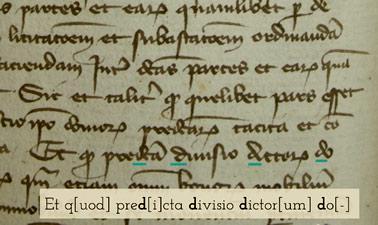
Medieval Europe has preserved enormous quantities of books and documents—many millions of pages, in fact—written in Latin and other languages. However, only a tiny percentage of these texts have been edited and published. To gain access to the rest, you need to learn the art and science of reading medieval handwriting.

This module of The Book: Histories Across Time and Space introduces students to the world of medieval paleography, the science of reading old handwriting. This particular module focuses on notarial handwriting from the city of Marseille in the 14th and 15th centuries. The module features household inventories, which identify some of the fascinating objects found in people’s houses. Assessments and quizzes will allow you to track your progress as you move from letter-group to letter-group. In addition to learning the handwriting, we will take special care to explore some of the many abbreviations and other elements of the secular registers of the later Middle Ages.
Some knowledge of Latin or another Romance Language will be very helpful for understanding the texts you will read, but students without these language skills will still enjoy this chance to explore medieval handiwork.
What you'll learn:

  • A style of handwriting known as notarial cursive, which was used for such documents across most of Europe in the later Middle Ages
  • The basic form of each letter, including variations and false positives
  • Standard abbreviations
  • Editing and navigation marks
Go to Class
MOOC List is learner-supported. When you buy through links on our site, we may earn an affiliate commission.

Related Courses

Biblical Archaeology: The archaeology of ancient Israel and Judah (edX) EdX
IsraelX

Biblical Archaeology: The archaeology of ancient Israel and Judah (edX)

Join me as I share with you my passion for archaeological discovery and learn about the exciting methods of modern archaeology. Explore how archaeology illuminates biblical Israel and Judah, and the archaeological finds relate to the bible. Join me for an introductory course on biblical archaeology of ancient Israel and Judah during the Iron Age (ca. 1200-586 BCE).

Nov 1st 2022
5-12 Weeks
Age of Cathedrals (Coursera) Coursera
Yale University

Age of Cathedrals (Coursera)

An introduction to some of the most astonishing architectural monuments the world has ever known—Gothic cathedrals. We shall study the art, literature, intellectual life, economics, and new social arrangements that arose in the shadow of the cathedrals and that were such an important part of the revival of cities in the twelfth and thirteenth centuries. The goal of the course is a better appreciation of the High Middle Ages, a world that is still recognizably our own.

Jun 8th 2026
5-12 Weeks
Toledo: Deciphering Secrets of Medieval Spain (Coursera) Coursera
University of Colorado System

Toledo: Deciphering Secrets of Medieval Spain (Coursera)

This course evaluates the medieval history of Toledo from the era of the Visigoth Kingdom (6th-8th centuries) through its Islamic period (8th to 11th centuries) and into its reintegration into Christian Spain (after 1085 c.e.) In particular, we take note of the cultural and religious transformations that characterized the city with a special effort to understand how many peoples and religions came to settle and live amongst one another.

Jul 1st 2024
5-12 Weeks
Histoire des sciences : une introduction (FUN) FUN
Université de Montpellier

Histoire des sciences : une introduction (FUN)

L'histoire des sciences, qu'est-ce que c'est et à quoi ça sert ? Comprendre les dynamiques qui ont permis aux sciences de se constituer, explorer ses évolutions, son organisation et ses démarches, telle est l'ambition de ce MOOC qui propose une initiation à une histoire critique des sciences. Se repérer dans l'histoire des sciences en abordant les grandes étapes de la science. Comparer les méthodes développées. La place de la mathématisation, le statut de l'observation et de l'expérience seront particulièrement examinés. Aborder à l'aide d'études de cas la question de la construction sociale des sciences et celle des communautés scientifiques (statut, institution, etc.)

No sessions available
5-12 Weeks
Enlightening the Dark Ages: Early Medieval Archaeology in Italy (FutureLearn) FutureLearn
University of Padova

Enlightening the Dark Ages: Early Medieval Archaeology in Italy (FutureLearn)

Learn what innovative methods and tools applied to the material culture of the past can tell us about the Early Middle Ages. Discovering the cultural heritage of Medieval Europe through archaeology On this archaeology course, you will explore what we can learn about the past through material culture. It focuses on the history of Medieval Europe, from the end of the Roman Empire in the West.

Nov 1st 2021
4 Weeks
Découper le temps : les périodes de l'histoire (FUN) FUN
Université Paris 1 Panthéon-Sorbonne

Découper le temps : les périodes de l'histoire (FUN)

L’objet du cours est de comprendre les raisons qui poussent l’historien à découper le temps. L’enseignement de l’histoire en France est traditionnellement découpé en quatre périodes canoniques : histoire ancienne, médiévale, moderne et contemporaine. Que signifient ces époques qui sont le produit d’une histoire avant tout européenne et méditerranéenne ? Ce qui pose la question de la pertinence de cette périodisation pour d’autres aires géographiques.

No sessions available
5-12 Weeks
Medieval Women Writers (saylor.org) Saylor Academy
Saylor.org

Medieval Women Writers (saylor.org)

Scholarship on medieval women writers is a somewhat recent phenomenon, in part because we know relatively little about men of the Middle Ages—and what we know about women from the period is even more limited. In this course, we will engage this new frontier in literary studies by examining the writings of a diverse group of medieval women—from reclusive anchoresses to aristocratic women of the court—and analyzing the perceptions of reality, both secular and religious, that they present.

Legacy Course
Self-Paced
The Bible in Light of the Ancient Near East (edX) EdX
IsraelX

The Bible in Light of the Ancient Near East (edX)

This course is an introduction to the Bible, set against the background of the rich Archaeological findings from the Ancient Near East. The purpose of this course is to introduce you to the fascinating world of Israel’s neighboring civilizations in biblical times. It offers a comparative study that examines the relationship between the Bible and these civilizations.

Mar 14th 2023
5-12 Weeks