Bioorganic Chemistry (saylor.org)

Offered by Saylor.org,
Bioorganic Chemistry (saylor.org)

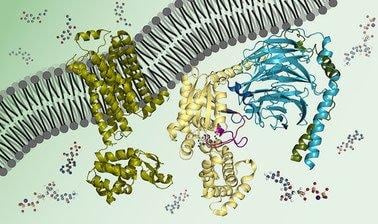
Bioorganic chemistry studies the chemistry of organic biomolecules. It is a rapidly growing interdisciplinary field that combines organic chemistry and biochemistry.

Bioorganic chemistry studies the chemistry of organic biomolecules. It is a rapidly growing interdisciplinary field that combines organic chemistry and biochemistry. Please recall that organic chemistry investigates all molecules that contain carbon and hydrogen, and biochemistry focuses on the network of molecular pathways in the cell. Bioorganic chemistry employs organic chemistry to explain how enzymes catalyze the reactions of metabolic pathways and why metabolites react the way they do. Bioorganic chemistry aims to expand organic-chemical research on structures, synthesis, and kinetics in a biological direction.

This one-semester course will cover several advanced chemistry topics and will discuss the chemistry behind biological processes. The course begins by introducing you to the mechanisms behind the most common biological chemical reactions (Unit 1). You will then take a closer look at the metabolic processes of biomolecules. You will apply your knowledge of the structural features of organic molecules to biomolecules (Unit 2). The next four units will cover the chemistry of metabolic processes in the cell: lipid metabolism (Unit 3), carbohydrate metabolism (Unit 4), amino acid metabolism (Unit 5), and nucleotide metabolism (Unit 6). This course will also discuss the medical significance of the relevant deficiencies of these pathways.

Upon successful completion of this course, the student will be able to:

Identify and characterize lipids, carbohydrates, amino acids, and nucleic acids.
Recognize chiral organic molecules, and explain their biological significance.
Explain the process of electrophilic and nucleophilic reactions, redox reactions, and enzyme catalyzed reactions.
Define the role of coenzymes and allosteric regulators in enzyme catalyzed reactions.
Compare and link terpenoid and steroid biosynthesis.
Compare and contrast the biosynthesis and the break down of biomolecules in the cell.
Predict the products of substitution, elimination, condensation, and redox reactions.
Design enzyme catalyzed reactions that lead to high-energy compound products.
Explain why certain lipids and amino acids are essential while others are not.
Determine the significance of fermentation during anaerobic metabolism.
Explain why certain metabolic pathways are called “cycles.”
Explain what happens if a eukaryotic cell lacks oxalic acid, ribulose bisphosphate, or ornithine.
Compare and contrast the Citric Acid Cycle and the Calvin Cycle.
Go to Class
MOOC List is learner-supported. When you buy through links on our site, we may earn an affiliate commission.

Related Courses

Advanced Inorganic Chemistry (saylor.org) Saylor Academy
Saylor.org

Advanced Inorganic Chemistry (saylor.org)

Advanced Inorganic Chemistry is designed to give you the knowledge to explain everyday phenomena of inorganic complexes. You will study the various aspects of their physical and chemical properties and learn how to determine the practical applications that these complexes can have in industrial, analytical, and medicinal chemistry.

Legacy Course
Self-Paced
Introduction to Chemistry: Reactions and Ratios (Coursera) Coursera
Duke University

Introduction to Chemistry: Reactions and Ratios (Coursera)

This is an introductory course for students with limited background in chemistry; basic concepts involved in chemical reactions, stoichiometry, the periodic table, periodic trends, nomenclature, and chemical problem solving will be emphasized with the goal of preparing students for further study in chemistry as needed for many science, health, and policy professions.

Jun 15th 2026
5-12 Weeks
Science & Cooking: From Haute Cuisine to Soft Matter Science (physics) (edX) EdX
HarvardX,Harvard University

Science & Cooking: From Haute Cuisine to Soft Matter Science (physics) (edX)

Top chefs and Harvard researchers explore how traditional and modernist cooking techniques can illuminate basic principles in chemistry, physics, and engineering. Learn about elasticity, viscosity, mayonnaise, baking, and more! In this course, which investigates physical transformations in food, we will be visited by world-famous chefs who use a number of different styles and techniques in their cooking. Each chef will demonstrate how he or she prepares delicious and interesting creations, and we will explore how fundamental scientific principles make them possible.

Self Paced
Self-Paced
Fluid Mechanics (saylor.org) Saylor Academy
Saylor.org

Fluid Mechanics (saylor.org)

In this course you will first learn about the definition of a fluid and the properties of a fluid, such as density, compressibility, and viscosity. You will then see how these properties influence the way in which fluids flow in response to pressure and velocity variations. You will study this dependence via conservation equations for mass, momentum, and energy. Use and solution of these equations for many situations allows the determination of many details of the fluid flow.

Legacy Course
Self-Paced
Iniciándome en la Química (Coursera) Coursera
Universidad Autónoma Metropolitana

Iniciándome en la Química (Coursera)

En este curso aprenderás los conocimientos básicos de química general que te permitirán tener una mejor comprensión del estudio de la química, así como de la naturaleza. A lo largo del curso aprenderás la clasificación de la materia y sus propiedades, las teorías atómicas, la clasificación periódica, los tipos de enlaces y nomenclatura inorgánica.

Jun 22nd 2026
4 Weeks
Basics of Nuclear Magnetic Resonance (FUN) FUN
Université Lille

Basics of Nuclear Magnetic Resonance (FUN)

Nuclear Magnetic Resonance (NMR) phenomenon is currently exploited for many purposes, including medical imaging using the MRI technique as well as the characterization of the structure and the dynamics of matter at atomic scale by NMR spectroscopy, which is a key tool in chemistry, structural biology, pharmacology and material sciences. NMR is also employed for oil exploration or the inspection of artworks. "Basics of Nuclear Magnetic Resonance" is the first course of a comprehensive three-part online learning programme on NMR.

Oct 5th 2021
5-12 Weeks
Pre-University Chemistry (edX) EdX
Delft University of Technology,DelftX

Pre-University Chemistry (edX)

Prepare for university by reviewing the science and technology of chemistry. Become familiar with the way chemistry and chemistry-related topics are taught at university level. Chemistry is the fundamental discipline that helps us explain properties, structure, and behavior of matter. A solid foundation in chemistry is of importance in addressing today’s challenges with innovative chemical technological solutions.

Jul 3rd 2023
5-12 Weeks
Industrial Biotechnology (Coursera) Coursera
University of Manchester

Industrial Biotechnology (Coursera)

Fossil fuels have been the primary energy source for society since the Industrial Revolution. They provide the raw material for the manufacture of many everyday products that we take for granted, including pharmaceuticals, food and drink, materials, plastics and personal care. As the 21st century progresses we need solutions for the manufacture of chemicals that are smarter, more predictable and more sustainable.

Jun 15th 2026
5-12 Weeks
Nanotechnology and Nanosensors, Part 2 (Coursera) Coursera
Technion - Israel Institute of Technology

Nanotechnology and Nanosensors, Part 2 (Coursera)

Learn about novel sensing tools that make use of nanotechnology to screen, detect and monitor various events in personal or professional life. Together, we will lay the groundwork for infinite innovative applications, starting from diagnosis and treatments of diseases, continuing with quality control of goods and environmental aspects, and ending with monitoring security issues.

Jun 15th 2026
5-12 Weeks
Predictive Models for Toxic Chemical Releases (Coursera) Coursera
University of California, Davis

Predictive Models for Toxic Chemical Releases (Coursera)

Discover the core principles of process safety and risk analysis in chemical engineering through our dynamic course. Gain expertise in modeling liquid and gas leaks, accurately assessing potential material releases, and calculating downwind exposures to toxic chemicals using state-of-the-art dispersion models. This course equips chemical engineers with essential skills to evaluate and mitigate hazardous concentrations effectively, ensuring industrial process safety.

Jun 22nd 2026
4 Weeks