Automating Image Processing (Coursera)

Offered by MathWorks,
Automating Image Processing (Coursera)

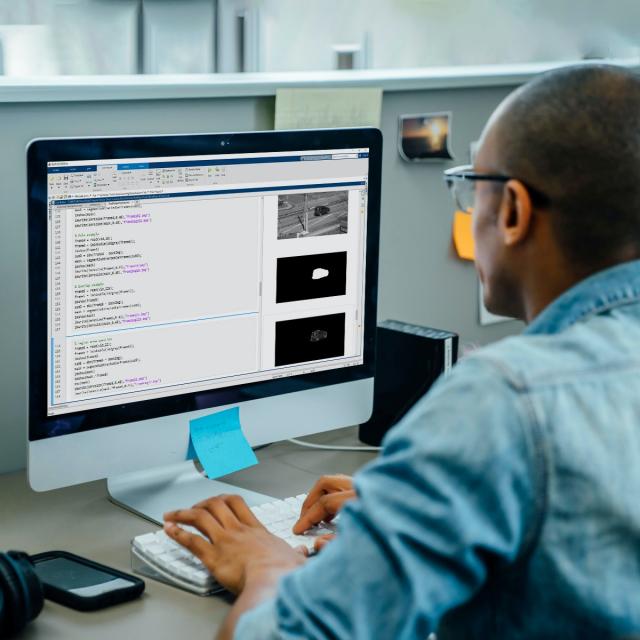
In this course, you will build on the skills acquired in Image Segmentation, Filtering, and Region Analysis to explore large sets of images and video files. It’s impractical to manually inspect results in large data sets. Automating image processing allows you to do your work more efficiently.

Class Deals by MOOC List - Click here and see Coursera's Active Discounts, Deals, and Promo Codes.

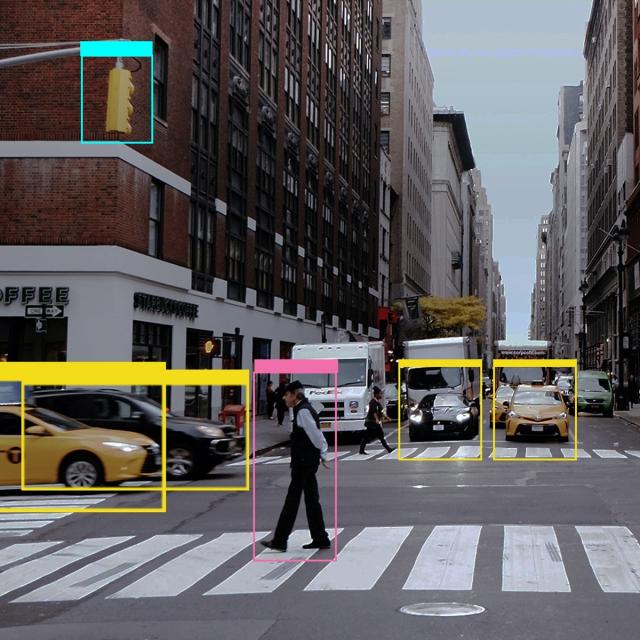
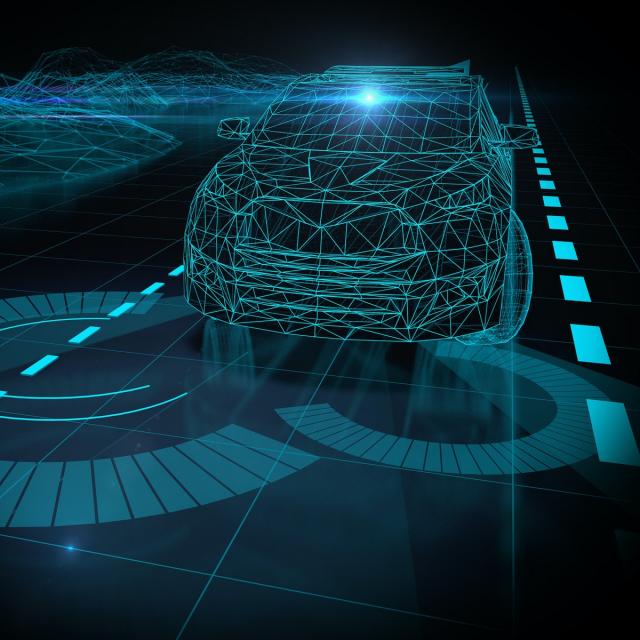
At the end of this course, you’ll apply all the skills learned in this specialization to a final project. You’ll take the role of an engineer being asked to monitor traffic on a busy road. You’ll detect cars from a noisy video and analyze the results.
You will use MATLAB throughout this course. MATLAB is the go-to choice for millions of people working in engineering and science, and provides the capabilities you need to accomplish your image processing tasks. You will be provided with free access to MATLAB for the duration of the course to complete your work.
To be successful in this course you should have a background in basic math and some exposure to MATLAB. If you want to familiarize yourself with MATLAB check out the free, two-hour MATLAB Onramp. Experience with image processing is not required.
Course 3 of 3 in the Image Processing for Engineering and Science Specialization.

Syllabus

WEEK 1: Processing Batches of Images
WEEK 2: Working with Video Files
WEEK 3: Analyzing Results
WEEK 4: Final Project: Detecting Cars in a Noisy Video
Go to Class
MOOC List is learner-supported. When you buy through links on our site, we may earn an affiliate commission.

Related Courses

Camera and Imaging (Coursera) Coursera
Columbia University

Camera and Imaging (Coursera)

This course covers the fundamentals of imaging – the creation of an image that is ready for consumption or processing by a human or a machine. Imaging has a long history, spanning several centuries. But the advances made in the last three decades have revolutionized the camera and dramatically improved the robustness and accuracy of computer vision systems. We describe the fundamentals of imaging, as well as recent innovations in imaging that have had a profound impact on computer vision.

Jun 15th 2026
5-12 Weeks
Probabilistic Graphical Models 1: Representation (Coursera) Coursera
Stanford University

Probabilistic Graphical Models 1: Representation (Coursera)

Probabilistic graphical models (PGMs) are a rich framework for encoding probability distributions over complex domains: joint (multivariate) distributions over large numbers of random variables that interact with each other. These representations sit at the intersection of statistics and computer science, relying on concepts from probability theory, graph algorithms, machine learning, and more. They are the basis for the state-of-the-art methods in a wide variety of applications, such as medical diagnosis, image understanding, speech recognition, natural language processing, and many, many more. They are also a foundational tool in formulating many machine learning problems.

Jun 8th 2026
5-12 Weeks
Mastering Programming with MATLAB (Coursera) Coursera
Vanderbilt University

Mastering Programming with MATLAB (Coursera)

The course builds on the foundation laid by the first course of the Specialization called “Introduction to Programming with MATLAB.” It covers more advanced programming concepts such as recursion, vectorization, function handles, algorithm efficiency and others. At the same time, it presents many features that make MATLAB a powerful programming environment for engineering and scientific computing, such as its support for object oriented programming, the new user interface design environment and Live Scripts.

Jun 22nd 2026
5-12 Weeks
Fundamentals of Digital Image and Video Processing (Coursera) Coursera
Northwestern University

Fundamentals of Digital Image and Video Processing (Coursera)

In this class you will learn the basic principles and tools used to process images and videos, and how to apply them in solving practical problems of commercial and scientific interests. Digital images and videos are everywhere these days – in thousands of scientific (e.g., astronomical, bio-medical), consumer, industrial, and artistic applications. Moreover they come in a wide range of the electromagnetic spectrum - from visible light and infrared to gamma rays and beyond.

Jun 15th 2026
5-12 Weeks
Introduction to Machine Learning with Python (Coursera) Coursera
Arizona State University

Introduction to Machine Learning with Python (Coursera)

This course will give you an introduction to machine learning with the Python programming language. You will learn about supervised learning, unsupervised learning, deep learning, image processing, and generative adversarial networks. You will implement machine learning models using Python and will learn about the many applications of machine learning used in industry today. You will also learn about and use different machine learning algorithms to create your models.

Jun 15th 2026
4 Weeks
Detección de objetos (Coursera) Coursera
Universitat Autònoma de Barcelona

Detección de objetos (Coursera)

¿Te interesa la visión por computador? ¿Te gustaría conocer qué métodos puedes utilizar para detectar y reconocer objetos en una imagen? En este curso te introducirás en los principios básicos de cualquier sistema automático de detección y reconocimiento de objetos en imágenes. A lo largo del curso analizaremos diferentes métodos de representación y clasificación que te permitirán abordar casos de aplicación de complejidad creciente.

Jun 8th 2026
5-12 Weeks
Advanced Computer Vision with TensorFlow (Coursera) Coursera
DeepLearning.AI

Advanced Computer Vision with TensorFlow (Coursera)

In this course, you will: a) Explore image classification, image segmentation, object localization, and object detection. Apply transfer learning to object localization and detection; b) Apply object detection models such as regional-CNN and ResNet-50, customize existing models, and build your own models to detect, localize, and label your own rubber duck images; c) Implement image segmentation using variations of the fully convolutional network (FCN) including U-Net and d) Mask-RCNN to identify and detect numbers, pets, zombies, and more; d) Identify which parts of an image are being used by your model to make its predictions using class activation maps and saliency maps and apply these ML interpretation methods to inspect and improve the design of a famous network, AlexNet.

Jun 22nd 2026
4 Weeks
Dynamical Modeling Methods for Systems Biology (Coursera) Coursera
Icahn School of Medicine at Mount Sinai

Dynamical Modeling Methods for Systems Biology (Coursera)

An introduction to dynamical modeling techniques used in contemporary Systems Biology research. We take a case-based approach to teach contemporary mathematical modeling techniques. The course is appropriate for advanced undergraduates and beginning graduate students. Lectures provide biological background and describe the development of both classical mathematical models and more recent representations of biological processes. The course will be useful for students who plan to use experimental techniques as their approach in the laboratory and employ computational modeling as a tool to draw deeper understanding of experiments.

Jun 15th 2026
5-12 Weeks
Predictive Modeling and Machine Learning with MATLAB (Coursera) Coursera
MathWorks

Predictive Modeling and Machine Learning with MATLAB (Coursera)

In this course, you will build on the skills learned in Exploratory Data Analysis with MATLAB and Data Processing and Feature Engineering with MATLAB to increase your ability to harness the power of MATLAB to analyze data relevant to the work you do. These skills are valuable for those who have domain knowledge and some exposure to computational tools, but no programming background.

Jun 22nd 2026
4 Weeks
Image and video processing: From Mars to Hollywood with a stop at the hospital (Coursera) Coursera
Duke University

Image and video processing: From Mars to Hollywood with a stop at the hospital (Coursera)

In this course, you will learn the science behind how digital images and video are made, altered, stored, and used. We will look at the vast world of digital imaging, from how computers and digital cameras form images to how digital special effects are used in Hollywood movies to how the Mars Rover was able to send photographs across millions of miles of space.

Jun 15th 2026
5-12 Weeks