EdX

Applied Bayesian for Analytics (edX)

Applied Bayesian for Analytics (edX)

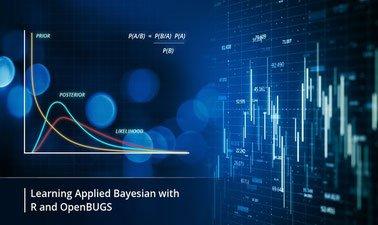
Learn how to construct, fit, estimate and compute Bayesian statistical models with the help of OpenBUGS (freely available software). Bayesian Statistics is a captivating field and is used most prominently in data sciences. In this course we will learn about the foundation of Bayesian concepts, how it differs from Classical Statistics including among others Parametrizations, Priors, Likelihood, Monte Carlo methods and computing Bayesian models with the exploration of Multilevel modelling.

Class Deals by MOOC List - Click here and see EdX's Active Discounts, Deals, and Promo Codes.

This course is divided into two parts i.e. Theoretical and Empirical part of Bayesian Analytics. First three weeks cover the Theoretical part which includes how to form a prior, how to calculate a posterior and several other aspects. Rest of the weeks will cover the empirical part which explains how to compute Bayesian modelling. Completion of this course will provide you with an understanding of the Bayesian approach, the primary difference between Bayesian and Frequentist approaches and experience in data analyses.

What you'll learn

  • Understand the necessary Bayesian concepts from practical point of view for better decision making.
  • Learn Bayesian approach to estimate likely event outcomes, or probabilities using datasets.
  • Gain “hands on” experience in creating and estimating Bayesian models using R and OPENBUGS.

Syllabus

Week 01: What is Bayesian Statistics and How it is different than Classical Statistics
Foundations of Bayesian Inference
Bayes theorem
Advantages of Bayesian models
Why Bayesian approach is so important in Analytics
Major densities and their applications

Week 02: Bayesian analysis of Simple Models
Likelihood theory and Estimation
Parametrizations and priors
Learning from binary models
Learning from Normal Distribution

Week 03: Monte Carlo Methods
Basics of Monte carol integration
Basics of Markov chain Monte Carlo
Gibs Sampling

Week 04: Computational Bayes
Examples of Bayesian Analytics
Introduction to R and OPENBUGS for Bayesian analysis

Week 05: Bayesian Linear Models
Context for Bayesian Regression Models
Normal Linear regression
Logistic regression

Week 06: Bayesian Hierarchical Models
Introduction to Multilevel models
Exchangeability
Computation in Hierarchical Models


Go to Class
MOOC List is learner-supported. When you buy through links on our site, we may earn an affiliate commission.

Related Courses

Data, Analytics and Learning (edX) EdX
University of Texas at Arlington,UTArlingtonX

Data, Analytics and Learning (edX)

An introduction to the logic and methods of analysis of data to improve teaching and learning. Capturing and analyzing data has changed how decisions are made and resources are allocated in businesses, journalism, government, and military and intelligence fields. Through better use of data, leaders are able to plan and enact strategies with greater clarity and confidence.

No sessions available
4 Weeks
Probability: Basic Concepts & Discrete Random Variables (edX) EdX
Purdue University,PurdueX

Probability: Basic Concepts & Discrete Random Variables (edX)

Learn fundamental concepts of mathematical probability to prepare for a career in the growing field of information and data science. Our capacity to collect and store data has exponentially increased, but deriving information from data from a scientific perspective requires a foundational knowledge of probability. Are you interested in a career in the emerging data science field, or as an actuarial scientist? Or want better to understand statistical theory and mathematical modeling?

No sessions available
5-12 Weeks
Analytics in Python (edX) EdX
Columbia University,ColumbiaX

Analytics in Python (edX)

Learn the fundamental of programming in Python and develop the ability to analyze data and make data-driven decisions. Data is the lifeblood of an organization. Competency in programming is an essential skill for successfully extracting information and knowledge from data. The goal of this course is to introduce learners to the basics of programming in Python and to give a working knowledge of how to use programs to deal with data.

This course is archived
5-12 Weeks
Probability - The Science of Uncertainty and Data (edX) EdX
MIT,MITx

Probability - The Science of Uncertainty and Data (edX)

Build foundational knowledge of data science with this introduction to probabilistic models, including random processes and the basic elements of statistical inference. The world is full of uncertainty: accidents, storms, unruly financial markets, noisy communications. The world is also full of data. Probabilistic modeling and the related field of statistical inference are the keys to analyzing data and making scientifically sound predictions.

Jan 29th 2024
13-24 Weeks
Foundations of Data Analysis - Part 1: Statistics Using R (edX) EdX
University of Texas at Austin,UTAustinX

Foundations of Data Analysis - Part 1: Statistics Using R (edX)

Use R to learn fundamental statistical topics such as descriptive statistics and modeling. In this first part of a two part course, we’ll walk through the basics of statistical thinking – starting with an interesting question. Then, we’ll learn the correct statistical tool to help answer our question of interest – using R and hands-on Labs. Finally, we’ll learn how to interpret our findings and develop a meaningful conclusion.

No sessions available
5-12 Weeks
Introduction to Applied Biostatistics: Statistics for Medical Research (edX) EdX
Osaka University

Introduction to Applied Biostatistics: Statistics for Medical Research (edX)

Learn data analysis for medical research with practical hands-on examples using R Commander. Want to learn how to analyze real-world medical data, but unsure where to begin? This Applied Biostatistics course provides an introduction to important topics in medical statistical concepts and reasoning.

No sessions available
5-12 Weeks
Analytics for Decision Making (edX) EdX
Babson College

Analytics for Decision Making (edX)

Discover the foundational concepts that support modern data science and learn to analyze various data types and quality to make smart business decisions. Want to know how to avoid bad decisions with data? Making good decisions with data can give you a distinct competitive advantage in business. This statistics and data analysis course will help you understand the fundamental concepts of sound statistical thinking that can be applied in surprisingly wide contexts, sometimes even before there is any data! Key concepts like understanding variation, perceiving relative risk of alternative decisions, and pinpointing sources of variation will be highlighted.

Self Paced
Self-Paced
Introduction to Statistics: Descriptive Statistics (edX) EdX
University of California, Berkeley,BerkeleyX

Introduction to Statistics: Descriptive Statistics (edX)

An introduction to descriptive statistics, emphasizing critical thinking and clear communication. We are surrounded by information, much of it numerical, and it is important to know how to make sense of it. Stat2x is an introduction to the fundamental concepts and methods of statistics, the science of drawing conclusions from data.

No sessions available
4 Weeks
Probability and Statistics in Data Science using Python (edX) EdX
University of California, San Diego,UC San DiegoX

Probability and Statistics in Data Science using Python (edX)

Using Python, learn statistical and probabilistic approaches to understand and gain insights from data. The job of a data scientist is to glean knowledge from complex and noisy datasets. Reasoning about uncertainty is inherent in the analysis of noisy data. Probability and Statistics provide the mathematical foundation for such reasoning.

Self Paced
Self-Paced
Introduction to Computational Thinking and Data Science (edX) EdX
MIT,MITx

Introduction to Computational Thinking and Data Science (edX)

This course is an introduction to using computation to understand real-world phenomena. This course will teach you how to use computation to accomplish a variety of goals and provides you with a brief introduction to a variety of topics in computational problem solving. This course is aimed at students with some prior programming experience in Python and a rudimentary knowledge of computational complexity.

Mar 20th 2024
5-12 Weeks
I "Heart" Stats: Learning to Love Statistics (edX) EdX
University of Notre Dame,NotreDameX

I "Heart" Stats: Learning to Love Statistics (edX)

Is your relationship with statistics dysfunctional? We can help: Get to know stats, build a healthy bond, and maybe even fall in love! When you meet a new person, it is hard to know what to expect. You may not be able to read the person or understand what they mean. Even if you want to have a good relationship with them, this lack of understanding can make interactions tense, unpredictable and scary!

No sessions available
4 Weeks