EdX

Statistical Inference and Modeling for High-throughput Experiments (edX)

Statistical Inference and Modeling for High-throughput Experiments (edX)

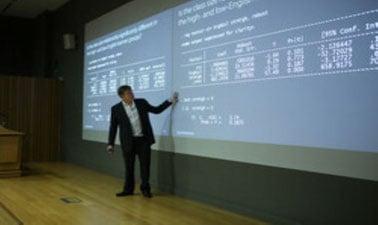
A focus on the techniques commonly used to perform statistical inference on high throughput data. In this course you’ll learn various statistics topics including multiple testing problem, error rates, error rate controlling procedures, false discovery rates, q-values and exploratory data analysis. We then introduce statistical modeling and how it is applied to high-throughput data. In particular, we will discuss parametric distributions, including binomial, exponential, and gamma, and describe maximum likelihood estimation.

Class Deals by MOOC List - Click here and see EdX's Active Discounts, Deals, and Promo Codes.

We provide several examples of how these concepts are applied in next generation sequencing and microarray data. Finally, we will discuss hierarchical models and empirical bayes along with some examples of how these are used in practice. We provide R programming examples in a way that will help make the connection between concepts and implementation.

Given the diversity in educational background of our students we have divided the series into seven parts. You can take the entire series or individual courses that interest you. If you are a statistician you should consider skipping the first two or three courses, similarly, if you are biologists you should consider skipping some of the introductory biology lectures. Note that the statistics and programming aspects of the class ramp up in difficulty relatively quickly across the first three courses. By the third course will be teaching advanced statistical concepts such as hierarchical models and by the fourth advanced software engineering skills, such as parallel computing and reproducible research concepts.
This course is part of the Data Analysis for Life Sciences XSeries.
These courses make up two Professional Certificates and are self-paced:

Data Analysis for Life Sciences:

Genomics Data Analysis:

What you'll learn

  • Organizing high throughput data
  • Multiple comparison problem
  • Family Wide Error Rates
  • False Discovery Rate
  • Error Rate Control procedures
  • Bonferroni Correction
  • q-values
  • Statistical Modeling
  • Hierarchical Models and the basics of Bayesian Statistics
  • Exploratory Data Analysis for High throughput data

Go to Class
MOOC List is learner-supported. When you buy through links on our site, we may earn an affiliate commission.

Related Courses

Modeling and Simulation of Multibody Systems - Part II (edX) EdX
LouvainX,Université Catholique de Louvain - UCL

Modeling and Simulation of Multibody Systems - Part II (edX)

90% of daily life multibody systems contain loops of bodies, e.g. vehicle or bike suspensions, parallel manipulators or robots, and musculoskeletal systems. They can also include joint constraints. In this second course about multibody systems, learn how to model them and how to deal with more advanced numerical analyses.

Self Paced
Self-Paced
Introducción a Ciencias de Datos y Estadística Básica para Negocios (edX) EdX
Tecnológico de Monterrey,TecdeMonterreyX

Introducción a Ciencias de Datos y Estadística Básica para Negocios (edX)

En este curso adquirirás los métodos estadísticos para la toma de decisiones en los negocios, así como herramientas tecnológicas para desarrollar habilidades cuantitativas. Áreas como el “big data” requieren un conocimiento muy claro de la estadística; en las áreas de negocios, la tecnología pone a nuestro alcance diversas aplicaciones que requieren una sólida formación en estadística para su correcto uso e interpretación.

Self Paced
Self-Paced
High-Dimensional Data Analysis (edX) EdX
HarvardX,Harvard University

High-Dimensional Data Analysis (edX)

A focus on several techniques that are widely used in the analysis of high-dimensional data. If you’re interested in data analysis and interpretation, then this is the data science course for you. We start by learning the mathematical definition of distance and use this to motivate the use of the singular value decomposition (SVD) for dimension reduction and multi-dimensional scaling and its connection to principle component analysis.

Self Paced
Self-Paced
Probability and Statistics I: A Gentle Introduction to Probability (edX) EdX
Georgia Institute of Technology,GTx

Probability and Statistics I: A Gentle Introduction to Probability (edX)

This course provides an introduction to basic probability concepts. Our emphasis is on applications in science and engineering, with the goal of enhancing modeling and analysis skills for a variety of real-world problems. In order to make the course completely self-contained (and to bring back long-lost memories), we’ll start off with Bootcamp lessons to review concepts from set theory and calculus.

Self Paced
Self-Paced
MathTrackX: Statistics (edX) EdX
University of Adelaide,AdelaideX

MathTrackX: Statistics (edX)

Understand fundamental concepts relating to statistical inference and how they can be applied to solve real world problems. This course will build on probability and random variable knowledge gained from previous courses in the MathTrackX XSeries with the study of statistical inference, one of the most important parts of statistics.

Self Paced
Self-Paced
Probability and Statistics II: Random Variables – Great Expectations to Bell Curves (edX) EdX
Georgia Institute of Technology,GTx

Probability and Statistics II: Random Variables – Great Expectations to Bell Curves (edX)

This course discusses properties and applications of random variables. For instance, how many customers are likely to arrive in the next hour? What’s the probability that a lightbulb will last more than a year? When you’re done with this course, you’ll have enough firepower to undertake a wide variety of modeling and analysis problems; and you’ll be well-prepared for the upcoming Statistics courses.

Self Paced
Self-Paced
Introductory Statistics : Sample Survey and Instruments for Statistical Inference (edX) EdX
Seoul National University,SNUx

Introductory Statistics : Sample Survey and Instruments for Statistical Inference (edX)

The purpose of this course is to introduce basic concepts of sample surveys and to teach statistical inference process using real-life examples. In this course, you will learn about sample surveys with the concepts of samples and populations. In addition, we will discuss possible problems(bias) of the surveys based on practical examples and concept of probability errors in sampling.

Self Paced
Self-Paced
Public Sector Debt Statistics (edX) EdX
International Monetary Fund - IMF,IMFx

Public Sector Debt Statistics (edX)

The course examines coverage and accounting rules for public sector debt, valuation, classification, important methodological issues, and the sources and methods used for compiling the statistics. This course, presented by IMF Statistics Department, covers the fundamentals needed to compile and disseminate comprehensive public sector debt statistics (PSDS) that are useful for policy- and decision-makers, as well as other users.

Self Paced
Self-Paced
R Data Science Capstone Project (edX) EdX
IBM

R Data Science Capstone Project (edX)

Apply various data analysis and visualization skills and techniques you have learned by taking on the role of a data scientist working with real-world data sets. In this capstone course, you will apply various data science skills and techniques that you have learned as part of the previous courses in the IBM Data Science with R or IBM Data Analytics with Excel and R Professional Certificate Programs.

Self Paced
Self-Paced
Probability and Statistics in Data Science using Python (edX) EdX
University of California, San Diego,UC San DiegoX

Probability and Statistics in Data Science using Python (edX)

Using Python, learn statistical and probabilistic approaches to understand and gain insights from data. The job of a data scientist is to glean knowledge from complex and noisy datasets. Reasoning about uncertainty is inherent in the analysis of noisy data. Probability and Statistics provide the mathematical foundation for such reasoning.

Self Paced
Self-Paced
Advanced Bayesian Statistics Using R (edX) EdX
University of Canterbury,UCx

Advanced Bayesian Statistics Using R (edX)

Now that you know the basics of Bayesian inference, dive deeper to explore its richness and flexibility more fully. Let’s take a closer look at modeling latent variables, Bayesian model averaging, generalised linear models, and MCMC methods. Advanced Bayesian Data Analysis Using R is part two of the Bayesian Data Analysis in R professional certificate.

Self Paced
Self-Paced