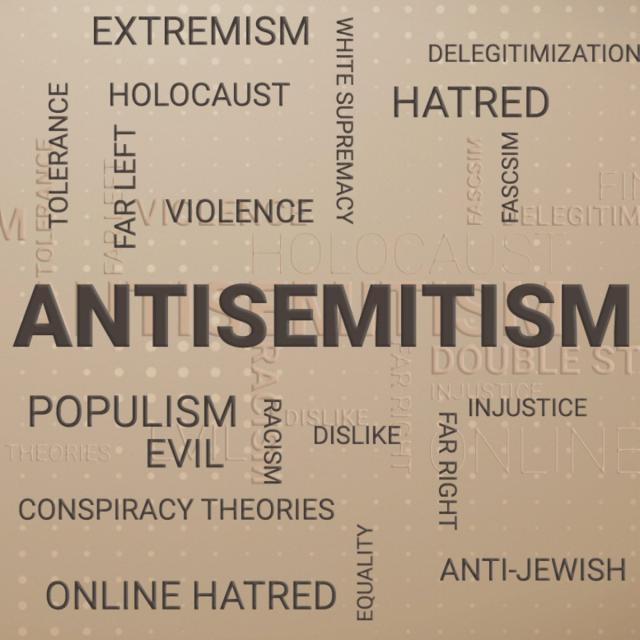
Antisemitism: From Its Origins to the Present (Coursera)

Offered by Yad Vashem,
Antisemitism: From Its Origins to the Present (Coursera)

In this course, 50 leading scholars from all over the world will explore questions and issues relating to antisemitism including: what is antisemitism? How has it changed throughout history? Why can it be found among so many diverse cultures, and even among opposing ideologies? What happened to antisemitism after the Holocaust? How is antisemitism expressed today, and what are the main spheres in which it can be found?

Class Deals by MOOC List - Click here and see Coursera's Active Discounts, Deals, and Promo Codes.

What You Will Learn

  • To discuss what antisemitism is and what is unique about it
  • To explain the historical and ideological roots of antisemitism and how it has developed
  • To discuss the characteristics of antisemitism today
  • To identify antisemitic language and actions in the past and in the present

Syllabus

WEEK 1
What is antisemitism? Definitions and origins
This week we will begin our exploration of the phenomenon of antisemitism. We will discuss the nature of hate, the unique characteristics of antisemitism as well as the etymology of the term. We will then turn to the historical roots and early development of the phenomenon - from the Greco-Roman period up until the Middle Ages.

WEEK 2
The changing face of antisemitism
We will move on to the Modern Era, examining how attitudes towards the Jews were affected by the major religious, social, and political movements that were shaping Europe and the world during this time.

WEEK 3
Genocidal antisemitism: from World War I to the holocaust
This week we will delve into the 20th century and see how modern antisemitic notions and perceptions continued to develop and to be expressed, reaching a murderous peak with the catastrophic event of the Holocaust

WEEK 4
Contemporary antisemitism
This week we will turn to the contemporary world by first examining how antisemitism is expressed by two of the main realms in which it can be found today - the Far-right and the Far-left

WEEK 5
The islamic and Arab World
This week we will continue with our exploration of antisemitism in the contemporary world, by focusing on the past and present of a realm which has not been discussed in the course so far - the Arab and Islamic world.

WEEK 6
Addressing antisemitism
During this last week of the course, we will try to better our understanding of contemporary antisemitism. We will also explore online hate, and examine the ways antisemitism is confronted and dealt with in various arenas today.
Go to Class
MOOC List is learner-supported. When you buy through links on our site, we may earn an affiliate commission.

Related Courses

Intellectual Change in Early China: Warring States and Han (Coursera) Coursera
The Chinese University of Hong Kong

Intellectual Change in Early China: Warring States and Han (Coursera)

This sequence of four courses will propose a multi-disciplinary approach to the study of Chinese cultural history conceived of as a succession of modes of rationality (philosophical, bureaucratic, and economic). The focus will be on the moments of paradigm shift from one mode of rationality to another. For each of these moments, cultural facts and artifacts—thought, literature, ritual—will be examined in relationship to changing social, political, and economic systems.

Sep 7th 2026
5-12 Weeks
The Mediterranean, a Space of Exchange (from the Renaissance to Enlightenment) (Coursera) Coursera
University of Barcelona

The Mediterranean, a Space of Exchange (from the Renaissance to Enlightenment) (Coursera)

The course The Mediterranean, a Space of Exchange (from Renaissance to Enlightenment) aims to explain the Mediterranean, using history and the analysis of the past, as a space generated by routes and circulation. We consider it crucial to disclose mobility as a historical factor: a mobility comprised of four major elements, namely people, objects, ideas and practices.

Sep 11th 2026
5-12 Weeks
The History of Modern Israel - Part II: Challenges of Israel as a sovereign state (Coursera) Coursera
Tel Aviv University

The History of Modern Israel - Part II: Challenges of Israel as a sovereign state (Coursera)

This course deals with the Israeli politics, economy, society and culture, since its creation in 1948 till today. It analyzes the construction of the Israeli historical narrative as an identity-building narrative, intending to inculcate a collective memory to a diverse society. We will focus on key events and essential components that shaped the Israeli society from the fifties till the present. We will also discuss the changes that the Israeli society experiences in its almost seventy years of existence and how it affects its politics and culture.

Sep 14th 2026
5-12 Weeks
Exploring Beethoven’s Piano Sonatas Part 2 (Coursera) Coursera
Curtis Institute of Music

Exploring Beethoven’s Piano Sonatas Part 2 (Coursera)

Welcome to Part 2 of Exploring Beethoven's Piano Sonatas! I'm delighted to launch another set of new lectures of this course as Part 2. As before, this class is meant for people of all levels of experience with Beethoven's music (including no experience at all!). Remember that you are able to watch the lectures as many times as you like, at whatever pace is comfortable for you.

Sep 7th 2026
5-12 Weeks
William Shakespeare's Twelfth Night: Comedy, Conflict, and Community (Coursera) Coursera
University of Colorado Boulder

William Shakespeare's Twelfth Night: Comedy, Conflict, and Community (Coursera)

This course introduces and explores William Shakespeare’s classic comedy, Twelfth Night. Interviews with actors who appeared in the Colorado Shakespeare Festival’s 2019 production of Twelfth Night, as well as lectures by scholars and theater professionals who work and teach at the University of Colorado Boulder, offer students insight into Shakespeare’s artistic vision and its applications.

Sep 14th 2026
5-12 Weeks
Understanding China, 1700-2000: A Data Analytic Approach, Part 1 (Coursera) Coursera
The Hong Kong University of Science and Technology - HKUST

Understanding China, 1700-2000: A Data Analytic Approach, Part 1 (Coursera)

The purpose of this course is to summarize new directions in Chinese history and social science produced by the creation and analysis of big historical datasets based on newly opened Chinese archival holdings, and to organize this knowledge in a framework that encourages learning about China in comparative perspective. Our course demonstrates how a new scholarship of discovery is redefining what is singular about modern China and modern Chinese history.

Aug 31st 2026
5-12 Weeks
Terrorism and Counterterrorism: Comparing Theory and Practice (Coursera) Coursera
Leiden University

Terrorism and Counterterrorism: Comparing Theory and Practice (Coursera)

Terrorism has arguably been one of the defining factors of our age. It frequently makes headlines, threatening or attacking governments, private business and ordinary citizens. And in many parts of the world, it has been one of the most important threats to peace, security and stability. But what does this exactly mean? What is the nature of this threat? Who or what is threatened, how, by whom and why? What can be done about it or how can we at least limit the impact of terrorism and make sure that terrorists do not make headlines and manage to scare us? These are just a handful of questions that will be addressed in this course that consists of three parts.

Sep 7th 2026
5-12 Weeks
Soul Beliefs: Causes and Consequences - Unit 2: Belief Systems (Coursera) Coursera
Rutgers University

Soul Beliefs: Causes and Consequences - Unit 2: Belief Systems (Coursera)

Throughout history, the vast majority of people around the globe have believed they have, however defined, a “soul.” While the question of whether the soul exists cannot be answered by science, what we can study are the causes and consequences of various beliefs about the soul and its prospects of surviving the death of the body. Why are soul and afterlife beliefs so common in human history? Are there adaptive advantages to assuming souls exist?

Aug 31st 2026
5-12 Weeks
History of Rock, Part Two (Coursera) Coursera
University of Rochester

History of Rock, Part Two (Coursera)

This course, part 2 of a 2-course sequence, examines the history of rock, primarily as it unfolded in the United States, from the early 1970s to the early 1990s. This course covers the music of Led Zeppelin, the Allman Brothers, Carole King, Bob Marley, the Sex Pistols, Donna Summer, Michael Jackson, Madonna, Prince, Metallica, Run-DMC, and Nirvana, and many more artists, with an emphasis both on cultural context and on the music itself. We will also explore how developments in the music business and in technology helped shape the ways in which styles developed.

Aug 31st 2026
5-12 Weeks
Egiptología (Egyptology) (Coursera) Coursera
Universitat Autònoma de Barcelona

Egiptología (Egyptology) (Coursera)

¿Sientes curiosidad por la civilización del antiguo Egipto? ¿Eres un apasionado de su cultura e historia? En este curso nos acercaremos a los templos de los antiguos faraones, a sus complejos funerarios, a sus ciudades, a su escritura jeroglífica, a su religión y a muchos otros aspectos de esta gran civilización.

Aug 31st 2026
5-12 Weeks
What Is Contemporary Art? (Coursera) Coursera
The Museum of Modern Art

What Is Contemporary Art? (Coursera)

What is contemporary art? In this course, you’ll consider this question through more than 70 works of art made between 1980 and the present, with a focus on art from the past decade. You’ll hear directly from artists, architects, and designers from around the globe about their creative processes, materials, and inspiration.

Sep 14th 2026
5-12 Weeks