System Validation (2): Model process behaviour (Coursera)

Offered by EIT Digital,
System Validation (2): Model process behaviour (Coursera)

System Validation is the field that studies the fundamentals of system communication and information processing. It is the next logical step in computer science and improving software development in general. It allows automated analysis based on behavioural models of a system to see if a system works correctly. We want to guarantee that the systems does exactly what it is supposed to do.

Class Deals by MOOC List - Click here and see Coursera's Active Discounts, Deals, and Promo Codes.

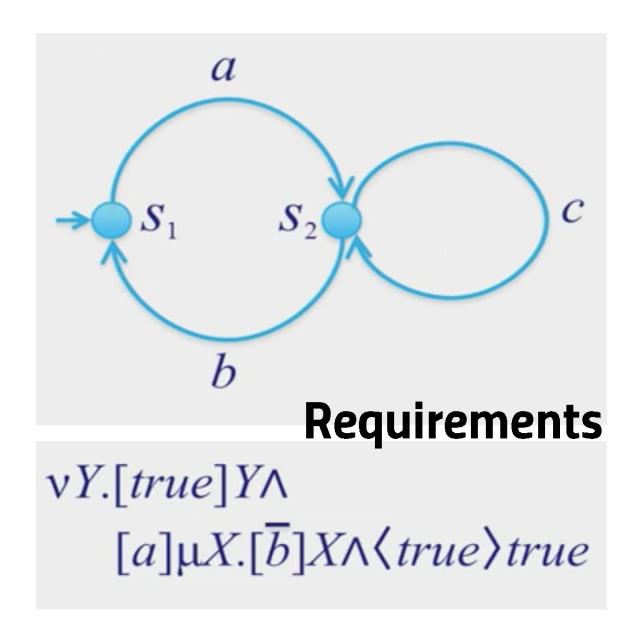
The techniques put forward in system validaton allow to prove the absence of errors. It allows to design embedded system behaviour that is structurally sound and as a side effect enforces you to make the behaviour simple and insightful. This means that the systems are not only behaving correctly, but are also much easier to maintain and adapt. ’Model process behaviour' is the follow up MOOC to 'Automata and behavioural equivalences'. This MOOC shows you how to model process behaviour, in particular protocols and distributed algorithms, dive deeper in the properties of system behaviour, and keep things simple to avoid a state space explosion.
Suggested Readings: J.F. Groote and M.R. Mousavi. Modeling and analysis of communicating systems. The MIT Press, 2014.
This course is part 2 of the set of courses for System Validation. System Validation, as a set of courses, is part of a larger EIT Digital online programme called 'Internet of Things through Embedded Systems'.

Syllabus

WEEK 1: Sequential behaviour
WEEK 2: Data types
WEEK 3: Parallel behaviour

Go to Class
MOOC List is learner-supported. When you buy through links on our site, we may earn an affiliate commission.

Related Courses

Software Design Threats and Mitigations (Coursera) Coursera
University of Colorado System

Software Design Threats and Mitigations (Coursera)

The design step in developing software has some unique characteristics. First of all, it’s the only step where drawing pictures of things is the norm. Why is that? What do pictures do that other representations cannot do? Pictures have varying levels of detail; pictures have context. Pictures…paint a picture. Why are these things important? In this course, too, we begin looking at other disciplines (building architecture is a favorite one) for lessons on design.

Jun 22nd 2026
5-12 Weeks
操作系统原理 (Operating Systems) (Coursera) Coursera
Peking University

操作系统原理 (Operating Systems) (Coursera)

操作系统原理》是针对计算机科学技术专业三年级本科生开设的一门专业基础课程。本课程着重学生系统观的培养,通过重点讲述操作系统的内部结构、工作原理及典型技术的实现,使学生建立起对操作系统的整体及各个功能模块的认识,从而系统掌握计算机的专业知识,进一步提升学生的软件开发能力乃至系统软件开发能力。

Jun 22nd 2026
13-24 Weeks
Software Development Processes and Methodologies (Coursera) Coursera
University of Minnesota

Software Development Processes and Methodologies (Coursera)

Software is quickly becoming integral part of human life as we see more and more automation and technical advancements. Just like we expect car to work all the time and can't afford to break or reboot unexpectedly, software industry needs to continue to learn better way to build software if it were to become integral part of human life.

Jun 22nd 2026
4 Weeks
Software Design Methods and Tools (Coursera) Coursera
University of Colorado System

Software Design Methods and Tools (Coursera)

Since many software developers are compulsive coders, they have created software over the years to help them do their job. There are tools which make design and its associated tasks easier. The course introduces some basic tools and techniques to help you with design. Tools aren’t always tangible, however. The last two lessons of this course discuss questions of Ethics in software development. The purpose here is, as with tools, to equip you to better carry our your responsibilities as a designer. Students will be required to have a prior knowledge of writing and delivering software and some programming knowledge in java.

Jun 22nd 2026
5-12 Weeks
Algorithms, Part II (Coursera) Coursera
Princeton University

Algorithms, Part II (Coursera)

This course covers the essential information that every serious programmer needs to know about algorithms and data structures, with emphasis on applications and scientific performance analysis of Java implementations. Part I covers elementary data structures, sorting, and searching algorithms. Part II focuses on graph- and string-processing algorithms.

Jun 22nd 2026
5-12 Weeks
Packet Switching Networks and Algorithms (Coursera) Coursera
University of Colorado System

Packet Switching Networks and Algorithms (Coursera)

In this course, we deal with the general issues regarding packet switching networks. We discuss packet networks from two perspectives. One perspective involves external view of the network, and is concerned with services that the network provides to the transport layer that operates above it at the end systems. The second perspective is concerned with the internal operation of a network, including approaches directing information across the network, addressing and routing procedures, as well as congestion control inside the network.

Jun 22nd 2026
5-12 Weeks
Networking and Security in iOS Applications (Coursera) Coursera
University of California, Irvine

Networking and Security in iOS Applications (Coursera)

You will learn to extend your knowledge of making iOS apps so that they can securely interact with web services and receive push notifications. You'll learn how to store data securely on a device using Core Data. You’ll also learn to securely deploy apps to the App Store and beta users over-the-air. The format of the course is through a series of code tutorials. We will walk you through the creation of several apps that you can keep as a personal app toolbox. When you make your own apps after this course, you can bring in these capabilities as needed. When necessary we pop out of the code tutorials to talk about concepts at a higher level so that what you are programming makes sense.

Jun 22nd 2026
4 Weeks
Foundations of Objective-C App Development (Coursera) Coursera
University of California, Irvine

Foundations of Objective-C App Development (Coursera)

An introduction to the Objective-C programming language. This will prepare you for more extensive iOS app development and build a foundation for advanced iOS development topics. Objective-C programming requires a Mac laptop or desktop computer. An iOS device is optional if the learner is willing to working exclusively with the simulator. Some learners have been able to work with an OS X virtual machine on Windows, but explaining how to do that is beyond the scope of this course.

Jun 22nd 2026
4 Weeks